Love Coming Home

Was it Dorothy from Baum’s The Wonderful Wizard of Oz who said, “There’s no place like home”?

I think so, but it has been a bit since I read it or watched the film.

But the statement is true for me.

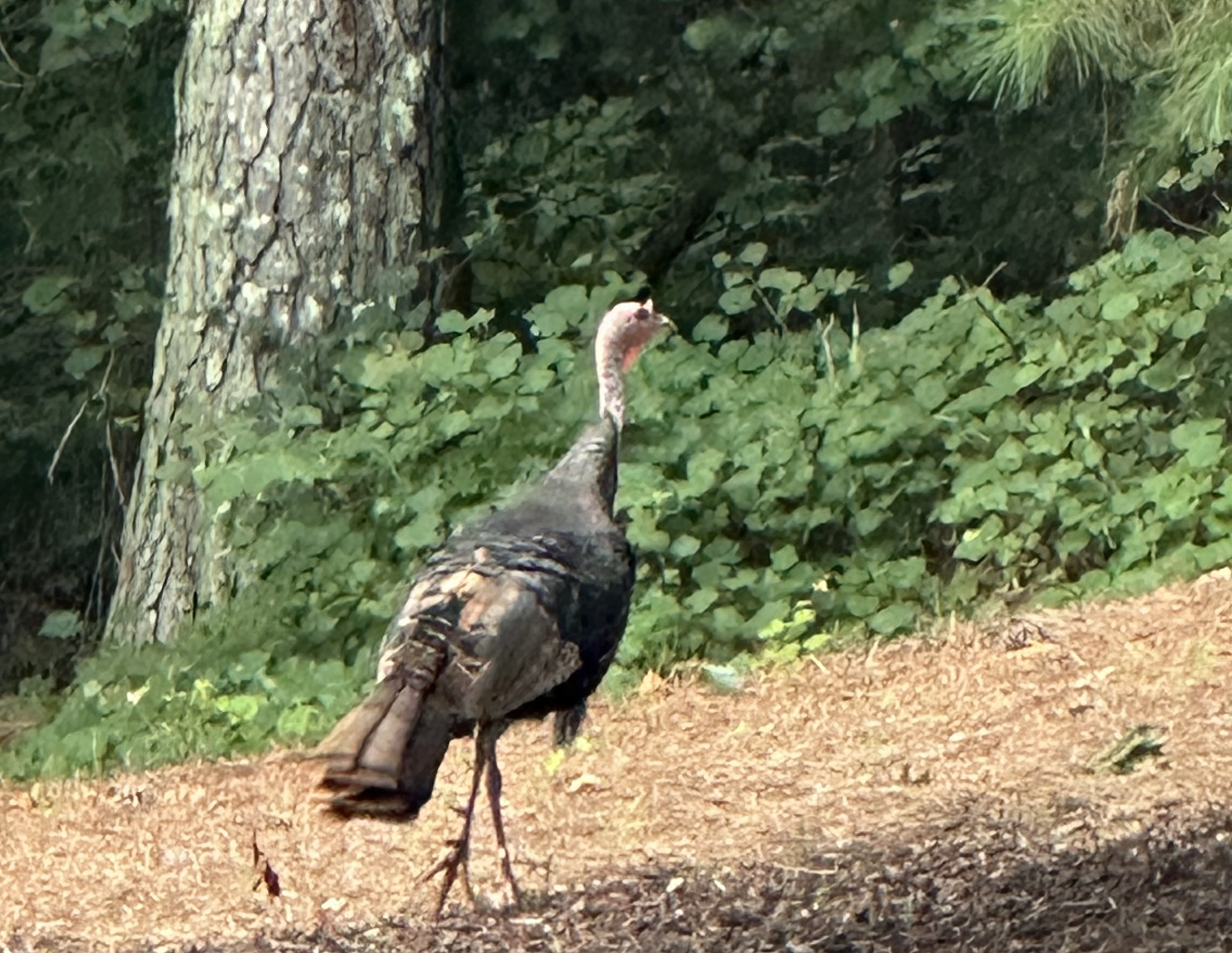
My wife was busy fattening the girl deer up on bread from her hands.

And I fed and watched the birds come and feed on sunflower and other seeds from a feeder.

And I think of such times when I’m flying from place to place and look down upon cities electrified at night.

And tomorrow I will be able to gather with the saints at Sunday school and church as we open the Scriptures to the wonder-filled book of Esther wherein we will learn of heroism (Mordecai and Esther), read of romance/love, dangers and threats to the good in a world of pervasive evil, read of one of history’s true villains (Haman), and see how obedience to the Lord was repaid in a temporal sense via Purim but also eternally for the redeemed by the Lord’s presence.

Did I mention that I concur with Dorothy? There’s no place like home.

Cold Temperatures but Warm Personalities: Snowy Days with Soldiers in Iowa

Was able to be with fellow soldiers in Iowa recently.

Some of the friendliest people I have ever encountered are in Iowa.

Grateful to spend time with them and plan future events together.

As I read last night before going to bed, the snow had begun falling.

When I woke this morning, it was still falling.

Pretty part of the country, here.

Thankful for the opportunities to minister to our troops.

Thoughts Upon Rereading Melville’s Masterpiece Moby-Dick

Earlier I laid out a 2023 reading regimen for myself. You can find that link here:

Reading Well: More than a Resolution

Several of the books/series I am going through are leviathans. In the current edition of Moby-Dick I am reading, there are over 600 pages. I am quite familiar with Moby-Dick as the literary masterpiece it is, and so the length of the novel does not intimidate me or hopefully anyone else who dives into its sea of profundities. But even if it does intimidate you, please see it through. Press on. Stick with it. Melville’s encyclopedic wisdom is in these pages. Plus, it’s just a masterful story of will, of good and evil, of humanity and inhumanity, of the great enduring truths of the human condition.

In the copy I’m using, it is marked up from my previous readings. Below are just a few of the places where characters from the novel, or the narrative voice, or perhaps Melvillean avatars utter thought-provoking gems:

What could be more full of meaning?–for the pulpit is ever this earth’s foremost part; all the rest comes in its rear; the pulpit leads the world. From thence it is the storm of God’s quick wrath is first descried, and the bow must bear the earliest brunt. From thence it is the God of breezes fair or foul is first invoked for favourable winds. Yes, the world’s a ship on its passage out, and not a voyage complete; and the pulpit is its prow” (55).

And one of the funniest scenes is when Ishmael meets Queequeg. Thinking Queequeg is some degenerate cannibal and that he (Ishmael) is the refined and sophisticated person, Ishmael begins to learn that things are often not what they appear. When Ishmael discovers he has to share a bunk with a tatooed cannibal, he (Ishmael) at first is prideful and resentful. But as he gets to know Queequeg, Ishmael learns that virtue abides in action rather than in appearance:

What’s all this I have been making about, thought I to myself–the man’s a human being just as I am: he has just as much reason to fear me as I have to be afraid of him. Better sleep with a sober cannibal than a drunken Christian” (38).

And of course one of the most familiar passages comes near the beginning of the adventure when Ishmael, trying to understand his reasons for wanting to take to the sea, has this interior monologue:

Why is almost every robust healthy boy with a robust healthy soul in him, at some time or other crazy to go to sea? Why upon your first voyage as a passenger, did you yourself feel such a mystical vibration, when first told that you and your ship were now out of sight of land. Why did the old Persians hold the sea holy? Why did the Greeks give it a separate deity, and own brother of Jove? Surely all this is not without meaning. And still deeper the meaning of that story of Narcissus, who because he could not grasp the tormenting, mild image he saw in the fountain, plunged into it and was drowned. But that same image, we ourselves see in all rivers and oceans. It is the image of the ungraspable phantom of life; and this is the key to it all” (19).

The characters loom large in this masterpiece, too: Ishmael, Queequeq, Starbuck, Ahab, the sea, and, of course, the whale.

And the meanings are nearly inexhaustible in the book: What does the whale represent? Why Ahab’s animus? Why the motif of sailors and sea? Why all references to Jonah from Scripture? Why the anger against the way things are? Why wrath rather than worship? The questions are nearly inexhaustible, too. If one could read only ten of the greatest novels ever penned, Moby-Dick would have to be on that list. And it will repay you in riches each time.

Upon Rereading Hemingway

Recently I completed another reading of Hemingway’s For Whom the Bell Tolls.

What follows below are several items: 1) quotes from the book; 2) some ideas about Hemingway’s atheism; 3) some questions to ponder; 4) why my views of the novel changed.

As a brief prolegomenon and as a matter of disclosure, I value Hemingway’s writing–especially his short stories–immensely. His place in the canon of classics of American and world literature is not in doubt. The fact that thousands of us still read his works is proof. So what follows is not a Hemingway-bashing screed.

I hope that it is rather a thoughtful response and series of questions for careful readers to ponder as we continue to read and study Hemingway’s works and his worldview.

Here are a few quotes from the book that moved me, told from a soldier’s perspective, amidst war:

Two Quotes from the Novel:

If this was how it was then this was how it was. But there was no law that made him say he liked it. I did not know that I could ever feel what I have felt, he thought. Nor that this could happen to me. I would like to have it for my whole life. You will, the other part of him said. You will. You have it now and that is all your whole life is; now. There is nothing else than now. There is neither yesterday, certainly, nor is there any tomorrow. How old must you be before you know that? There is only now, and if now is only two days, then two days is your life and everything in it will be in proportion. This is how you live a life in two days. And if you stop complaining and asking for what you never will get, you will have a good life. A good life is not measured by any biblical span” (169).

And then this quote. It is, like the one above, from a soldier’s perspective, an internal stream-of-consciousness interior monologue, and it reflects a worldview:

I think that we are born into a time of great difficulty, he thought. I think any other time was probably easier. One suffers little because all of us have been formed to resist suffering. They who suffer are unsuited to this climate. But it is a time of difficult decisions. The fascists attacked and made our decision for us. We fight to live. But I would like to have it so that I could tie a handkerchief to that bush back there and come in the daylight and take the eggs and put them under a hen and be able to see the chicks of the partridge in my own courtyard. I would like such small and regular things.

But you have no house and no courtyard in your no-house, he thought. You have no family but a brother who goes to battle tomorrow and you own nothing but the wind and the sun and an empty belly. The wind is small, he thought, and there is no sun. You have four grenades in your pocket but they are only good to throw away. You have a carbine on your back but it is only good to give away bullets. You have a message to give away. And you’re full of crap that you can give to the earth, he grinned in the dark. You can anoint it also with urine. Everything you have is to give. Thou art a phenomenon of philosophy and an unfortunate man, he told himself and grinned again” (368).

Thoughts on Hemingway’s Atheism:

It should be evident from both quotes that Hemingway’s characters in the novel embody a naturalistic worldview. There is no God; there is only material and chance. Man came from nowhere; there is no divine overarching purpose to the cosmos, much less to individual lives, except what one arbitrarily manufactures. No heaven, no hell. Just blood and soil, as it were. Lots and lots of blood, blood-soaked soil, and war.

But what strikes me each time I read this novel is that Robert Jordan, the protagonist, loves. He loves his fellow soldiers (like Anselmo, for example) and he loves Maria, the Spanish girl. He also loves concepts like honor and sacrifice.

Some Questions to Ponder:

Is that not interesting? Why would a person with an atheistic/naturalistic worldview love people, love his fellow soldiers, love a woman, or love ideas like honor and sacrifice? How can one logically account for these things in an atheistic/naturalistic worldview?

But what we find in this novel, and in all of Hemingway’s other masterful works, is that his characters do love. They do value sacrifice. They do value honor. They do believe in right and wrong, good and evil.

Why My Views Have Changed:

When I read this novel now, I see its contradictions, and those contradictions lessen my appreciation for the atheistic position.

The writing (please hear me) is wonderful. But the logical inconsistencies are replete.

Robert Jordan is in many ways, one might reasonably say, a “good” man. (“Why do you call me good?” should be ringing in your bibical ears, if you know the Scriptures.) He is at war voluntarily to combat what he views as evil.

He loves his battle buddies.

He loves a woman.

He loves life and hates meaningless violence while also recognizing that violence is necessary at times to destroy evil’s advances.

But all of these concepts about good and evil, love and hate, right and wrong, purpose versus accident, chance versus providence–they all only make sense if there’s a personal, transcendent, objective reference point, i.e., God.

Generosity

I was flying in uniform today. When I went through pre-check and walked out to my gate, a man spoke to me kindly.

“Thank you for your service,” he said.

“Thank you, sir.”

Moments later we were all boarded. The plane was full. Packed. The man at the Delta kiosk offered checked-in passengers $1,200 to take a flight twelve hours later.

When I boarded, I strained to fit my backpack into the overhead bin. This plane appeared smaller than the ones I normally fly. And the bins seemed smaller, too.

Finally I squeezed my black backpack into the overhead bin, grabbed my bottle of water and the novel I was completing, and took my seat.

I was seated near the rear in a window seat. I was speaking with a kind woman next to me who was flying with her two young daughters. The girls were clearly excited to fly but their mom was less spirited. I tried to cheer her up and make small talk while her girls took their seats across the narrow aisle.

Then the man who had earlier thanked me for my service stood up from his seat in first class. He pointed at me. He waved me forward, mouthing, “This seat’s for you,” and told me to come to his seat.

He came and took my little window seat in the back and insisted I take his large seat in first class. He would not accept my refusal. And I did not wish to cause a scene.

Because of him, I flew first class across the country.

When we arrived several hours later, I stayed on the plane until he exited. “Thank you, sir. I really appreciate it,” I said. I asked him if he was prior service.

“I’m not,” he said, “but my dad is a Marine. He died last year. But there are no former Marines,” he said.

“Yes, sir, I know,” I said and laughed. “Thank you, again.”

Despite the self-absorption and selfishness that tend to characterize most current things, kindness (often in quiet ways) abides.

I salute you, sir, and your dad, the Marine, for raising a generous and kind man.

She Was Dancing When I Saw Her

S6. That was the designated area where my shuttle driver would pick us up to drive us back to our vehicles parked in a distant parking lot. As I exited the baggage claim area and crossed the street to the pickup area for shuttles, I could see a woman dancing and snapping her fingers and mouthing some words. She was smiling, too, as I approached. It would have been difficult to be in a bad mood around this woman, her spirit was just that way.

“I want some of the coffee you drink, “I said, as I approached the pickup area, close enough to her I thought she’d be able to hear, even with all the noise from airplanes and vehicles in the pickup/dropoff area.

“The joy of the LORD is my strength,” she said.

“Well, amen,” I said, not knowing how exactly to respond.

“How you doin’ this mornin’, hon?” she said, still smiling, and swaying as if from music only she could hear.

“Doing well. Have I found the right place–the shuttle pickup to go to my vehicle back out at B21?” I responded.

“You got it, hon. I’ll take care of you. Just put your bag inside and lay it on its side so it doesn’t roll, okay, sugar?”

“Yes, ma’am. Will do.”

I was the only patron on the shuttle, when I did as she said and took a seat. I took my rolling bag and placed it as directed and then took my backpack off and put it on the seat beside me.

“Looks like you’re it, honey. But don’t you worry. I’ll take care of you.”

“Sounds great,” I said. “This is very convenient. I’m glad to have met you today,” I said.

“Honey, I’m beyond sixty years old, been driving big rigs for a career, am now retired, and I just do this here job because I love driving and I love meeting folks, and I can take care of my grandbaby,” she said.

“Well, that sounds nice. You live in the city?”

“Decatur. Just sixteen miles from here. I started driving part-time, but now I get all the hours I want. I treat folks right. I’m a recovering addict, but the Holy Spirit got a’hold of me and convicted me of my ways a long time ago, honey. Now I’m filled with the Spirit. No more drugs for me, baby, but the joy of the LORD is my strength!”

She spoke so quickly that I could not even tell when she inhaled and exhaled. She flowed with words and energy.

I let the conversation hang for a minute or two, unsure whether I could match her energy level. I’d been up since three a.m. and flown across the country. Were it not for the caffeine in my system, I could have easily dozed off, at least on the plane. But not now. She was different.

Very soon we were in the parking lot where I had parked serveral days prior.

“Honey, what type’s a car you got?”

I told her and she spotted it right away in the lane.

I took some cash from my wallet and placed it in the cup she had on her dashboard, where it bulged with singles, fives, and ten-dollar bills.

“May I share something with you?” I asked, as I put on my backpack and retrieved my rolling bag.

“Of course, hon. What you got?”

“I’m a military chaplain. And I just love hearing stories like yours. Thank you for telling me your story,” I said.

“We were supposed to meet today, hon. That’s the Lord at work, you see,” she said.

I put the cash in her white cup on the dashboard and waved to her.

“I’ll see you,” I said.

“You drive careful, hon,” she said, and honked the horn on the empty shuttle.

She was singing to herself again and smiling. And she pulled off to see who else the Lord would put in her path.