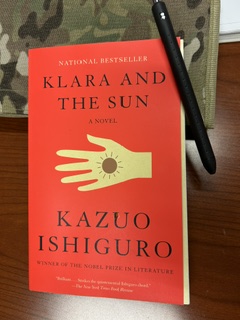
Today I presided as the chaplain for three–yes, three–military funerals. It is one of the duties and privileges I relish as a minister of the gospel and as a military chaplain. Between the first and second funeral, I had a two-hour break. As we waited for the next family of the deceased to arrive I completed my reading of Ishiguro’s Klara and the Sun. Typical of Ishiguro’s style it was sublime and understated. But his theme was commanding–the human need for and power of love.
What’s important to understand, however, is that the protagonist in the novel was an “AF,” (Artifical Friend). The main character was Klara, an AI android machine, that was so evolved and perceptive that she (yes, she’s portrayed with a female pronoun) had learned human emotions, human spirituality, and the capacity for self-sacrifice and love. When the vast majority of people abandoned the girl character of Josie, Klara was the noble and sacrificial one. Ishiguro masterfully explored the cruelty of mankind by portraying how androids are brought in to supplement and/or replace what other people should be, namely, a friend, who loves at all times.
What does this have to do with the apostle Peter? A great deal. This coming Sunday, I am slated to teach 2 Peter 1:1-15 to the saints of Christ Covenant Church (3cs-canton.org). What’s Peter’s topic in those verses? It’s what the Christian life is to look like. He lists several traits that evidence the reality of being a Christian:
- Faith
- Virtue
- Knowledge
- Self-control
- Steadfastness
- Godliness
- Brotherly affection
- Love
Ishiguro is a wise writer. Peter was an apostle of Christ. He was Jesus’ lead apostle. Peter, though a fallen man like the rest of us, triumphed in the end. He persevered in the faith. He penned two New Testament epistles that bear his name in church history. He equipped the saints. He taught. He shepherded. He labored in the truth for the sake of his people. He died a martry, being crucified under Nero in Rome, Italy in the mid-60s A.D.
And how did Peter end this section of his second letter? With these words:
Therefore I intend always to remind you of these qualities, though you know them and are established in the truth that you have. I think it right, as long as I am in this body, to stir you up by way of reminder, since I know that the putting off of my body will be soon, as our Lord Jesus Christ made clear to me. And I will make every effort so that after my departure you may be able at any time to recall these things (2 Pt 1:12-15, ESV).
Encouragement: Great literature is great because it deals truthfully, wisely, and beautifully with the enduring realities of human experience. Ishiguro’s novel was about the need for love, the beauty of self-sacrifice for a higher cause, and for connection. Peter labored and spent himself for the sake of Christ and those Christ ransomed from the talons of Satan and hell. In both cases, what was necessary was sacrifice, denial of self, and love. In short, the gospel.

