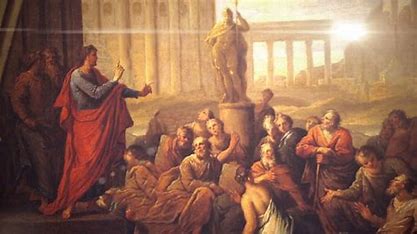
“I use the grotesque the way I do because people are deaf and dumb and need help to see and hear.”

Introduction: Ever found or experienced a place/group/kinship where you were more than just a member, but were part of a family?
Background and Context: I do a great amount of reading and research as part of my vocation in ministry. Why? In order to understand the times and know what to do. I have discovered a principle that grows more and more important daily. It centers on the principle of belonging to a spiritual family.
Much of my study reveals that, generally speaking, folks in our era are living a corrosive paradox. What is it? We are more electronically connected but spiritually-isolated than ever before. We can reach someone across the planet in seconds, but we don’t have anyone who cares. That is, to be plain, tragic.
Shelves of books are being written about the epidemic/pandemic of loneliness that confronts today’s world. Folks are on their gadgets but have no meaningful connections.
Perhaps you are like I am in that you sense the double-edged nature of technology. I relish the fact that I can have a Dostoyevsky novel or a C.S. Lewis book in hardback or paperback delivered to my residence in a day. That excites me to no end. But I also understand that receiving a text message from someone is not the same as hanging out with him/her. Technology is convenient but it is a poor substitute for a spiritual family.
Connection to Our Daily Lives: This past Sunday I was with my biological family and my spiritual family. My wife, son, and I were at our church (our daughter has moved out and supports herself now). We went to our Sunday school classes and to our corporate worship services. My wife, part of the music ministry at the church, played keyboards and sang. I taught a Sunday school class. We sang hymns and spiritual songs. Our son was part of youth ministry. We sat together as a family in corporate worship and listened to a solid, biblical homily from a wise teaching pastor at our church from Jeremiah 17 on the necessity of trusting the Lord.
And Sunday night I attended our men’s discipleship class where we studied particular passages from Psalms and 1 & 2 Samuel. And as I drove back to post today in order to prepare for another day of soldiering tomorrow, I have communicated via email and texting (a huge blessing of technology) with my spiritual family to pray for one of our own as she has undergone surgery. And we are praying for another who will undergo surgery tomorrow. And the list goes on.
What’s the point? That having a spiritual family you love and that loves you back is essential by divine design. We are crafted for fellowship, for pouring into one another, for coming alongside one another.
Takeaway & Encouragement: Foster, cultivate, and feed your spiritual family. The return on investment is invaluable. In the biblical worldview, it is essential: “a threefold cord is not quickly broken,” a wise man wrote (Eccl 4:12, ESV). And Christ himself told us, “A new commandment I give to you, that you love one another: just as I have loved you, you also are to love one another” (Jn 13:34). Having a spiritual family, a place where you show and receive love, is essential, and desperately needed, especially amidst all the idols and substitutes for our designed need of actual spiritual families rather than mere simulacra or avatars.

Introduction: Have you ever longed to see soul change wrought in yourself or another? That is, have you had the experience of an enduring longing–a deep plea–to see genuine and enduring heart change in yourself or another person? I would think most of us have. I certainly have.
Connection to a Very Familiar Passage in History: With a group of fellow pilgrims, I am going through the Gospel of Matthew line-by-line. And in some of my studies, I was camped out in Matthew 3. This is the time period when John the Baptist is the last of the Old Covenant prophets and is calling out: “Repent, for the kingdom of heaven is at hand” (Mt 3:2, ESV). Like many of you probably, I have read that line hundreds of times. But when you slow down and meditate on what unfolds in Matthew 3, you begin to see that yes, preachers of righteousness like John the Baptist often faithfully herald the truth, but only God is sufficient to change hearts.
What do I mean? In v. 5 of the same chapter, we see how “Jerusalem and all Judea and all the region about Jordan were going out to him” (Mt 3:5). Even the Pharisees and Sadducees were coming to John’s baptisms (Mt 3:7) but it is clear that those same Pharisees and Sadducees coming out were not genuinely changed; they were onlookers, spiritual spectators, unbelievers in the truth.
How do we know they were unbelievers? Because they played the spiritual resume card. They trusted in their ethnic and/or educational and religious pedigree and genealogy. Did John the Baptist baby them? Did he compromise the command of God for sinners to repent and believe the gospel?
Here was John the Baptist’s seeker-friendly sermon:
“You brood of vipers! Who warned you to flee from the wrath to come? Bear fruit in keeping with repentance. And do not presume to say to yourselves, ‘We have Abraham as our father,’ for I tell you, God is able from these stones to raise up children for Abraham. Even now the axe is laid to the root of the trees. Every tree therefore that does not bear good fruit is cut down and thrown into the fire” (Mt 3:7b-10).
Seeker-friendly? Hardly. It was Truth 101, with no attempt at soft selling Christianity’s non-negotiables: repentance of one’s sin and fleeing to Christ in the gospel.
Why did John the Baptist not hold back? Why didn’t he nuance his speech to soften the intellectual and visceral impact of his message? Because he knew that God was able from those stones to raise up children for Abraham (Mt 3:9). That’s a literary way of saying, “God has no need of anything–especially your pride in your lineage, ethnicity, education, religiosity, pomp, or social standing.”
The Principle: What God requires of all who will come to Him is something which God alone grants: genuine humility, repentance of sins, and saving faith. Humanistic efforts are too sin-soaked to ever redeem; they only serve to condemn us.
Connections to Us All: So many of us have been disappointed in ourselves and/or in those we care about because we thought that we or another person wrought genuine heart change. But we discovered that our flesh was too weak. Or we found that we were right back in a sin pattern. Or we saw those we love return to erring ways leading to destruction. To use a biblical metaphor, we saw ourselves or others as dogs who return to their vomit.
Encouragement: Recently at church, the discipleship pastor and brother in the Lord taught the congregation from Jeremiah 17. He focused perfectly on Jeremiah’s emphasis on man’s deeply sick human heart and of our constant need to trust in God alone who is sufficient to circumcise the human heart, to grant true repentance and faith, and that trusting in man or humanistic schemes will invariably disappoint. Jason was spot-on in his teaching from Jeremiah.
Jeremiah’s message is the same message as John the Baptist brought. Flee to the gospel. Come to the Redeemer, who is Christ. Trust not in anything or anyone else to change your nature. Only God is sufficient for this work, and He will do it.

Many Americans are amidst plans for a long Veterans Day weekend. I hope to get some time to relax. I aim to fish and hunt some. I hope to spend time with loved ones. I hope to rest some. But I am determined to remember. The older I grow, the more important the study of history becomes.
A nation’s memory is vital. If we do not know our past, we cannot learn from it. I think, for example, how my great-grandparents, now long deceased, would likely respond if I told them that Americans nowadays are crazed and mad because they are being forced to deny reality and list their ‘preferred pronouns’. I can just see my old great-grandfather, a hog farmer from south GA, look at me as if I had just landed from outside the Milky Way. He would have told me to look at the hogpen and point to the boars and the sows, and then he might have said, “And that’s how you get shoats. Any questions?” Country wisdom is helpful like that.
Memory is vital. A wise culture will understand why it is where it is. How is that possible? By knowing and understanding history. Not by tearing down history–statue by statue, building by building, street by street, installation by installation. If we have no shared memory and understanding of the past, the culture disintegrates. Visigoths are not limited to 5th century Rome, in other words. There is never a worry that clueless mobs will not be available. Useful idiots are in great and terrifying supply.
Historical memory is essential to a culture’s health. I do not say that just because I have been in the military for over 20 years. It is not because I am a sentimentalist when I look at my nation’s flag. No, there are many atrocities for which I think my nation is under divine judgment. A nation that demands a ‘right’ to murder its children is barbaric rather than redeemed.
But we are a mixed bag, like other nations, a nation in dire need of repentance and revival. We are in perilous times because it is clear that clear-headed leadership is lacking. We are witnessing a time that demands a denial of reality. And we are reaping the whirlwind.
I hope to continue to serve faithfully and to bear witness to the truth as best as I am able. I am grateful for my own family’s history, veterans who served well. I hope to see that history continue. But it will require courage, clear-headed courage, and spiritual wisdom in order to endure. No amount of secular existentialism will see us through. No, one requires a foundation–a fixed and holy standard–one upon which to build a life and a nation and a culture. That foundation has a name. There is a logos. There is a Word that has come and revealed that wisdom does not hide, but rather calls out:
8 Does not wisdom call?
Does not understanding raise her voice?
2 On the heights beside the way,
at the crossroads she takes her stand;
3 beside the gates in front of the town,
at the entrance of the portals she cries aloud:
4 “To you, O men, I call,
and my cry is to the children of man.
5 O simple ones, learn prudence;
O fools, learn sense.
6 Hear, for I will speak noble things,
and from my lips will come what is right,
7 for my mouth will utter truth;
wickedness is an abomination to my lips.
8 All the words of my mouth are righteous;
there is nothing twisted or crooked in them.
9 They are all straight to him who understands,
and right to those who find knowledge.
10 Take my instruction instead of silver,
and knowledge rather than choice gold,
11 for wisdom is better than jewels,
and all that you may desire cannot compare with her.
12 “I, wisdom, dwell with prudence,
and I find knowledge and discretion.
13 The fear of the Lord is hatred of evil.
Pride and arrogance and the way of evil
and perverted speech I hate.
14 I have counsel and sound wisdom;
I have insight; I have strength.
15 By me kings reign,
and rulers decree what is just;
16 by me princes rule,
and nobles, all who govern justly.
17 I love those who love me,
and those who seek me diligently find me.
18 Riches and honor are with me,
enduring wealth and righteousness.
19 My fruit is better than gold, even fine gold,
and my yield than choice silver.
20 I walk in the way of righteousness,
in the paths of justice,
21 granting an inheritance to those who love me,
and filling their treasuries.
22 “The Lord possessed me at the beginning of his work,
the first of his acts of old.
23 Ages ago I was set up,
at the first, before the beginning of the earth.
24 When there were no depths I was brought forth,
when there were no springs abounding with water.
25 Before the mountains had been shaped,
before the hills, I was brought forth,
26 before he had made the earth with its fields,
or the first of the dust of the world.
27 When he established the heavens, I was there;
when he drew a circle on the face of the deep,
28 when he made firm the skies above,
when he established the fountains of the deep,
29 when he assigned to the sea its limit,
so that the waters might not transgress his command,
when he marked out the foundations of the earth,
30 then I was beside him, like a master workman,
and I was daily his delight,
rejoicing before him always,
31 rejoicing in his inhabited world
and delighting in the children of man.
32 “And now, O sons, listen to me:
blessed are those who keep my ways.
33 Hear instruction and be wise,
and do not neglect it.
34 Blessed is the one who listens to me,
watching daily at my gates,
waiting beside my doors.
35 For whoever finds me finds life
and obtains favor from the Lord,
36 but he who fails to find me injures himself;
all who hate me love death.” (Proverbs 8:1-36, ESV)
Thank the vets around you. Listen to their stories. Learn from them. Pray for their families. And seek wisdom while she may be found.

Question: Who is/what is your spiritual anchor?
Intro: Recently my father-in-law died. He was, for me and others, one of the godliest people we have ever known. “Papa,” as we called him, was funny, self-effacing, humble, and the embodiment of a servant-leader. He led spiritually but he did not do so in an overbearing, ostentatious way. You just sensed when you were with him that he was a man comfortable in his own skin because he was anchored in someone and something greater than himself.
The Rubber Meeting the Road: When Papa died, I watched my wife’s prayer life deepen as never before. She has, ever since we’ve been married, been a stalwart woman of prayer. But when Papa was declining and eventually died, she turned ever more to the anchor of her soul: Christ. She would write down her prayers in a journal. She would list how they were answered. She was specific in her spiritual discipline. None of the vague spirituality you hear so much about which is often a pastiche of secular psychology, bubblegum bromides, and sentimentality. No amount of sloganeering is sufficient to speak to the deepest longings in our lives. We require answers. And who is sufficient to answer? Where, in other words, do we turn for our spiritual anchor?
Segue: Religious Support (RS) is what we call it in the Army. When GEN Washington stood up the Chaplain Corps immediately after the Infantry in our nation’s earliest days, he understood that a Soldier’s core, his soul, must be anchored to something steadfast and sure in order to endure and prevail. If he is unanchored, he will atrophy. Why? Because he is trying to build upon sand. And if you’ve watched the sands under your feet when you’re at the beach, you know why that image is so powerful. You put your toes in the sand one moment, and then that sand is replaced by other sand, and on and on continually. Flux amidst all the flotsam and jetsam.
Encouragement: In my faith and worldview, we are told throughout Scripture in whom we are to ultimately trust as our anchor: “The LORD is my rock and my fortress and my deliverer, my God, my rock, in whom I take refuge, my shield, and the horn of my salvation, my stronghold. I call upon the LORD, who is worthy to be praised, and I am saved from my enemies” (Psalm 18:2-3, ESV). And in the New Testament, we are again reminded of the same wisdom. Paul writes in 1 Corinthians 10:4 that it is none other than Christ Himself who was and is the “spiritual Rock.” Folks, I don’t know about you, but I want to rest on the immovable; I want an anchor for my soul, not shifting sands. Our prayers should be that we know the Rock, the anchor of the soul.
Introduction: Ever heard the adage, “The pen is mightier than the sword”? I wager you probably have. But have you thought about the wisdom of that proverbial phrase? In other words, is it true? I contend that it certainly is true and the wise person will be known by the books he’s absorbed. Not just books for the sake of books, but wisdom gained from the wisdom of the ages. And that wisdom is largely conveyed via the written word.
The Heart of the Issue: In his masterpiece, How to Read a Book, Mortimer Adler wrote the following:
There is some feeling nowadays that reading is not as necessary as it once was. Radio and especially television have taken over many of the functions once served by print, just as photography has taken over functions once served by painting and other graphic arts. Admittedly, television serves some of these functions extremely well; the visual communication of news events, for example, has enormous impact. The ability of radio to give us information while we are engaged in doing other things–for instance, driving a car–is remarkable, and a great saving of time. But it may be seriously questioned whether the advent of modern communications media has much enhanced our understanding of the world in which we live.
Perhaps we know more about the world than we used to, and insofar as knowledge is prerequisite to understanding, that is all to the good. But knowledge is not as much a prerequisite to understanding as is commonly supposed. We do not have to know everything about something in order to understand it; too many facts are often as much of an obstacle to understanding as too few. There is a sense in which we moderns are inundated with facts to the detriment of understanding (3-4).

Adler penned that in 1972, but he originally penned the book in 1940. 1940! How much has changed since then. In our culture, social media is nearly inescapable. TVs are pervasive. TikTok, Facebook, Instagram, X, et al. The list continues to expand. Smartphones are part of people’s hands. Tablets, laptops, desktops, iPads, and on and on. Loads of info. Arguably too much info. De trop. But how often do we read deeply?
Three Leaders on Reading: Napoleon Bonaparte is credited with penning, “Show me a family of readers, and I will show you the people who move the world.”
Frederick Douglass wrote, “Once you learn to read, you will be forever free.”
Cicero wrote, “A room without books is like a body without a soul.”
Encouragement: When I was a kid in high school, I stumbled across a couple of novels about soldiers. One was O’Brien’s Going After Cacciato. Another was Del Vecchio’s The 13th Valley. I was hooked–not just on reading about all-things-Vietnam-era, but on reading, on grasping the power of the pen to show forth the agonies and ecstasies of life. It’s cliche but true: leaders are readers. Reading, especially reading well, adds life to our years.
Three of my favorites: