


“Sir!”
I didn’t hear her because I had my music playing out of my phone as I was walking. Plus, I’m deaf as a post, too, so there’s that.
“Sir!” she said again, walking briskly towards me.
She was a girl, out for a jog on the sand track. Her brown hair was in a ponytail, and she wore a black tanktop, pink running shorts, and running shoes.
“There’s a snake over here, and I wanted to make sure you saw.”
“Oh,” I said. “Thank you.”
I had been walking under the oaks and letting my memories of the live oaks from childhood take me where they would. I don’t know why but I’ve a fascincation with live oaks.

I love just about everything I’ve learned of them, how and why they develop the ways they do, why their wood is so valuable, why they take so long to mature, how they reproduce, how and why the acorns are shaped differently from other varieties of oaks, etc.
“Is he poisonous?” she asked.
“I’m not sure. But I’m sure someone will know.”
I snapped a picture with my old i-Phone, and the serpent slid away from me, wanting to be left alone.
The three of us parted. The girl resumed her jog. I resumed my walk. The serpent made off into the grass.

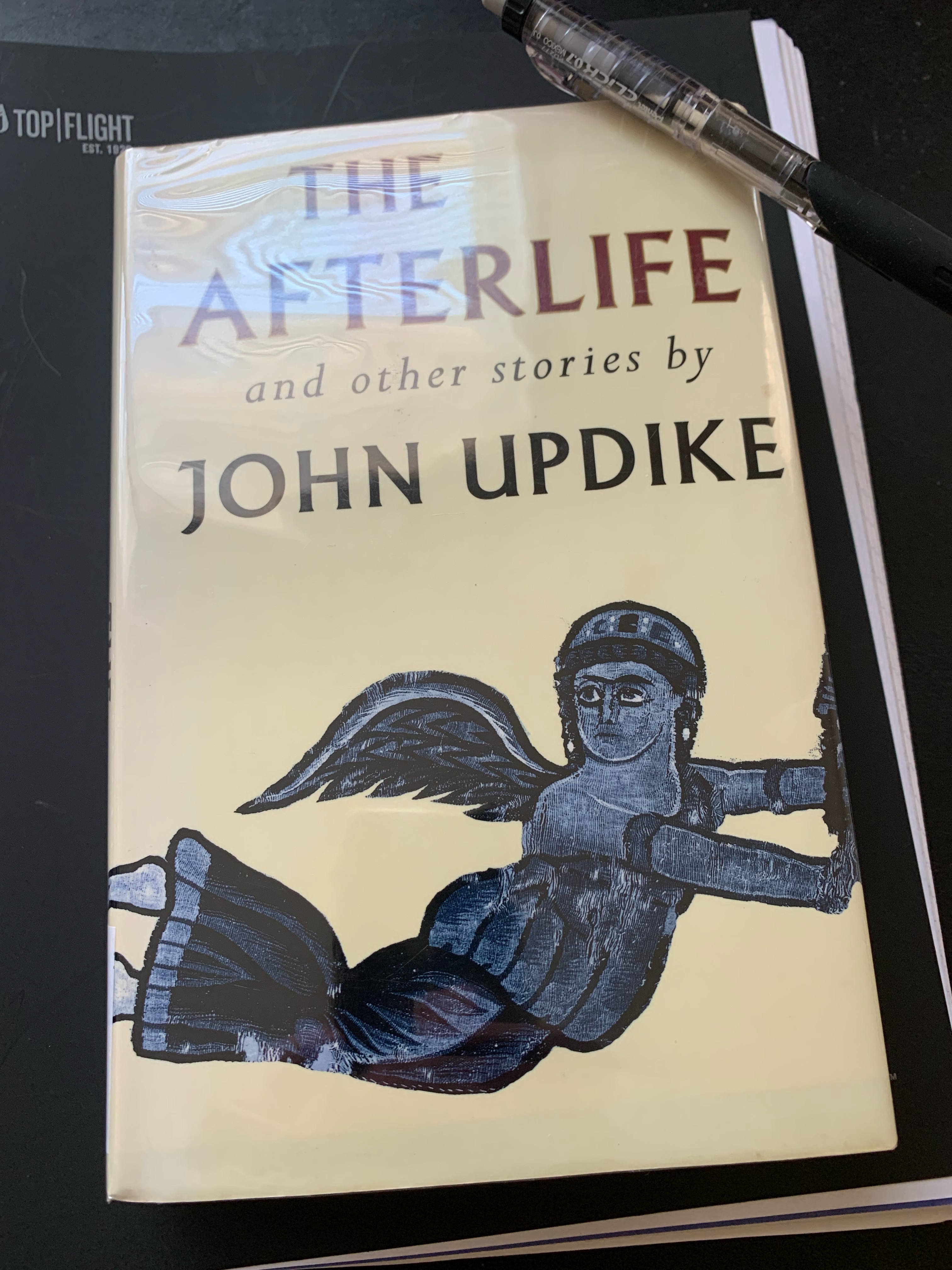
Again, my thanks to my buddy Greg for keeping my book habit going. He sent me another volume of a writer I never tire of reading: John Updike. Thank you, Greg.
I am not quite through this volume you sent me, but should be by the end of this week.
The stories I have read so far are typically Updikean. They’re meticulous examples of Updike’s precision and detail. I know few writers (perhaps Nicholson Baker in this generation, or Flaubert or Dickens in earlier generations) who name fashion (women’s and men’s) with such accuracy. I find myself looking up words all the time with Updike, but the labor is more than worth the work.
The same Updikean themes are evident in this volume of stories, too: marriage, divorce, appearance vs. reality, accomplishment (or lack thereof), God vs. the void, adulteries of various kinds, hope vs. despair, and death.
No small ideas with Updike, in my view. He used the mundane as his canvas in order to display the profound.
Art is about particular detail, arranged intentionally, crafted to herald messages and meaning to those with eyes to see and ears to hear.
And few crafted so well as John Updike.
Came home for the first time in a long time. ‘Twas so good. My favorite time of year, too. The weather was perfect.
Read some more of King Lear, a Poe short story, some C.S. Lewis, and studied Hebrews.
Played with the dogs (and cat). Piddled on the property. Saw the fam, too.
Relished the colors of the leaves, the crispness in the air, the cerullean sky.


Grateful.

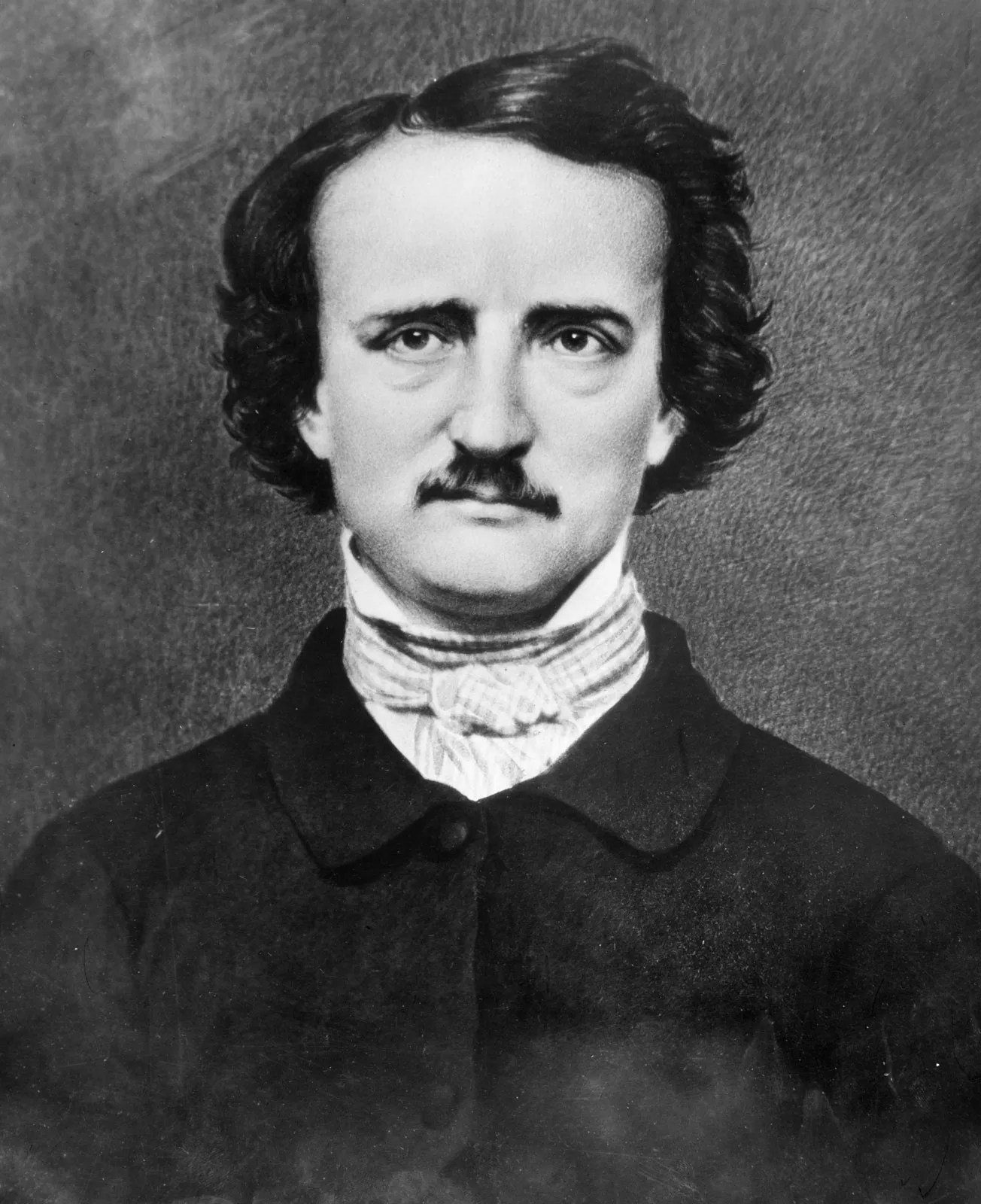
Reread “The Pit and the Pendulum” today by Edgar Allan Poe.
Some of the Poeesque word selctions:
I will not spoil the short story’s ending. But it is, shall we say, a cliffhanger.
I remember one time after having visited Whitman’s apartment in Camden, NJ, I made a literary pilgrimage to some of Poe’s old domiciles in Pennsylvania.. They were, as one might expect, masonry, dark, dank, often underground, and cloistered.
I have not made my mind up regarding Poe, and about where he stood. He seemed to be open and susceptible to perhaps too much and was perchance ill-equipped at moderation.
But he spun some magically tantalizing and horror-laden tales from realms of existential torture. About that, there is no doubt.


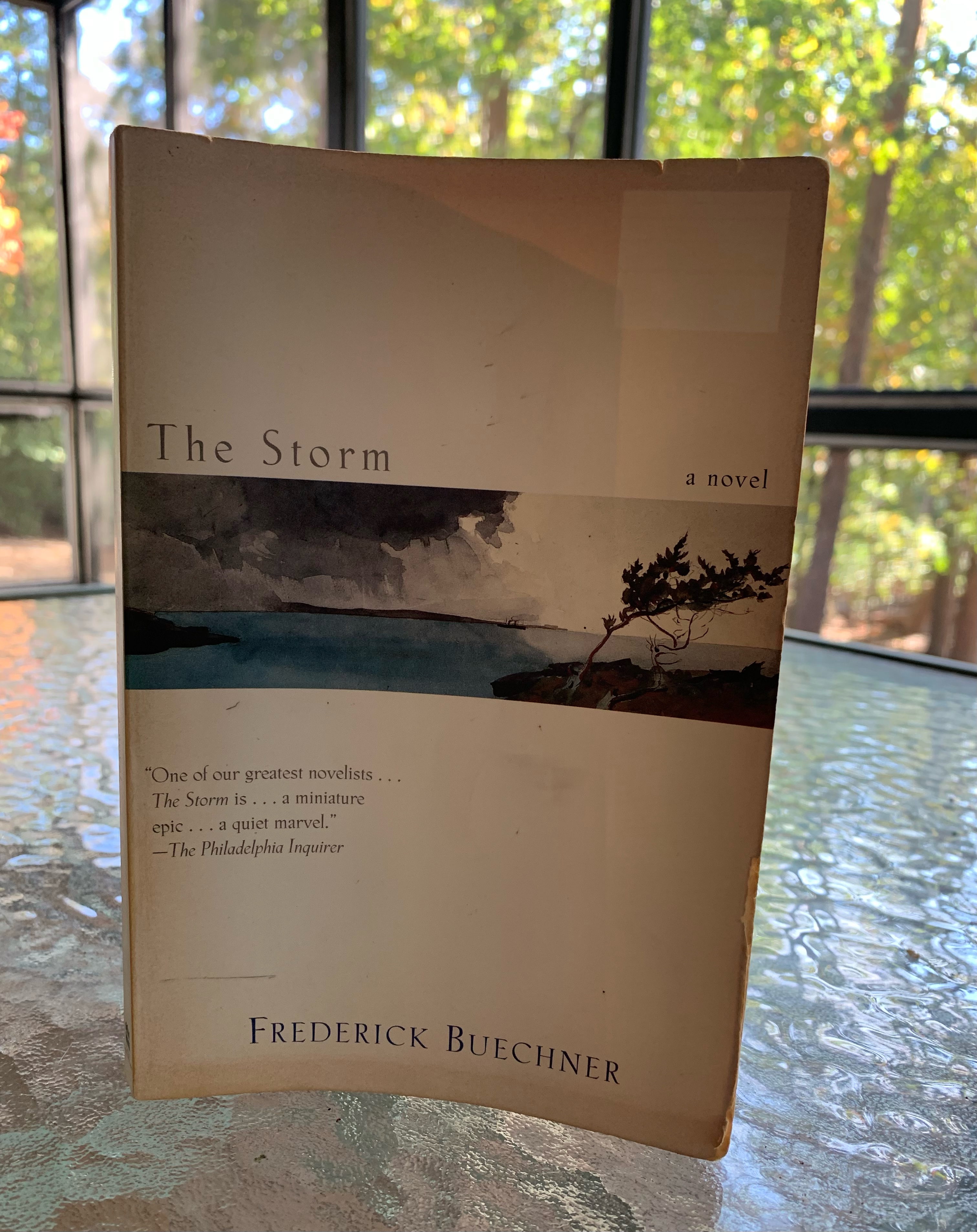
Fred Buechner’s novel The Storm centers on whether life’s storms have overarching meaning, whether (pun intended) the souls men of women, boys and girls, are within the sovereign wise counsel of God and his providence or whether this seemingly random, chaotic, temptest-tossed life is, in the end, merely a storm with no God of the storm.
It’s a slow book, at least it was for me, despite its brevity (199 pages). It centers on a handful of characters, all trying to come to grips with their broken lives. Kenzie, the protagonist, is a man who cannot forgive himself for his adulteries and for his secret life. He pines for forgiveness, crying out (to God?) for forgiveness, for atonement.
He sees unbelievable beauty and brokenness in the world and in himself and in others. How to explain such beauty? Is it all just random matter in motion? Is beauty an illusion? Is the longing for a metanarrative a fool’s errand? Are we all just mad here, after all, a la Carroll’s Alice in Wonderland?
I’ve read all but one or two other books from Buechner’s pen, and I suspect, based upon his substantial body of work, he believed in God and his providence, but that he (Buechner) was often double-minded and unstable in many ways (James 1:8). And the storm as a trope was the fitting image, the allusions to Shakespeare’s romance of the same name notwithstanding. Kenzie is the Prospero-type protagonist. Here is a glimpse into Kenzie’s thinking late into the novel:
For a moment he thought that for the third time in his life he was going crazy. If the world wasn’t coming to an end as he had once thought it was from the arrangement of knives and forks on his brother’s table, it was at least coming apart. He was coming apart. If the young woman beside him was telling the truth, it meant no more than that she was Kenzie’s illegitimate daughter. But maybe it was the young woman who was crazy. In that case how could he know whethere she was telling the truth or not, how could she herself know, how could anybody know anything for sure? Maybe there was simply no truth to tell, no order to things, no fixed point to give him his bearings, but only confusion and chaos. He could feel his calp going cold as ice and was afraid that he was about to start weeping (114-15).
This is why, in my view, The Storm is about pining. It’s about the human longing for the metanarrative, if it exists, that explains both the comedy and tragedy that characterize human history.
Yesterday was the Day of Atonement. Yom Kippur is the term for followers of Judaism. Christians, on the other hand, understand that the only atonement for sins was/is the atonement of Jesus Christ at Calvary in Jerusalem in the 1st century. No other high priest ever atoned for sin. Why? Because all other high priests are sinners. Only Jesus was/is sinless. Hence, his expiation and propitiation satisfied God’s holy standard.
Why should Christians understand the Day of Atonement? Because it was ordained by God as a temporary practice. It never atoned for sins at all but it did point forward to how God as high priest would atone for the sins of his people.
Jesus, the Christ, the Messiah, the promised one, the final high priest, the Anointed One, was the final high priest whose sacrifice–once for all at Calvary–accomplished redemption for all who would ever believe upon him for salvation.
Where is it in the Bible? Two main places:
Significance of the Day of Atonement?
It pointed to Jesus Christ who was to come. The whole of the Bible makes this clear. Jesus, not any sinner who has to atone for his people’s sins, and even his own, over and over again, year after year, is the final high priest.
Hebrews 9 is explicit in its explanation:
But when Christ appeared as a high priest of the good things that have come, then through the greater and more perfect tent (not made with hands, that is, not of this creation) he entered once for all into the holy places, not by means of the blood of goats and calves but by means of his own blood, thus securing an eternal redemption. For if the blood of goats and bulls, and the sprinkling of defiled persons with the ashes of a heifer, sanctify for the purification on the flesh, how much more will the blood of Christ, who through the eternal Spirit offered himself without blemish to God, purify our conscience from dead works to serve the living God. (Hebrews 9:11-14, ESV)
All three persons of the Trinity are referenced here: God the Father, God the Son, and God the Holy Spirit. And who gets sole credit for atoning for sin? Christ. Not any sinful human high priest. Christ alone.
In Romans 3 the Bible is again explicit regarding the atoning work of Christ alone:
God put forward as a propitiation by his [Christ’s] blood, to be received by faith. This was to show God’s righteousness, because in his divine forbearance he had passed over former sins. It was to show his righteousness at the present time, so that he might be just and the justifier of the one who has faith in Jesus. (Romans 3:25-26, ESV)
It is remarkable when you consider that this was written by the Hebrew of Hebrews, Paul, formerly Saul of Tarsus. He was a pride-filled legalist (Philippians 3:4), a Pharisee (Philippians 3:5), a persecutor of Christians (Philippians 3:6; Acts 8). But God gripped him and gave him eyes to see the truth of the grace of God in the person and work of Jesus Christ (Acts 9:1-22).
Takeaway/Encouragement: So much in the observance of holy days can lead to pride if we misapply observances and their designed lessons. The Day of Atonement can lead to trusting in the works of men to atone for their own sins. They cannot. Only Christ can and did atone.
Temporary biblical rituals can lead to pride if we misapply ordained rituals by not understanding how the high priesthood pointed to Jesus, the final high priest, whose sacrifice was once for all at Calvary.
So much of the Bible can be misunderstood if we miss this fundamental: Scripture does have a hero, but it’s not us; it’s God:
in Christ God was reconciling the world to himself, not counting their trespasses against them, and entrusting to us the message of reconciliation. Therefore, we are ambassadors for Christ, God making his appeal through us. We implore you on behalf of Christ, be reconciled to God. (2 Corinthians 5:19-20, ESV)

Sometimes I think what it would be like to be blind after having had sight.
This evening as I went for a walk (it was very, very slow, as I’ve an ankle injury, but I can get along slowly without crutches now). I walked. And saw. Perhaps the better word is, I beheld.

Small things, yes?
No. Not really.
Not when you see them with gratitude.
Gold, halcyon, roaring.
And the way oak limbs bend towards the light like old men’s skeletal frames.
And the way cicadas thrum and the last doves streak gray-winged rockets across the sky solo, and bats flitter seemingly half-mad after moths.
But one must see. Truly see.

Saul Bellow is probably best known for his novels. Some of his masterpieces follow:
2. The Adventures of Augie March
3. Henderson the Rain King
4. Herzog
5. Humboldt’s Gift
But Bellow’s short stories are gems, too, especially “A Father-to-Be.”
Bellow’s giftedness is arguably best evidenced in his dramatization of man’s blindness to his own nature. Like Bellow’s main characters, we tend to be much more skilled at seeing the specks in other people’s eyes than seeing the logs in our own eyes.
You recall Jesus’ teaching in the Sermon on the Mount:
Why do you see the speck that is in your brother’s eye, but do not notice the log that is in your own eye? Or how can you say to your brother, ‘Let me take the speck out of your eye,” when there i sthe log in your own eye? You hypocrite, first take the log out of your own eye, and then you will see clearly to take the speck out of your brother’s eye. (Matthew 7:3-5, ESV)

In “A Father-to-Be,” a short story about Rogin, a 31-year-old chemist living in New York City, who is engaged to Joan, Rogin is a worrier. He feels the weight of the world on his shoulders. He worries–most of all–about money, about being able to provide for his future, and about whether he and Joan have children, what would they be like?
Rogin is the literary trope of the urban Jew whose worldview is almost completely consumed by thoughts of money. (Bellow was Jewish, of course, so this is not meant as anything other than calling attention to the story, and its literary trope.)
Here’s the way Bellow describes Rogin early on in the story:
“While the woman in the drugstore was wrapping the shampoo bottle, a clear idea suddenly arose in Rogin’s thoughts: Money surrounds you in life as the earth does in death. Superimposition is the universal law. Who is free? No one is free. Who has no burdens? Everyone is under pressure. The very rocks, the water of the earth, beasts, men, children–everyone has some weight to carry” (504).
Rogin is quick to judge others and quick to think he has all the answers, and that he is therefore somehow superior to the rest of people.
Again, look at how Bellow reveals Rogin’s character through his (Rogin’s) thought life:
“Rogin’s illuminated mind asked of itself while the human tides of the subway swayed back and forth, and cars linked and transparent like fish bladders raced under the streets: How come he thought nobody would know what everybody coudn’t help knowing? And, as a chemist, he asked himself what kind of compound this new Danish drug might be, and started thinking about various inventions of his own, systhetic albumen, a cigarette that lit itself, a cheaper motor fuel. Ye gods, but he needed money! As never before. What was to be done? His mother was growing more and more difficult” (507).
Again, we readers see Rogin, but Rogin does not see himself. And we get the sense that a moment of illumination is coming. Surely an epiphany for Rogin neareth.
And it does.
Rogin watches two friends get into a dispute in the subway when Friend A makes a confession to Friend B, and says in effect, “I betcha didn’t know that about me, did you?” and Friend B, without missing a beat, says, “Of course I did. That was obvious.”
And can you guess Rogin’s response as a spectator? How silly of both men. See, Rogin thinks to himself, how little people know of each other! If only folks were as insightful as Rogin.
By the time Rogin has gone by the pharmacy for a bottle of shampoo, and gone by the deli for some roast beef and other items Joan had asked him to pick up, he is incensed. He feels he has penetrated into the mysteries of life whereas most others only skate upon life’s surface, unreckoning and unaware of life’s deeper truths.
Finally when Rogin arrives at the apartment, his kind fiancee Joan greets him.
“Oh, my baby. You’re covered with snow. Why didn’t you wear your hat? It’s all over its little head”–her favorite third-person endearment (511).
And Joan washes her fiance’s (Rogin’s) hair, notices his scalp is pink (like a baby’s), and Rogin is undone. She bathes his scalp, shampoos his hair, tends to him:
Then Bellow brings it all home:
“But there’s abosolutely nothing wrong with you,” she said, and pressed against him from behind, surrounding him, pouring the water gently over him until it seemed to him that the water came from within him, it was the warm fluid of his own secret loving spirit overflowing into the sink, green and foaming, and the words he had rehearsed he forgot, and his anger at his son-to-be disappeared altogether, and he sighed, and said to her from the water-filled hollow of the sink, “You always have such wonderful ideas, Joan. You know? You have a kind of instinct, a regular gift” (513).

Rogin sees, perhaps for the first time, he’s the child. He needs to be mothered. He is the one longing for love. He’s the one in need. Actually, there is debate about whether or not Rogin does actually grow up and come to see that he’s been the child. I kind of think, in fact, that he has not come to himself yet. Rogin was humbled, yes, a lesson we need more than we usually realize. But usually we’re the last ones to know. Others see our need first, kind of like that penchant we have for seeing those specks in other people’s eyes.
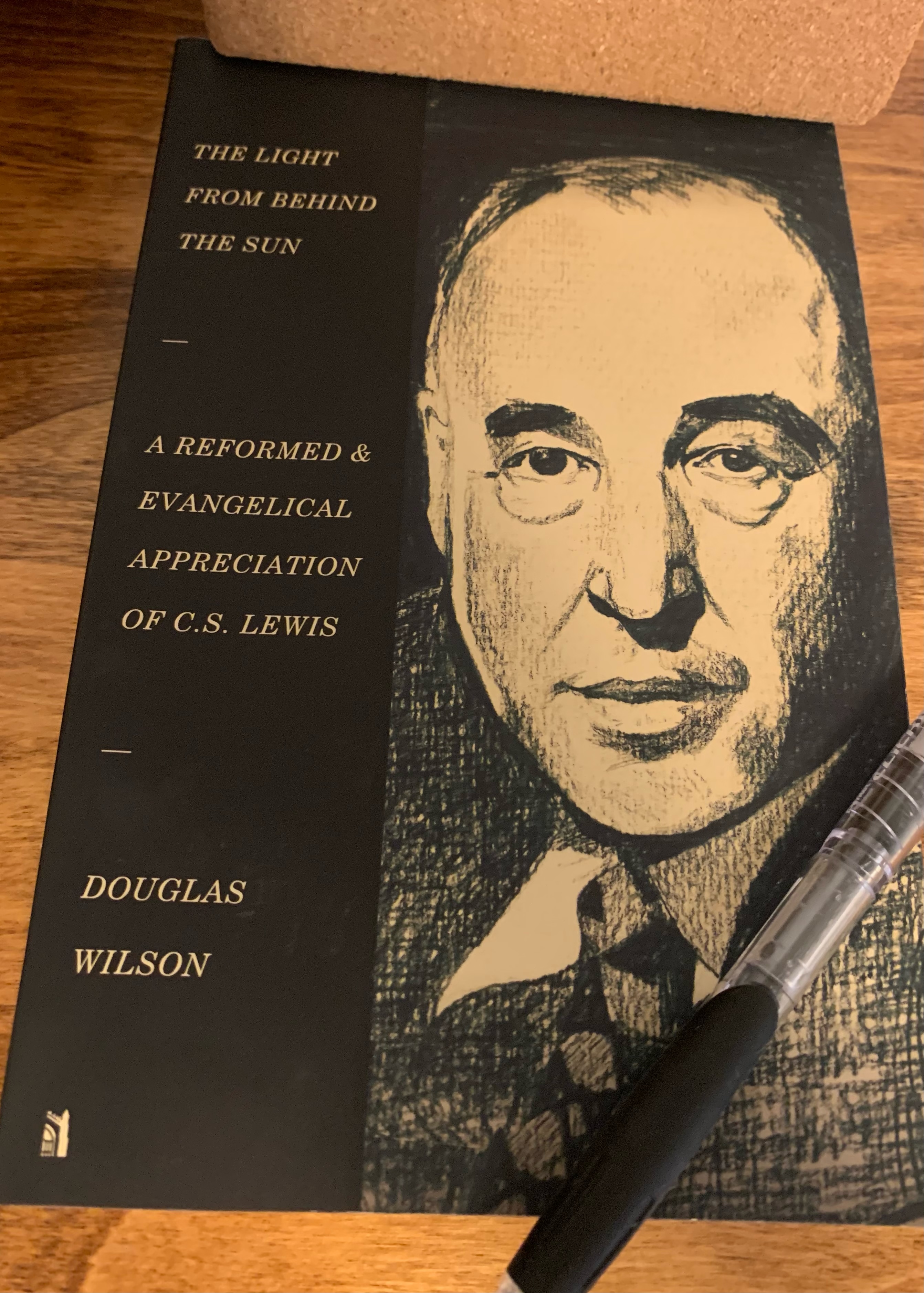
Why C.S. Lewis? Because I think it is clear he’s the 20th century’s most read, most written about, most enduring Christian thinker/writer.
Three Gems about Lewis’ Insights in Wilson’s Book:
2) Having said this, in The Screwtape Letters, Lewis took a jab at modern man who is accustomed to carrying around a mass of contradictions. “Your man has been accustomed, ever since he was a boy, to having a dozen incompatible philosophies dancing about together in his head” (The Screwtape Letters, 11). And Owen Barfield once said that Lewis himself was utterly unlike this, saying that what Lewis thought about everything was contained in what he said about anything.
3) A blind, purposeless, and material process does not and cannot know that it is blind, or purposeless, or material. It cannot know anything. If thought is simply the froth on the waves of our brain activity, then one of the first things that thought loses is the ability to know that there is even such a thing as brain activity, or froth for that matter. If human argumentation is simply the epiphenomena that our brain chemistry produces, then there is absolutely no reason to trust human argumentation—including any arguments that urge us to believe that argumentation is simply the epiphenomena that our brain chemistry produces.
I have read C.S. Lewis probably as much as I have read anyone except perhaps Jonathan Edwards, David Martyn Lloyd-Jones, and J. Gresham Machen. And there are some excellent bios of Lewis out there. I wrote about one just last week. But Wilson is a Lewis of today, in my view. He is courageous. He is not content to seek the applause of men. He is, like Lewis in his day, or like Calvin in his day, and Machen in his day, a biblical thinker, a wordsmith, and a man of courage.
We have a lot of men who began well but who have stumbled and made shipwreck of their professed faith. Very often, the men of the hour fell away because their idols were cultural relevance and men’s applause rather than the crucified and risen Savior, the Christ.
Wilson’s book is an impressive book about one of church history’s greatest minds, C.S. Lewis, but it also encourages me that God has raised up Doug Wilson, too, one about whom others will hopefully write biographies. Both men deserve to be heard and read and reread.
1 Douglas Wilson, The Light from Behind the Sun (Moscow: Canon Press, 2021), 110.
2 Ibid., 98.
3 Ibid., 54-55.
 MIND & MATTERS