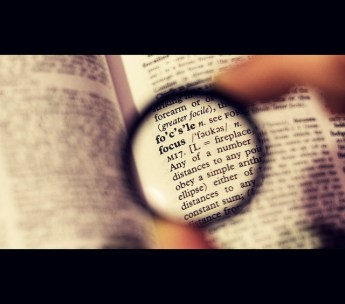
Focus or Distraction: That is the Question


6602332085_60b6526b99_z

“If the devil can’t make you bad, he’ll make you busy.” I’m not sure where I heard that phrase the first time but its truth remains with me. Am I the only one who is too busy? More often than not, I’m pulled in several different directions, and those pulls happen at the same time. Like you, I can only be one place at a time. Thus, prioritizing has become critical in my life. Knowing in what order to work one’s to-do list is a critical skill. It’s triage in time management. Below are two recent illustrations where I was confronted with the importance of focus. Expressed another way, there are seas of distractions. Since the easiest thing to do is fritter one’s time, learning to navigate well is focusing on the lighthouse. That focus lessens the likelihood of being tossed about.

The first illustration involves when our daughter returned home from college for a holiday weekend recently. My wife and I have been experiencing that ache that parents know. It comes after their children leave the nest. Suddenly you find yourself searching for familiar footfalls, the smells and sounds of one’s children, etc. that parents intuitively know. When our now-college-student-daughter came home, the passage of time became palpable. She told us of her classes, her teachers, her new sets of friends, etc. I found myself envious. Because I love learning, and because I enjoyed college perhaps too much in my generation, some of which involved learning, I told her, “I wish I could go back to college and do it all over again.” She just laughed at me. Why? It’s because there were so many opportunities I wasted. The things that seemed important at the time were often distractions from what would last.

The second illustration revolves around a conversation my son and I had as he and I were walking one of our dogs. Titan, our less-than-gargantuan Pomeranian/terrier mix of a dog (I couldn’t resist the irony when we named him) was pulling at his leash I was walking him on. He let me know he wanted to increase our pace. So, we gave in. Jeremiah took off running. Titan gave chase and took off after Jeremiah. Holding the leash, I found myself in the race. Jeremiah sprinted ahead of our little group, followed by Titan. I came in last, holding the leash, panting. When we reached the end of the road where we typically turn around, I was trying to regain my breath. Neither my son nor my dog was breathing as heavily. Without missing the opportunity to laugh at his old man, my son said, “Come on, Dad! It’s not like you’re old or something. You’re only 46.”

Just like when my daughter laughed at my comment about wanting to return to college and do things better the second go-round, my son’s comment reminded me of a basic truth: we don’t get do-overs. We better do what’s important the first time.

In Paul’s letter to the Ephesians, he wrote “Look carefully then how you walk, not as unwise but as wise, making the best use of the time, because the days are evil” (Eph 5:15-16 ESV). The idea Paul explores here involves redemption, redeeming one’s time, purchasing what is valuable indeed. In a world of distractions, wisdom lives near simplicity, and simplicity (at least for this old guy) hinges on focus. Focus or distraction, that is the question. May my children learn early to make the best use of their time. Before they know it, they’ll be panting, too, as my grandchildren outrun them.

What do Oedipus, Chick-fil-A, and a Kentucky Christian Woman Share?


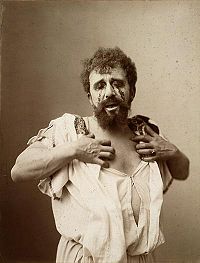
Oedipus-RexAt the end of Sophocles’ play Oedipus the King, after Oedipus has gouged out his eyes with his mother’s “long gold pins” that held her robes, and after he’s “seen” the folly of his anger, his hubris, his failure to listen to counsel, the Chorus in the play concludes the tragedy with this lament: “Count no man happy till he dies . . .” Then it’s curtains. Tragedy befalls even kings.


In recent news, Chick-fil-A, a restaurant chain owned by Christians, is once again persecuted for one reason: they’re Christian and won’t capitulate to secularism which mandates that marriage be redefined to mean what it never has meant.Chick-Fil-A-Logo So, Denver International Airport’s board, heavily influenced by leftist/secularist ideologies, may bar Chick-fil-A from setting up a business inside the airport, despite the demand for their products. “Count no man happy till he dies.”

In Rowan County, KY this week, County Clerk Kim Davis has been taken to jail for refusing to issue marriage licenses to people of the same gender, claiming her Christian 150902_POL_KimDavis.jpg.CROP.promo-xlarge2convictions, based upon the Bible, forbid her condoning so-called same sex marriage, because that would violate her sincerely held religious belief that marriage always has been, and always will be, the sacred union of one man and one woman, under God. Today, she’s in jail for refusing to abide by the arm of secular law. “Count no man happy till he dies.”

As always, God taught his people about what it meant to follow him: “If the world hates you, know that it has hated me before it hated you. If you were of the world, the world would love you as its own; but because you are not of the world, but I chose you out of the world, therefore the world hates you” (Jn 15:18-19 ESV).

What do Oedipus, Chick-fil-A, and a Kentucky Christian woman share? First, be clear: Sophocles was a Greek politician, military general, and playwright, steeped in paganism and polytheism. However, for the Christian-owned Chick-fil-A and Kim Davis, they are daring to follow a crucified and risen Lord who told his followers they’d be hated because they’re not of this world. What that means is that they’re not of this world system of godlessness, of paganism, and Gnosticism—all of which attempt to deny the obvious differences between men and women, as well as their complementary roles as designed by God.

There is, to risk overstating the obvious, a reason God commanded our first parents, Adam and Eve, to be fruitful and multiply (Gen 1:28). They were designed for one another. When homosexuality, pederasty, and other abominations pervade history, God’s judgment falls (Gen 18:23-29). Since God is incapable of change (perfection cannot be improved upon) then God has not “evolved on the issue.” He has not evolved on any issue. In other words, God has not evolved.

What we are witnessing, and what more and more Christians are experiencing, is exactly what we were told we’d experience. Sophocles skirted with the truth when he penned that we should count no man happy till he dies. But another writer, the apostle Peter, martyred for his Christian faith under government persecution, was crystal clear: “Beloved, do not be surprised at the fiery trial when it comes upon you to test you, as though something strange were happening to you. But rejoice insofar as you share Christ’s sufferings, that you may also rejoice and be glad when his glory is revealed. If you are insulted for the name of Christ, you are blessed, because the Spirit of glory and of God rests upon you” (1 Pt 12-14).

“Count no man happy till he dies,” penned Sophocles. Wise counsel. However, because of Christ, and because of his conquering through pagan persecution, there is hope beyond the grave…not just for Chick-fil-A’s witness, not just for Kim Davis’ witness, but for all who will call upon the Lord as Christ. May God grant ears to hear that good news, for that news changes everything.

Too Much World

034BED83-D911-4074-801968990B8EBFDC


“The world is too much with us” is the opening salvo in one of William Wordsworth’s sonnets. Wordsworth’s setting was 1800s England. If understanding the risk of choking on this world was a real danger to one’s soul in the 1800s, how much more nowadays? Below I share an anecdote with a message I bet you already know intuitively: it’s important to simplify.

When I’m in my hometown, I have several things I do to blow off steam. First, I like to work outside in the yard. Second, I enjoy exercising/doing PT (physical training, for non-military folks). On a recent trip to the local gym where my family and I work out, I was struck by something: there was no silence. When I entered, I was overcome with the sounds of music from the overhead speakers. Moreover, on the treadmills, there perched TV screens with ports for users to plug in to watch 24/7 “breaking news,” alerts, the latest murders, protests, etc. Of course, that equipment was not new to the gym. Apparently, customers should have TV and music piped in while working out nowadays.

I went to exercise, to sweat, to push myself physically, and I could not escape media bombardment. What does it say about our culture that many people know more about Hollywood gossip (aren’t there entire shows, magazines, and even networks dedicated to this stuff?) than they do about what endures, about what matters, about what is enduringly important? Does anyone really think that the latest breaking news/alert is going to matter in the end? I fear that many people are choking on this world and missing the true, good, and beautiful. There’s too much world in our everydayness. Might we not be better to simplify, unplug some, and thereby increase our likelihood of making the best use of our time (Eph 5:16)?

I’m amazed often when someone tells me about the latest Hollywood shenanigans, and I’m lost. I could not care less who’s marrying whom, divorcing, having adulterous affairs, or what Rosie O’Donnell or Ben Affleck think about politics. Asking Rosie or Ben what they (or others of their ilk) think of political science would be akin to asking me how to repair a Porsche: no thinking person would do it.

Before I’m accused of being a Luddite, I’m not opposed to technology. I, too, spend many hours on a computer, cell phone, etc. with my various jobs and ministries. So, I’m not aiming at the very medium I’m using. Rather, I’m aiming at this question: Are we using technology with discernment or are we enslaved to the banal? In other words, what are the criteria of what’s news? What is newsworthy? May I humbly suggest that the so-called news is infinitely more about profits than discernment? How people can sit in front of TVs or the internet for hours and not feel convicted that their lives are sliding down the drain, mystifies me. Don’t they want to contribute to life? Don’t they have someone they can help? Don’t they want to volunteer at a charity? Don’t they have family or friends they can spend time with or to whom they might write a letter (remember those?)?

Now, to change the setting from our local gym to home. Recently my wife, our 8-year old son, and I were reading a book aloud together as a family. The book was a children’s classic, Hatchet, by Gary Paulsen, about an adolescent boy who is stranded in the woods of northern Canada. He struggles to survive after a dramatic plane crash. It’s a wonderful, drama-filled, imaginative story of a boy, fear, loneliness, adventures in the Canadian woods, close escapes, and discovering resilience amidst his new knowledge of the real world, etc. As the three of us took turns reading and talking about what we read, education occurred. And it involved nothing but a book, a family, and time. No TVs, no digital devices, no breaking news or updates, etc. It was simple. It was the ordinary simple ways of learning. However, I bet it’s another time that’ll endure as valuable.

The world is too much with us, I fear, perhaps more than ever. As Christ himself taught, the easiest thing to do is gain the whole world and forfeit one’s soul (Mk 8:36).


Richard Wilbur’s poem, “The Beautiful Changes”


url

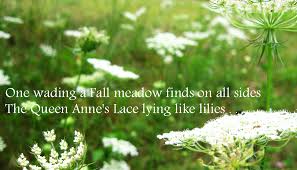
One wading a Fall meadow finds on all sides

The Queen Anne’s Lace lying like lilies

On water; it glides

So from the walker, it turns

Dry grass to a lake, as the slightest shade of you

Valleys my mind in fabulous blue Lucernes.


The beautiful changes as a forest is changed

By a chameleon’s tuning his skin to it;

As a mantis, arranged

On a green leaf, grows

Into it, makes the leaf leafier, and proves

Any greenness is deeper than anyone knows.


Your hands hold roses always in a way that says

They are not only yours; the beautiful changes

In such kind ways,

Wishing ever to sunder

Things and things’ selves for a second finding, to lose

For a moment all that it touches back to wonder.

imgres-19320874-large

Certain poems I find I cannot shake. Richard Wilbur’s poem, “The Beautiful Changes,” is such a poem. It continues to grip me. Perhaps it is because this past week, I visited the eye doctor and I received some news. I don’t need just reading glasses; I don’t need just driving glasses; I don’t need just work glasses. I need glasses—period. My eyes are fading. My years of being an avid reader have caught up with me. My eyes are fading. Yet in some ways, I think I see better. I’ve grown older and my eyes have lost some of their original power. Yet with the years, I understand that time brings some things into focus.glasses

“The Beautiful Changes,” is a three-stanza poem dealing with how beauty endures in spite of time’s effects. The reason people continually pursue beautiful things and moments is because we see how time robs and destroys much of life. The dominant image is of a person walking through a meadow of Queen Anne’s lace. As the character walks through the meadow, the Queen Anne’s lace divides, almost like rippling water. The character sees how his motion causes other motion. He sees a sea of movement. Time is captured in the image of motion.

The second stanza is perhaps the most overt in its expression of the poem’s meaning of how beauty is a bulwark, not just in spite of time, but in a way, because of time. Wilbur writes that a mantis’ presence is “arranged/On a green leaf, [and] grows/Into it, [and] makes the leaf leafier, and proves/Any greenness is deeper than anyone knows.” The idea is that people would not notice the beauty unless time ravaged us.

We appreciate beautiful sights when we “see” that we don’t see as well as we used to. The dimness of physical limitations becomes a conduit to seeing the beauty that is there if we could see it. We experience the “second finding” (line 17) more wonderfully for knowing that beauty, not our experience of it, lasts.

As I don my new glasses next week, I will see better. In some ways, however, I already see better because of Wilbur’s poem, “The Beautiful Changes.”


His Speck but My Log

url

Some books should be read once; some books should be read and recommended; some books should be read and purchased for others who will read them. Lastly, some books should be read, purchased for others, and read again for our own benefit. This is my third time reading through I Don’t Have Enough Faith to be an Atheist by Norman Geisler and Frank Turek. The title is appropriate and summative. The authors ask rimgreseaders to examine their own assumptions in their search for truth. I’ve read scores of books on Christian apologetics, but what I appreciate about this book is its forthrightness and accessibility for lay persons. I use it as a gift for others whom I believe will actually read it.

What demands more faith—to believe that an intelligent, uncaused, personal being (God) created everything, or to believe that nothing gave rise accidentally to everything? If God exists, then origins, identity, meaning, morality and destiny are explainable. If atheism is true (where God’s non-existence is assumed as an absolute) then origins, identity, meaning, morality and destiny are unexplainable rationally; they become subjective and preferential. Stick with me as I tell a personal story from just a couple of years ago.

During a military deployment a couple of years ago in Afghanistan, I developed a friendship with another officer within our battalion. We both had been English majors as undergraduates and we talked often of our favorite books, writers, and ideas. He’d grown up in Pennsylvania and Massachusetts as a nominal Roman Catholic but said he was now agnostic. He said he’d read the Bible through but could not bring himself to believe in the exclusivity of Jesus as God incarnate. He’d come to reject Christianity. Why? He said that he’d seen too many sins (his word) in the Roman Catholic circles in which he was reared. Even in his forties, he was still wounded by them. In short, he said he was disappointed. Therefore, he said, Christianity could not be true.

Are you following his reasoning? Because he’d seen sinful behavior of those claiming to be Christians, he rejected the Christian faith. May I say this kindly but clearly? That’s very poor reasoning. None of us is righteous. None of us is good. We’re all sinners. The first three chapters of Romans explain this with unmistakable clarity. Because hypocrites exist, Christianity is false? That’s hardly sound reasoning. Jesus excoriated hypocrites: “The scribes and the Pharisees sit on Moses’ seat, so do and observe whatever they tell, you, but not the works they do. For they preach, but do not practice” (Mt 23:2-3 ESV).

Over and over again, Jesus pronounced judgment upon hypocrites. In Matthew 23 alone, Jesus pronounced “woes” and judgments repeatedly upon fakers. Why? Because they (scribes, Pharisees, etc.) were charlatans, they were fakes. They brought reproach upon God’s name for pretending to be lovers and followers of God, yet living ungodly: “Woe to you, scribes and Pharisees, hypocrites! For you tithe mint and dill and cumin, and have neglected the weightier matters of the law: justice and mercy and faithfulness” (Mt 23:23a).

Were that insufficient, Jesus turns the screws tighter still: “Woe to you, scribes and Pharisees, hypocrites! For you clean the outside of the cup and the plate, but inside they are full of greed and self-indulgence. You blind Pharisee! First clean the inside of the cup and the plate, that the outside also may be clean” (Mt 23:25-26).

Any righteousness is internal before it’s external. Because our hearts are evil, self-absorbed, and factories of idols, we need new hearts. And that is what Christ provides. He did not come for the righteous but for sinners. Conviction over one’s own sin, not scoffing at others’ hypocrisy, is evidence of a teachable spirit. Trying to use others’ hypocrisy is a tactic of distracting oneself from addressing our own personal sin. We reveal ourselves to be just like the Pharisees Jesus excoriated. We want to appear righteous but we know that we’re guilty sinners.

My friend was right to loathe the hypocrisy of the hypocrites he witnessed. But he (and I) would do well to loathe the hypocrisy in ourselves more than we lament it in others. We’ll not answer for others’ sin; our own is more than enough to battle.

I bought my friend a copy of Geisler and Turek’s book two years ago. He promised me he would read it. I don’t know if he has. I’m now reading it through for the third time. I don’t say that to boast, but out of love for a friend, who sees the specks in others’ eyes with clarity. May God use this helpful book to help him see himself as well as he sees others. When we begin to see ourselves as the sinners we are, we see what amazing grace is extended to all who will humble themselves before the cross of Christ.


Flannery O’Connor and Jesus


flannery-jpg

A good man is hard to find…until you meet Jesus; then it’s impossible. Flannery O’Connor’s masterful short story, “A Good Man is Hard to Find,” is perhaps my favorite short story, because it throws down a gauntlet. It challenges readers to confront Jesus. If Jesus rose, we’ve got to deal with it, because a resurrection would change everything.

If you’re unfamiliar with thimgres-2e story, it’s a simple plot: A grandmother, the protagonist, persuades her only son, Bailey, to take her along on a family vacation Bailey and his family have planned to FL. The grandmother, a complaining prig and gossip, would rather go to east TN, but she acquiesces to the FL plan. Referencing the newspaper, the grandmother alerts her son (Bailey) that an escaped convict called the Misfit, is on the loose:

“Here this fellow that calls himself The Misfit is aloose from the Federal Pen and headed toward Florida and you read here what it says he did to these people. Just you read it. I wouldn’t take my children in any direction with a criminal like that aloose in it. I couldn’t answer to my conscience if I did.” (117)

Nonetheless, they all set out–Bailey (the grandmother’s son), his wife, the two adolescent children (John Wesley and June Star), the unnamed infant, and the pontificating grandmother.

The ensuing irony is superb. The grandmother is resolved that she wouldn’t put her family in harm’s way. Naturally, she’s concerned with keeping a clear conscience. But guess what happens? The family gets lost (due to the grandmother), is involved in a car accident, and ends up at the end of the Misfit’s muzzle.

The paths of the escaped criminal/main antagonist (the Misfit), along with his fellow escapees (Hiram and Bobby Lee), and the vacationing family, cross. Murder, the reader senses, looms.

The confrontation is unforgettable. These words from the Misfit are some of the most important in literature:

“Jesus thown everything off balance. It was the same case with Him as with me except He hadn’t committed any crime and they could prove I had committed one because they had the paper on me. Of course,” he said, “they never shown me my papers. That’s why I sign myself now. I said long ago, you get you a signature and sign everything you do and keep a copy of it. Then you’ll know what you done and you can hold up the crime to the punishment and see do they match and in the end you’ll have something to prove you ain’t been treated right. I call myself The Misfit,” he said, “because I can’t make what all I done wrong fit what all I gone through in punishment.” (131)

Again the irony is dramatic and tragic. The grandmother, a southern “lady,” meticulous in her dress, mindful of her acquaintances and how she appears in her sphere, is a “good” person on the outside. And for a while, she is spared…until now. She has been granted grace. Her family, however, is a few yards away, slaughtered in the woods, and she’s in existential discussion in a few tense minutes before eternity. And the Misfit utters these words:

“If He [Jesus] did what He said, then it’s nothing for you to do but throw away everything and follow Him, and if He didn’t, then it’s nothing for you to do but enjoy the few minutes you got left the best way you can—by killing somebody or burning down his house or doing some other meanness to him. No pleasure but meanness,” he said and his voice had become almost a snarl.” (132).

The Misfit was right, of course. Jesus was right, too, when He said, “No one is good but God alone” (Mark 10:18b). Who’s good in the story, truly good? The grandmother? Hardly. Her family? No. The Misfit? No. But if Jesus did what He said, then that changes everything, and we should follow.

Flannery has thrown down a gauntlet, and we’d do well to pay attention.

Homage to Faulkner

MTE5NDg0MDU0OTYxNzUxNTY3

Faulkner. His oeuvre is like an anvil. Many writers have crushed themselves on it; it’s just that imposing.

His stature continues to grow. His novels like The Sound and the Fury and As I Lay Dying often appear in advanced literature courses. Short stories like “Barn Burning” and “A Rose for Emily” are often anthologized as examples of excellent short fiction. Mention Faulkner’s name and work and watch people identify as either detractors or disciples. (I’m in the second category.)

This past month I stopped in Oxford, Mississippi yet again to peruse the Faulkner sections of Square Books, then went for another pensive stroll through Rowan Oak, Faulkner’s home for much of his writing life, located just blocks from beautiful downtown Oxford. Perhaps I should be embarrassed at how many times I’ve gone there and paid respect to the contributions of Faulkner. Some people go to Disney; others visit the islands; others go on cruises. But I return to offer silent homage to Faulkner.

11742841_10205654919027152_7071992575159259396_n1610972_10205654939347660_4591486241170904850_n11745339_10205654919467163_4661116339080316700_n11707697_10205654919907174_6700630190519027862_n

There are many sections of Faulkner’s books that I treasure but perhaps none is more illustrative of his goal than what he heralded in his Nobel Prize acceptance speech:

Ladies and gentlemen,


I feel that this award was not made to me as a man, but to my work – a life’s work in the agony and sweat of the human spirit, not for glory and least of all for profit, but to create out of the materials of the human spirit something which did not exist before. So this award is only mine in trust. It will not be difficult to find a dedication for the money part of it commensurate with the purpose and significance of its origin. But I would like to do the same with the acclaim too, by using this moment as a pinnacle from which I might be listened to by the young men and women already dedicated to the same anguish and travail, among whom is already that one who will some day stand here where I am standing.

Our tragedy today is a general and universal physical fear so long sustained by now that we can even bear it. There are no longer problems of the spirit. There is only the question: When will I be blown up? Because of this, the young man or woman writing today has forgotten the problems of the human heart in conflict with itself which alone can make good writing because only that is worth writing about, worth the agony and the sweat.

He must learn them again. He must teach himself that the basest of all things is to be afraid; and, teaching himself that, forget it forever, leaving no room in his workshop for anything but the old verities and truths of the heart, the old universal truths lacking which any story is ephemeral and doomed – love and honor and pity and pride and compassion and sacrifice. Until he does so, he labors under a curse. He writes not of love but of lust, of defeats in which nobody loses anything of value, of victories without hope and, worst of all, without pity or compassion. His griefs grieve on no universal bones, leaving no scars. He writes not of the heart but of the glands.

Until he relearns these things, he will write as though he stood among and watched the end of man. I decline to accept the end of man. It is easy enough to say that man is immortal simply because he will endure: that when the last dingdong of doom has clanged and faded from the last worthless rock hanging tideless in the last red and dying evening, that even then there will still be one more sound: that of his puny inexhaustible voice, still talking.

I refuse to accept this. I believe that man will not merely endure: he will prevail. He is immortal, not because he alone among creatures has an inexhaustible voice, but because he has a soul, a spirit capable of compassion and sacrifice and endurance. The poet’s, the writer’s, duty is to write about these things. It is his privilege to help man endure by lifting his heart, by reminding him of the courage and honor and hope and pride and compassion and pity and sacrifice which have been the glory of his past. The poet’s voice need not merely be the record of man, it can be one of the props, the pillars to help him endure and prevail.


If you’re unfamiliar with or intimidated by his work, would you nevertheless heed his call in that famous speech? Remembering that the basest of all things is to be afraid, take up his works and read.

Welcome to the anvil.


Shakespeare, David Foster Wallace, and Jesus: Intimations on Death and the Afterlife (Part 2 of 2)

shake imgres-2 imgres-3

  1. Lasting meaning only possible with eternal reference point
  2. Jesus’ claims to be the eternal reference point
  3. Yorick’s life matters because of the imago Dei; denial of Jesus ends in denial of dignity

Why would an atheist weep at a funeral? His weeping could be over missing his loved one. He might weep over his own loneliness now that his loved one has departed. But if he is a consistent atheist, he cannot explain why the life of the deceased mattered in any objective sense. All he can say is that the life mattered to him. It’s a purely subjective ascribing of value to another. But I do not see how the atheist can claim justifiably that a life matters–any life—objectively.

When Hamlet and Horatio interact with the Gravedigger in Act V of Hamlet, Shakespeare dramatizes the conflict between a theistic worldview vs. an atheistic worldview. Hamlet obviously loved Yorick. Yorick had played with Hamlet, had fostered his growth, and had perhaps mentored young Prince Hamlet. But now, having died, how should Hamlet view the meaning of Yorick’s life and death?

If Hamlet were an atheist, he’d have no objective reason why he should mourn. Who mourns over material? Sure, we mourn when we lose our property, or wreck an automobile, etc. But Hamlet is mourning the loss of a relationship, another person that had loved him, and that Hamlet had loved in return. But if Hamlet were a theist, and he had an eternal reference point for meaning, then it would make perfect sense to mourn for the loss of his friend, and to also have hope that Yorick’s life was not just dust to dust, but that his soul lives, and would even be reunited with his glorified body. But that would be the case only if Jesus Christ conquered the grave.

Here is Paul’s account in 1 Cor 15:

“For I delivered to you as of first importance what I also received: that Christ died for our sins in accordance with the Scriptures, that he was buried, that he was raised on the third day in accordance with the Scriptures, and that he appeared to Cephas, then to the twelve. Then he appeared to more than five hundred brother at one time, most of whom are still alive, though some have fallen asleep. The he appeared to James, then to all the apostles. Last of all, as to one untimely born, he appeared also to me.” (1 Cor 15:3-8 ESV)

Paul says Jesus’ bodily resurrection from the dead is the matter of “first importance.” That means we must deal with it if we’re to come to terms with the meaning of life and death. If Christ was resurrected, then we will be—either to hell or heaven. The “Yoricks” that we know will likewise be resurrected.

But do we have evidence to substantiate Paul’s claims? Yes; there is so much evidence that tomes are written about it. However, below are five reasons that, as a minimum, deserve our thoughtfulness.

First, there are precise predictions in the Old Testament, prior to Jesus’ incarnation as the suffering servant who would bear the sins of many, being crushed as as a substitute for sinners. Isaiah 53:3-12 is probably the most overt reference to Jesus’ role in this regard.

Second, in the NT we have Jesus’ post-resurrection discussion with Cleopas and another early Christ-follower on the road to Emmaus in Luke 24. “And he [Jesus] said to them, ‘O foolish ones, and slow of heart to believe all that the prophets have spoken! Was it not necessary that the Christ should suffer these things and enter into his glory?’ And beginning with Moses and all the Prophets, he interpreted to them in all the Scripture the things concerning himself” (Lk 24:25-27).

Third, consider Jesus’ own words: “For just as Jonah was three days and three nights in the belly of the great fish, so will the Son of Man be three days and three nights in the heart of the earth” (Mt 12:40). That claim is either true or false. If Jesus was not resurrected, as he clearly said he would be, why has no one produced his body?

Fourth, how do we explain the utterly transformed lives of the disciples? Other than Judas Iscariot, whom Jesus knew would betray him (see Jn 6:64; 13:11), the lives of the disciples were revolutionized by Jesus. They were martyred for their exclusive allegiance to Christ as Lord. Some were beheaded; others were crucified; others were exiled (John off the coast of Turkey, for example).

Fifth, why did the Romans place extra guards by the tomb of Jesus? Why could they not account for Jesus’ disappearance? This was the strongest army in the ancient Near East. They were experts in crucifixion, yet they could not guard a corpse or possible thieves? And how could a flayed and bloodied Jew, claiming to be God in the flesh, exit a tomb, and no one restrain him?

Because Jesus was and is the eternal reference point, dignity is real. “Truly, truly, I say to you, before Abraham was, I am” (Jn 8:58).

In sum, unless Jesus exited that tomb, there is no qualitative difference between us and the dirt. Yorick’s life didn’t matter, if Jesus is not God, and if Jesus did not conquer the grave.

As David Foster Wallace commented in his interviews about Infinite Jest, he (DFW) set out to write a sad book. In a world without Jesus’ unrepeatable work of conquering the curse of the grave, we’re all characters in a sad book. However, because Jesus did do what was prophesied, and because we have millennia of evidence to substantiate it, there is dignity to this life, and there is hope beyond the grave. Yorick mattered–not just to Hamlet but to God, because Yorick, too, bore the imago Dei. Yorick will live again.

Shakespeare, David Foster Wallace, and Jesus: Intimations on Death and the Afterlife (Part 1 of 2)

shake

imgres


imgres-2


  1. Lasting meaning
  2. Lasting meaning only makes sense if God exists.
  3. Jesus’ historicity and the historical record

No, this is not an article answering the question about whom I’d like to have as dinner guests. Rather, I want to examine a famous literary scene and ask the question, what worldview of these presented here most accurately corresponds to our intimations of death and the afterlife (if there is one)? That is, whose portrayal of the questions about death, and what comes after (if anything), seems most credible?

First, in full disclosure of some of my literary biases, I’m more than fond of each of these people’s works. I earned a B.A. and M.A. in English years ago. I’m a literary geek by, surely, anyone’s standard. Other literary bibliophiles out there understand. Imagine walking down an unfamiliar street and glimpsing a bookstore new to you. From the street, you can see quotes from Bunyan, Dickens, or Hemingway on placards through the store’s windows. Before you’ve blinked again, you’re inside for a cup of coffee and scouring the store’s shelves for your favorite reads.

I read Shakespeare out of sheer marvel at his linguistic genius and his accurate portrayals of human experience. As to Wallace, I’m a newcomer to his writings. I eschewed postmodern literature for many years because I thought it was self-defeating (more on this theme in subsequent articles), but I’ve come to respect what Wallace was grappling with, even though I may disagree with his intimations regarding God.

When it comes to Jesus, though he is not recorded in history as having written anything other than what he drew/wrote on the ground (as recorded in John 8:6b-8), few intelligent people would argue that anyone else’s life has engendered more change, been investigated more, or is more crucial to deal with than his. Jesus was not a writer, per se. He either was/is God in the flesh or he wasn’t/isn’t. He either was/is the savior of sinners or he isn’t. Say what you will, he never came to write a great novel (like Wallace’s Infinite Jest) or to pen some of the world’s noblest tragedies (King Lear, Hamlet, Macbeth, etc.). No, Jesus addressed death and the afterlife in distinctive ways.

Second, I concede that volumes could be written about the question being asked. I take that to mean this question is thereby a question worthy of thoughtful discussion. I am simply interested in gauging each man’s worldview concerning this question, as evidenced by one famous scene in literature.

For the sake of briefly addressing the question of which person most accurately portrays our intimations of death and the afterlife, consider the scene in Hamlet where Hamlet is walking with Horatio, and they come across the Gravedigger and his burial of Hamlet’s former friend, Yorick:

Alas, poor Yorick! I knew him, Horatio: a fellow
of infinite jest, of most excellent fancy: he hath

borne me on his back a thousand times; and now, how
abhorred in my imagination it is! my gorge rises at
it. Here hung those lips that I have kissed I know
not how oft. Where be your gibes now? your
gambols? your songs? your flashes of merriment,
that were wont to set the table on a roar? Not one
now, to mock your own grinning? quite chap-fallen? (5.1.181-89)

Admittedly, it is dangerous and premature to judge a writer’s/thinker’s oeuvre by cherry picking one scene from an entire life’s work. For the sake of the question I’m addressing here, will we at least consider the question in light of this scene from Hamlet since it (the scene) contains both the phrase for which Wallace entitled his masterpiece and, second, the scene illustrates the issue of mortality and the question of the afterlife?

Since this is to be (at least) a two-part article, may I suggest that Shakespeare is putting before us the question of lasting meaning? Did Yorick’s life matter? Sure, to Yorick, right? And obviously to Hamlet. After all, Hamlet is lamenting the loss of Yorick to the grave. Yet, Shakespeare is illustrating more. He’s asking, what is anyone’s life worth if the grave is all there is? If Yorick was just material, then he’s reduced to material again via death. This would be the consistent position of a naturalistic worldview. In a naturalistic worldview, Hamlet’s lamentations would be folly. Why lament death of material when you, too, are just material? But was Yorick just material? Is Hamlet just material? Are you and I just material? It does make sense to even speak of material that laments. Shakespeare illustrates the question, but is not overt in answering it.

For Wallace, I think, he sees death as the final scene, but only if there’s no transcendent Creator (God). Death is the end if we jest or if are in earnest. If there’s no God, then all we have is distraction, entertainment, and isolation. We’re exiled east of Eden, like Cain, but there’s no God to give us a mark to keep us from being avenged by other lost souls. We can jest, but not infinitely. In the end, we end like (perhaps) Yorick did, only dust to dust. Our jesting would be more rightly turned to lamentation, if God is absent and there’s no triumphing over the curse of death.

With Jesus, however, he promised that if we’re united to him via genuine faith, we’d conquer the grave. He said he’d prepare a place for us (Jn 14:3a), that he’d come again and take believers to himself (Jn 14:3b). Was he lying? If so, then he wasn’t trustworthy, and we are cast back upon the inevitability of death and how to address the afterlife (if there is one). In sum, if Jesus did rise from the dead, that would change the playing field. Several thousand years of church history have attested to Jesus’ resurrection. Pharisees who originally persecuted Christians became evangelists and apologists for Jesus and the Christian worldview. The true disciples were martyred or exiled for their convictions that Jesus was the resurrected Lord. No one has produced the body of Jesus. Surely, these claims are worthy of thoughtful investigation. If Jesus conquered death, that changes everything in the cosmos.

If you’ve not done so, I suggest reading through Hamlet again, and reading Wallace’s fiction, too. If you’re willing, read the gospel of John. Ask honestly if Jesus is trustworthy and see if he’ll reward your earnest search. Thomas, too, was a skeptic, so you’re neither the first nor the last. Genuine inquiry after the truth is worth our energies.

Who best addressed this issue? Shakespeare, it seems to me, merely highlighted the question for dramatic effect. How we answer the dilemma posed reveals our worldview. Based upon DFW’s writing that I’ve read (I’ve not read all of his material, yet) man lives in a closed universe (where God’s non-existence is presupposed). This seems a much more difficult world in which to make the case for moral law. In the absence of the eternal reference point (God) who conquered death, relativism seems the inevitable deduction.

However, if Christ conquered the grave, then the way we view the “Yoricks” in our lives is revolutionized. No small amount depends on whether Jesus was trustworthy and if there’s historical evidence to substantiate his claims. More to follow on that question in part two.
World-weariness

     It is tempting to cloak doubting God’s providence as world-weariness, by saying (maybe just to oneself), “That’s just where the world is today.” But one would fail to tell the whole truth, in saying that. World-weariness is, for the Christian, sin. Why? It is sin because it’s failing to trust God amidst cultural darkness and rot. Christian pilgrims are commanded to trust God with all of oneself (cf. Dt 6:5; Ps 73:24-28; Pr 3:5-6).

     Perhaps you’re like I—sinfully tempted to despair over the state of the world. In the world of the political Left, one is taught to view “progress” as abortion on demand, state-sanctioned sodomy, lesbianism, identity being what one feels like on a given day, the denial of others’ rights if they conflict with an all-powerful State, and forced distribution of one’s resources via taxing him/her into poverty–but calling it “fairness.”

      On the political Right, one is taught “progress” would be seen if the U.S. would reintroduce plaques of the Ten Commandments into its government schools. If they opened with prayer in government schools, then, surely, adolescents would not graduate from high school barely literate. At least they’d be well-behaved, right? And let us not forget blind patriotism for one’s nation; God, after all, must be American at heart, right?

     World-weariness comes from disbelieving the providence of God. However, God transcends our cultural rot. He both exalts and humbles nations—whether Egypt, Israel, Sodom and Gomorrah, Babylon, or America. Nebuchadnezzar was humiliated, and it was of God (cf. Dan 4:28-37).

     Let us not despair, Christian pilgrims. The postlapsarian world has always been rotten and sin-soaked. God drowned all but eight people in Noah’s generation, because man’s heart was rotten. Rottenness/sin is not new. What is amazing, what is cause for hope, what is historical, is that God raises corpses to life. Lazarus exited his tomb at the word of Christ; the perishing put on the imperishable; and weak self-pitying sinners are restored by virtue of the firstfruits of the resurrected Christ—the “founder and perfecter of our faith” (Heb 12:2).

     When Chesterton was asked, “What’s wrong with the world?” he wrote these profound words, “I am.” Exactly. Long before I lament the evil “out there,” I’d do well to remember the evil within. Therein lies the seedbed of the world’s evil.