It’s one of those passages in the Bible that is inexhaustibly rich in terms of drama, pathos. It’s Isaiah 6:
In the year that King Uzziah died I saw the Lord sitting upon a throne, high and lifted up; and the train of his robe filled the temple. Above him stood the seraphim. Each had six wings: with two he covered his face, and with two he covered his feet, and with two he flew. And one called to another and said:
“Holy, holy, holy is the Lord of hosts;
the whole earth is full of his glory!”
And the foundations of the thresholds shook at the voice of him who called, and the house was filled with smoke. And I said: “Woe is me! For I am lost; for I am a man of unclean lips, and I dwell in the midst of a people of unclean lips; for my eyes have seen the King, the Lord of hosts!”
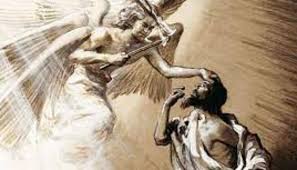
Then one of the seraphim flew to me, having in his hand a burning coal that he had taken with tongs from the altar. 7 And he touched my mouth and said: “Behold, this has touched your lips; your guilt is taken away, and your sin atoned for.” (Isaiah 6:1-7, ESV)
Teaching: Here is the great prophet Isaiah, and he is reduced to nothing spiritually. He is brought low under the sovereignty of God. Isaiah finally understood who God was. And then Isaiah accurately understood who he was–a sinner in need of grace. Otherwise, he would be consumed by the justice of God.
God saved Isaiah from God but also through God. This is the glory of the gospel. God demonstrated his holiness and his grace simultaneously.
God’s singular seraph came down, touched Isaiah’s mouth, and atoned for Isaiah’s sin (vv. 6-7). This is the gospel in the Old Testament. It’s God coming down, interposing his grace to the sinner, atoning for others’ sins (God doesn’t have sin), and redeeming his creation. Isaiah’s response was gratitude: “Here I am! Send me” (v. 8).
Encouragement: I’m not sure how anyone can miss this typology. It’s the gospel in Isaiah 6.
2 Corinthians 5:21 unpacks it even more explicitly: “For our sake he [God the Father] made him [God the Son, Jesus] to be sin who knew no sin, so that in him [God the Son, Jesus] we [sinners who repent and believe] might become the righteousness of God.”

