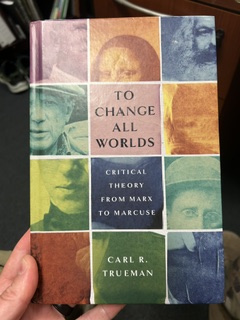
There are a few non-fiction writers and thinkers whose works I always read. Carl Trueman is one of those. Why? Several things set Trueman apart:
His grasp of the history of thought
His grasp of alternatives: “If not that, then this.”
His pattern recognition. He’s gifted at seeing and explaining the consequences of ideas. What begins in the academy ends up as a t-shirt slogan. And many people advertise a worldview whose underpinnings they’re often unaware of. They don’t see the connections. Trueman does.
His fidelity to Christianity as man’s only hope for redemption and restoration
His intellectual depth but his humble spirit
I know of very few people who are readers. And of those who do read, depth of content is often absent in their choices. Most folks doomscroll and entertain themselves into further imbecility and distraction. On the other hand, I do know of those who read deep, important books. And for those few, here’s another volume from which you will profit. It will likely sharpen your thinking and enrich your soul. Because like in all of Trueman’s books, he shows the genesis of good ideas and bad ones, and then traces the history of those ideas in how they play out in actual history. And as always, he calls the wisest among us to Scripture, to Christ, and to life.
Recently I completed another reading of the 150 psalms in Scripture. Psalms come in myriad genres. Below are some of those types:
Prophetic
Royal
Messianic
Celebration
Lament
Wisdom
Worship
There are other types, too, but those are some of the most common.
I was struck particularly by some verses from Psalm 145 recently:
17 The Lord is righteous in all his ways and kind in all his works. 18The Lord is near to all who call on him, to all who call on him in truth. 19He fulfills the desire of those who fear him; he also hears their cry and saves them. 20 The Lord preserves all who love him, but all the wicked he will destroy. (Ps 145:17-20)
Several thinks stood out from these lines from David’s pen:
The righteousness of God (v. 17)
The fellowship with God (v. 18)
The covenant faithfulness of God (v. 19)
The salvation of God (v. 20)
Because I’m burdened for those who remain hostile to God, because I want to reach them with the good news of the gospel, I try to always understand their worldview. I think, for example, of how a person who rejects God deals with the reality of cancer or loss or divorce. As a person who believes God and believes these biblical attributes of God described above, I am promised the righteousness of God, fellowship with God, God’s fidelity to his covenant promises, and the salvation of God.
But the unbeliever who rejects these truths, where does he find hope? In psychological pep-talks? In bubblegum bromides? In horoscopes? In sundry forms of escape and endless distraction?
God’s nature is characterized by covenant faithfulness. God cannot lie. Unlike sinners, God cannot lie. That is crucial to understand. And it is a truth that brings the believer solace of soul. In a world drowning in deceptions, the balm from Gilead is covenant faithfulness found only in God, a salve for the pilgrim’s soul.
Text: “He who goes out weeping, bearing the seed for sowing, shall come home with shouts of joy, bringing his sheaves with him” (Psalm 126:6).
Questions: Ever felt defeated? Ever felt like you left it all on the field but it wasn’t enough? Ever felt like your labors were in vain? Ever felt like, “Why bother? No one even cares”?
Possible responses: I think we’ve all felt some variation on that theme, at least sometimes. If we are honest, if we’ve labored at something with passion, with diligence, with love and concern, it is possible that at times we failed to see what we envisioned–at least in the timeframe we desired for it. I think, for example, of all the years Edison spent inventing–trying and failing, trying and failing. But eventually . . . success!
About verse 6 quoted above, the great Reformed preacher and evangelist George Whitefield wrote, “This, my dear brothers, is the greatest charity possible, to save a soul from death.”
Encouragement: In my favorite book of the Bible, Ecclesiastes, Solomon wrote this: “Cast your bread upon the waters, for you will find it after many days” (Eccl 11:1). Yes and amen. Let us labor in love, in truth, and trust the Lord for the results. He will not fail.
Coherence is an important word and idea. It denotes the degree to which something holds together. Is something logical? Does it hold together? Is it internally consistent? Does it correspond to the way things actually are? For example, if I say, “It’s sunny today in Atlanta,” but then you open your door and look outside and there’s a thunderstorm, the sky is darkened by ominous clouds, and there’s nothing but rain as far as you can see, well, then my statement does not cohere. It does not accurately reflect the way things are in reality. It does not correspond to reality.
Coherence is one of the tests for the trustworthiness of Scripture. God is holy; God cannot, therefore, lie. When God speaks, his Word is true. So when God said that all men everywhere are to repent and flee to the gospel of Christ Jesus to escape holy judgment, that word from God is true: “The times of ignorance God overlooked, but now he commands all people everywhere to repent, because he has fixed a day on which he will judge the world in righteousness by a man [Jesus] whom he has appointed; and of this he has given assurance to all by raising him from the dead” (Acts 17:30-31).
God’s Word coheres. It holds together. It accurately expresses the way God is, the way we creatures are, and the way the world is. God does not say one thing and do another. He is internally consistent. His nature, his Word, and his covenants are trustworthy. This is why the resurrection of Jesus from the dead welcomes investigation. No one has produced the body of Jesus, and no one will, until God’s promise is fulfilled. You can count on Christianity, dear ones, because God is coherent. And in an age that is as intellectually vapid as our day, coherence is a beautiful treasure.
Text: “The fear of the LORD is the beginning of wisdom; all those who practice it have a good understanding. His praise endures forever!” (Ps 111:10)
Context, Context, Context: Psalm 111 is characterized as a praise/thanksgiving psalm. Why? Because it heralds the holiness, justice, and mercy of God. It is only 10 verses in our English translations. Those 10 verses brim with praiseworthy works of God: righteousness (v. 3); grace and mercy (v. 4); provision (v. 5); covenant faithfulness (v. 6); faithfulness and trustworthiness (v. 7); redemption (v. 9); and holiness (v. 9). Then the writer does a mic drop: “The fear of the LORD is the beginning of wisdom” (v. 10a).
Teaching: Attributes of God are manifested. They are clear. They are obvious. They are irrefutable. But they’re not good news to those who suppress them and/or attempt to deny them. They are only good news to those who recognize them for the truth, goodness, and beauty that they are, and embrace them.
The reality is that many despise these truths. Just as one example, think of the 1987 ‘art’ piece by Andres Serrano, the Immersion (Piss Christ). It was a photograph of a plastic crucifix submerged in a plastic container of Serrano’s urine. Art or anger? Art or petulance? Art or just vitriol to stir up culture wars by those emanating more heat than light?
Encouragement: Solomon wrote in Proverbs 9:10 that “The fear of the LORD is the beginning of wisdom, and the knowledge of the Holy One is insight” and Psalm 111:10 reiterates this verity. Wisdom hinges upon an accurate reverential posture to the holy. The reason we have a world drowning in plastic bottles, refuse, needles, aluminum cans, and scarred and potholed roads is inseparable from the reality that people have cut themselves off from the sacred, the holy—namely, God. When they don’t value God, we should not be surprised they trash the creation. But for God’s people, we understand stewardship. We understand the value of beauty. We understand wisdom. Why? Because those concepts only make sense when God is at the center. God is the nexus for coherence, truth, goodness, and beauty. Without God, you inherit rubbish.
‘Twas a Sunday near my affections. We gathered at Christ Covenant Church (3cs-canton.org). We sat under an elder teach on the Doctrine of Man/biblical anthropology. We heard the Scriptures and read and discussed and taught. We heard from Scripture that man is the crown of God’s creation–either male or female–created by the spoken word of God in Genesis. So much hinges upon that. Man is not mere matter in motion–some random collocation of atoms bandied about on the winds of chance or nothingness. Nothing of the sort. He is a creature formed by God to know God and to have fellowship with him. But sin . . . Sin shattered that. The first Adam failed to obey. But God the Son, being rich in mercy, became the second and last Adam in Christ Jesus. All of grace–from beginning to end–and God says to us rebels, “Come and live.”
Then I taught on “Joy Amidst Suffering,” based upon 1 Peter 4:12-19. I don’t know that anyone benefits as much as the teacher, if he cares to do the study. We don’t know something until we can teach it well. Lord, help me to be a good student–then a good teacher–in that order.
Then we went and ate Chinese food at one of our favorite restaurants. The proprietor is so friendly. She is, as is her daughter, the girl who fetches our water and brings the wonton soup. Then we ate our sesame chicken, and Hunan chicken (spicy!), fried rice, and even cracked open the fortune cookies at the end of the meal.
Afterwards we returned home, let the dog out, checked on our son who’s down with a cold, changed into swimwear, and went to the pool for a couple of hours. The sun appeared and disappeared on and off again behind the clouds that flirted with possible thunderstorms, perhaps arriving during the night.
I read for the umpteenth time more of McCarthy’s Blood Meridian, and my bride reclined on a lounge chair, her brown skin absorbing the sun, as if a sponge.
We had my JBL speaker on the table, too, and streamed Spotify playlists of music from the 1970s-80s, and I watched the fellow pool patrons sing along with Hall and Oates, Kenny Loggins, and Bill Withers’ tunes. A father tossed a green and black football to his lanky, pale son in the pool. A grandmother read the first volume of the Harry Potter series near the steps of the pool. An older man in a swimshirt swam laps in the middle of the pool, his shoulders brown from sun.
I put my book down on the table, watched the people, watched the trees, and snapped a photo of one of the healthy maples around the pool.
Now I’m back home. My bride is off to some friends’ house to practice music for next week. We’re meeting at a local park as part of Memorial Day weekend. We’re playing games, eating, enjoying fellowship, and we’ll once again hear the teaching and preaching of the Scriptures.
The novel at my side calls again, and I’m near done with yet another rereading of this masterpiece. Our family dog, Ladybug, is snoring atop the pink blanket in “her chair,” and all is well during this Sunday snapshot. Lord, thank you for the simple pleasures.
Text: “Whoever is greedy for unjust gain troubles his own household, but he who hates bribes will live” (Pr 15:27). Proverbs 17:23 teaches much the same thing: “The wicked accepts a bribe in secret to pervert the ways of justice.” The lesson here is to have the wisdom to say no to the bride, to be unpurchasable.
In one of my favorite songs by Roger Waters named “Too Much Rope” he has the following lyrics:
When the sleigh is heavy And the timber wolves are getting bold You look at your companions and test The water of their friendship, with your toe And they significantly edge Closer to the gold Each man has his price, Bob And yours was pretty low
Bob was for sale, as it were. And it didn’t take much. Bob had his price.
It’s different strokes for different folks, as the cliche goes. For some people, it’s positional authority. They’ll compromise in order to gain it. For others, it’s money. They’ll fudge in certain areas or look the other way, if it benefits their bottom line. For others, it’s power. If they feel they can be viewed as “large and in charge,” their insecurites get validated in their spirit. Now they feel they finally have a seat at the table of importance.
This past week, someone came to me and said, “Hey, we have a soldier who needs a chaplain down at unit ______. Can you handle it?”
“Sure,” I said. “Do you have the contact info?”
I copied down the contact info, contacted the soldier, drove to meet him, spent about an hour with him, listened to him, gave him a summary of what I had understood him to mean, and offered some practical steps to help navigate the waters he was in. It was, in short, our bread and butter as chaplains–providing spiritual wisdom and religious support to soldiers. I loved it. It was “our lane” as chaplains.
Afterwards I followed up with the soldier again and then informed his chain of command that I’d gotten the soldier the help he had requested from a chaplain. Mission success.
But here’s the thing. There was nothing to be gained by me. I was just doing my job, my calling. The soldier got what he needed. The unit got their soldier back–and he was better off. There was no fanfare. The reward was simply knowing that I did my job. No money was involved. No publicity. No gamesmanship. Just doing my duty.
But what Solomon is driving at here is that some people don’t want to do the work; they want notoriety. They want the applause of men. They want to be seen as the savior-figure but they don’t want to put forth any effort. They want to be seen as caring and concerned, but they don’t actually care or demonstrate concern. They have the appearance of godliness but lack the character of such godliness. Paul says they go about “having the appearance of godliness, but denying its power. Avoid such people” (2 Tim 3:5). They dupe sheeple. They pimp the undiscerning for their own selfish gains.
A recurring theme in Christianity is wisdom–to understand the times and what God’s people are to do. Christians are commanded to seek wisdom and live wisely. A crucial part of wisdom is learning to discern the true from the false, to see through optics to the reality, to distinguish between mere appearance and the genuine. Lord, grant eyes to see, I pray, for blindness is pervasive.
This coming Sunday at Christ Covenant Church (3cs-canton.org), I am teaching the end of 1 Peter 4. This section of Peter’s first epistle is about fighting for joy amidst suffering.
Here is the last verse from chapter 4: “Therefore let those who suffer according to God’s will entrust their souls to a faithful Creator while doing good” (1 Pt 4:19).
About this theme of godly joy amidst sufering Richard Sibbes wrote the following:
It is the work of the flesh and blood to depart from God, but when a man goes to God it is a sign he has more than flesh and blood in him, for this cannot be done without a supernatural work of faith, which alone will make a sinful conscience fly to God, look to him as a father in Christ, and desire him by his almighty power, whereby he created heaven and earth, to create faith in the soul. And when you have cast your soul into the arms of the Almighty, labor to settle it there and to quiet yourself in the discharge of your duty; say thus, “Now I have done that which belongs to me; let God do that which belongs to him. I will not trouble myself about God’s work but in well-doing commit my soul to him alone with the rest.” Christians should not outrun God’s providence and say, “What shall become of me? This trouble will overwhelm me!” But serve his providence in the use of the means, and then leave all to his disposal. Especially this duty is needful in the hour of death, or when some imminent danger approaches; but then it will be a hard work, except it be practiced aforehand.
Suffering as a Christian is ordained to deepen our faith in the sufficiency of God. Pain is part of the providence of God whereby the Christian both sees his situation for what it is but simultaneously sees that it is temporal and designed to sanctify the believer, deepen his trust in the providence and sufficiency of God, refine him, purify him, shape him into a vessel fit for the potter’s hands.
Peter says we are to entrust our souls (v. 19). To whom? Does it say we’re to entrust our souls to happy-clappy psychological bromides and self-talk? No. He says we’re to entrust our souls “to a faithful Creator.” In other words, we’re to cast the nets of our trust onto the rock that is everlasting: God.
Pain and suffering as a Christian are ordained by God not that we would shake our fists at God in anger or resentment or despair, but that we would develop deeper understandings of the sufferings of Christ on our behalf, that we would grow more Christlike in faithfulness, humility, and service in the kingdom, knowing that God sees all and that the judge of all the earth does only that which is right.
For weeks now I have been reflecting upon Psalm 90. It is a prayer of Moses. Verse 2 reads, “Before the mountains were brought forth,/or ever you had formed the earth and the world,/from everlasting to everlasting you are God.”
From everlasting to everlasting, God remains. From everlasting to everlasting, God is constant. From everlasting to everlasting, God is steafast and sure. Amidst cancer, amidst leukemia, amidst bulging discs in the spine, amidst wayward children, amidst family strife, amidst false friends, amidst isolation and betrayal and corruption, from everlasting to everlasting, God is there–unchanging, holy, and certain.
Each week at our church we send out a prayer list. It is normally full of people requesting prayers for loved ones battling cancer of some kind, or back surgery, or some such. The focus is on bodily health. And that is understandable. Sickness is bad; no one that I’m aware of longs to be sick or to suffer.
Verse 9 of Psalm 90 reminds us that we are finite: “For all our days pass away under your wrath;/we bring our years to an end like a sigh.” The people recognize their sins and God’s anger and wrath towards that sin. They feel God’s just judgments against them. We don’t want to go too far, like Job’s three friends did, and imply that sickness is a direct result of an individual’s unconfessed sin. That would be presumptuous for fellow sinners to do. After all, God was the one who ordained Satan to afflict Job, in order to show Job’s genuine faith in the covenant faithfulness of God to his people. God was there throughout all of Job’s suffering, and God rewarded Job in the end and rebuked the shallow theology of Job’s three friends.
In Psalm 90, Moses prays in verse 12, “So teach us to number our days/that we may get a heart of wisdom.” This is one of those lines of Scripture that is burned into my soul. Learning to accept the reality of our finitude is to lead us to wisdom. And wisdom is to drive us to God, the fountain and spring of all wisdom.
Christ is called “the power of God and the wisdom of God” (1 Corinthians 1:24) in the New Testament. In sum, this beautiful prayer of Psalm 90 is to lead us to the person and work of Jesus, the Christ, the power of God and the wisdom of God.
Moses was a man who was likewise afflicted and acquainted with grief. He knew suffering. He knew frustration with the wickedness of the world system. He knew the loneliness of leadership. He knew rebellious and fractious people. Yet he endured. He persevered. He prayed that God would instruct him in how to number his days so that he would get a heart of wisdom. Why should we do any differently, if we are seeking to honor the Lord in the ways we live?
This morning after PT I was reading Scripture and meditating upon this verse: “Whoever loves discipline loves knowledge, but he who hates reproof is stupid” (Proverbs 12:1). That’s a straightforward statement and it is replete with wisdom. Follow me . . .
Defining the Terms:
Discipline in the noun form “refers to self-control, mental training, a specific field of study (academic discipline), or a system of rules for conduct. It aims to foster order, strengthen character, and ensure compliance.” Etymologically, discipline is rooted in the idea of “order necessary for instruction.”
Knowledge refers to “the awareness, understanding, or familiarity of facts, truths, principles, or skills acquired through experience, education, or study.” Etymologically, knowledge refers to “the capacity for knowing, understanding; familiarity;” also “fact or condition of knowing, awareness of a fact.”
Part of the wisdom of this one verse, however, hinges upon the condition and posture of the person. The person who “loves discipline loves knowledge,” the verse says. The necessary condition is one of proper affection. In other words, there must be a love of discipline, a love of knowledge. Otherwise, all is for naught. If the person is unteachable in spirit, you’re just spinning your wheels. You get no traction with such a person. It’s the sort of person who says, “I’m unteachable. No one can tell me what to do.” And there you have it. With such a spirit, he is correct. You can’t teach him. Why? Because he’s recalcitrant. He’s not interested. He is, in fact, hostile.
Think, for example, of Jesus speaking in the Gospels: “Why do you not understand what I say? It is because you cannot bear to hear my word” (John 8:43). Jesus shook the dust from his sandals, as it were, and drove on. Otherwise, it’s a casting of pearls before swine. The legalists could not bear the truth. Their affections were hostile to the truth. They hated it.
Encouragement: The Bible says that the person who hates reproof/correction is “stupid.” That’s strong language, but it’s right there in the text. So, we need to receive it as such. It’s God’s Word, not man’s. Discipline is inextricable from true freedom. We’re either slaves to truth or to lies. We’re either slaves to righteousness or unrighteousness. We’re either teachable by God or we aren’t. Our affections will reveal our allegiance.







 MIND & MATTERS