
Not Far Away

BLUF (Bottom Line Up Front): The litmus test for the true prophet

Introduction: This morning I was again studying the Old Testament Book of Jeremiah. Specifically, I was focused on chapter 23. The passage below is about the litmus test for the true prophet. That is, how we are to discern and distinguish the true from the false, the genuine from the charlatan.

Am I a God at hand, declares the Lord, and not a God far away? Can a man hide himself in secret places so that I cannot see him? declares the Lord. Do I not fill heaven and earth? declares the Lord. I have heard what the prophets have said who prophesy lies in my name, saying, ‘I have dreamed, I have dreamed!’ How long shall there be lies in the heart of the prophets who prophesy lies, and who prophesy the deceit of their own heart, who think to make my people forget my name by their dreams that they tell one another, even as their fathers forgot my name for Baal? Let the prophet who has a dream tell the dream, but let him who has my word speak my word faithfully. What has straw in common with wheat? declares the Lord. Is not my word like fire, declares the Lord, and like a hammer that breaks the rock in pieces? Therefore, behold, I am against the prophets, declares the Lord, who steal my words from one another. Behold, I am against the prophets, declares the Lord, who use their tongues and declare, ‘declares the Lord.’ Behold, I am against those who prophesy lying dreams, declares the Lord, and who tell them and lead my people astray by their lies and their recklessness, when I did not send them or charge them. So they do not profit this people at all, declares the Lord. (Jer 23:23-32, ESV)

Context, Context, Context: Jeremiah was God’s true prophet as distinct from the false prophets. Jeremiah was tasked with speaking uncomfortable truths about God’s righteeousness and judgment to a people who demanded psychological bromides of blessing from the lips of false prophets. Jeremiah spoke of war, invasion, and judgment. The false prophets kept saying, “Peace, peace” when there was no peace. The false prophets peddled a message that made hearers feel good, but their feelings were built on lies. Jeremiah, on the other hand, spoke truth, and people resented him for it. That’s a cost of being a truth-teller in a culture that demands comforting lies.

Encouragement: Jeremiah 23:28 is clear: ” . . . but let him who has my word speak my word faithfully.” There are many costs, dear ones, for being the genuine in a world of fakes. But in the end, it will all be worth it. God sees, and God will always do what is right.

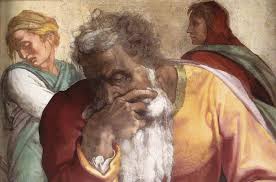
The Soiled Loincloth

BLUF: The Ruined Loincloth

Text: Thus says the Lord to me, “Go and buy a linen loincloth and put it around your waist, and do not dip it in water.” So I bought a loincloth according to the word of the Lord, and put it around my waist. And the word of the Lord came to me a second time, “Take the loincloth that you have bought, which is around your waist, and arise, go to the Euphrates and hide it there in a cleft of the rock.” So I went and hid it by the Euphrates, as the Lord commanded me. And after many days the Lord said to me, “Arise, go to the Euphrates, and take from there the loincloth that I commanded you to hide there.” Then I went to the Euphrates, and dug, and I took the loincloth from the place where I had hidden it. And behold, the loincloth was spoiled; it was good for nothing. (Jer 13:1-7, ESV)

Context, Context, Context: Jeremiah was God’s man to call out the sin of the nation. The people were idolaters, worshiper of Baal, self-centered pagans. Only a relatively faithful remnant of believers kept the faith in the one true God. And Jeremiah had the formidable task of calling his own people back to God, back to righteousness. Not an easy mission. God commanded Jeremiah to execute an object lesson whose message would be overt.

Encouragement:  Once again, Jeremiah faithfully executed his mission from God. The soiled loincloth was just that—soiled—after Jeremiah retrieved it from the river. Like the cloth, the nation had become soiled. They were dirty; they needed to be cleaned. Yet they refused. Again, think about the battle to trust the Lord that Jeremiah was enduring. This mission he’d been given was a far cry from the false gospels peddled in our day from the prosperity preachers, who look like they spend more time in front of their mirrors than in the Scriptures. But God was gracious, you see. How? By sending his servant, the prophet Jeremiah, with the only truth sufficient to clean the soiled garments of our sins. God is gracious, but God is simultaneously holy. Those two attributes must both be understood about the unchanging God of Scripture.

Chaplain Daily Touchpoint #287: Loving People Enough to Tell Them the Truth (Lovingly)

Bottom Line Up Front: Self-Sacrifice for the Truth: Love People Enough to Warn Them

Text: In Jeremiah 7, the great Old Testament prophet Jeremiah spoke the word of God to the people he loved:

7 The word that came to Jeremiah from the Lord: 2 “Stand in the gate of the Lord’s house, and proclaim there this word, and say, Hear the word of the Lord, all you men of Judah who enter these gates to worship the Lord. 3 Thus says the Lord of hosts, the God of Israel: Amend your ways and your deeds, and I will let you dwell in this place. 4 Do not trust in these deceptive words: ‘This is the temple of the Lord, the temple of the Lord, the temple of the Lord.’

5 “For if you truly amend your ways and your deeds, if you truly execute justice one with another, 6 if you do not oppress the sojourner, the fatherless, or the widow, or shed innocent blood in this place, and if you do not go after other gods to your own harm, 7 then I will let you dwell in this place, in the land that I gave of old to your fathers forever.

8 “Behold, you trust in deceptive words to no avail. (Jer 7:1-8, ESV)

Encouragement/takeaway: Recently when teaching the saints, I was again struck by the consistent teaching of God in Scripture about the costs involved for being a person of truth. Jeremiah endured a staggeringly difficult prophetic ministry. But he was God’s man in his season. He was one of many in a long line of Godly men and women, who had counted the costs, and who took up the struggle, casting it all on the providence of God. Jeremiah loved his people enough to tell them the truth, to try and reach as many as God would enable him to reach, to say hard things but with a loving heart/motive; namely, their salvation and redemption. Jeremiah told the people not to trust in deceptive words. He preached that message again and again. And you’ll remember what happened; most ‘shot the messenger,’ if you will. Most didn’t want the truth. Instead, most put their heads in the sand, and divine judgment fell upon the nation. But Jeremiah was proven to be right, was ultimately preserved by God, and went down as one of the greatest of the prophets of God. Do we think our generation is smarter than Jeremiah’s? The question answers itself. There’s sacrifice involved in loving people enough to tell them the truth, and to do so lovingly.