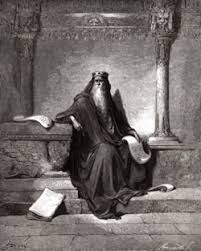
Solomonic Wisdom

BLUF: The Vanity of Self-Indulgence

Context: Ecclesiastes 2 is the passage. The context is that of wisdom literature. The wisest man, Solomon, is penning a book of wisdom. Here’s a man, but not just any man. Solomon is king. He is unspeakably wealthy. And he is pagan at this point. He is living for his flesh. He does not fear the Lord or have godliness in his sights. He worships at the altar of self. And we are to learn from his poor example. We can learn from all people—especially from those whom we do not wish to emulate. The sort of man described in Ecclesiastes 2 is just that—a type to avoid. Why? Because his love is himself—not God, not others, not the organization, not the unit, not some ideal. He is given over to self.

Text: “And whatever my eyes desired I did not keep from them. I kept my heart from no pleasure . . .” (Eccl 2:10).

Encouragement: I love the Book of Ecclesiastes for sundry reasons. One of the reasons is because of its transparency, its rawness. In Solomon, we see an Everyman. That is, he illustrates the universal human condition. We all must battle the temptation to put ourselves at the center of the story. We want to see ourselves as the protagonist, the hero. But Solomon is teaching through the Book of Ecclesiastes that it’s the fool who sets himself up as God. Why? Because we’re all sinners. Unless and until God grips us savingly, we’re idolaters. The encouragement is this: Ecclesiastes does not end with chapter 2. It ends with chapter 12. Until we arrive there, we need to keep short accounts with God who sees our motives. It’s not the wise person who worships at the alter of self; that’s the fool. The wise person knows that he/she is very much the clay and that God is the Potter. And we are wise insofar as we rest in the Potter’s hands.


Chaplain Daily Touchpoint #466: The Paradox of Wisdom (Ecclesiastes for Today, Part 3)

Intro: Currently at church, I’m beginning a 12-week series through the Old Testament book of Ecclesiastes. For many years, it has been my favorite book of the Bible. Why? To some degree, it is because it is literary and poetic in genre. It’s not a straightforward narrative of a battle, or crossing a body of water, or healing a leper, or epistolary literature about how the New Testament church is to be governed. None of that. Ecclesiastes is part of the wisdom literature. It’s more nuanced. It’s written by a man who went from hero to zero many times, and then back again—Solomon. Solomon was wise beyond his years. He gained unprecedented wealth and reign. People traveled just to come see Solomon’s Temple, his riches, his kingdom, etc.

Segue: But then you get a book like Ecclesiastes. And what you find there is a series of mood pieces and reflections upon a life that has seen many highs and many lows. In Ecclesiastes 1, for example, we read the following:

      I said in my heart, “I have acquired great wisdom, surpassing all who were over Jerusalem before me, and my heart has had great experience of wisdom and knowledge.” And I applied my heart to know wisdom and to know madness and folly. I perceived that this also is but a striving after wind.

                                             For in much wisdom is much vexation,

                                                And he who increases knowledge increases sorrow (Eccl 1:16-18, ESV)

Teaching: The paradox is striking. Here’s Solomon, wise beyond all other men, and we would think his mood would be one of joy. His heart, he writes, “has had great experience of wisdom and knowledge” (v. 16). And yet he found that they—though noble and proper pursuits—were also vanity/wind/hebel (Hb.). Even in wisdom, Solomon was well acquainted with sorrow. Because he saw into the heart of the matter, he grieved over it. That’s what he means by, “And he who increases knowledge increases sorrow” (v. 18b). It’s much more convenient to skate upon the surface of life, to doomscroll from one image to another, to plug your ears with earbuds conveying only the views with which you agree. Postman wrote years ago a wonderful book, Amusing Ourselves to Death. I have found it prophetic. How? Well, we’re living in a time when many have entertained themselves into imbecility. Ask a person what shade of red lipstick Taylor Swift is wearing today, and he or she would be engaged. But ask a person the last deep book he/she read, and enjoy the hum of crickets.

That’s what Solomon’s driving at; he understands viscerally the fallenness of the world—that wisdom entails more than a taste of sorrow, because human fallenness is the most empirically verifiable reality. Solomon knew it, and that’s part and parcel of wisdom—learning to admit the reality of fallenness in this world.

Encouragement: Learning to live with the paradox of wisdom is less easy than one might wish for. There is wisdom in hoping for good from ourselves and others. At the same time, however, there is wisdom in being realistic about human nature and knowing the condition of the flocks with which we are dealing.

Chaplain Daily Touchpoint #464: Ecclesiastes for Today (Part 2)

Text: 

I said in my heart, “Come now, I will test you with pleasure; enjoy yourself.” But behold, this also was vanity. I said of laughter, “It is mad,” and of pleasure, “What use is it?” I searched with my heart how to cheer my body with wine—my heart still guiding me with wisdom—and how to lay hold on folly, till I might see what was good for the children of man to do under heaven during the few days of their life. I made great works. I built houses and planted vineyards for myself. I made myself gardens and parks, and planted in them all kinds of fruit trees. I made myself pools from which to water the forest of growing trees. I bought male and female slaves, and had slaves who were born in my house. I had also great possessions of herds and flocks, more than any who had been before me in Jerusalem. I also gathered for myself silver and gold and the treasure of kings and provinces. I got singers, both men and women, and many concubines, the delight of the sons of man (Eccl 2:1-8, ESV). 

BLUF (Bottom Line Up Front): Know the condition of the well from which you drink. 

Context, Context, Context: Ecclesiastes is part of the ‘wisdom literature’ in Scripture. Its goal? Wisdom–to lead the wise from fruitless pursuit of wisdom under the sun to true wisdom in the Son. Solomon is a magnificent case study. He went from hero to zero many times. But he, in my view, finally got it right. Wisdom drives the Christian pilgrim to Christ, wisdom personified and incarnated. 

Connection: Who among us has not played the fool? Haven’t we all been like Eliot’s Prufrock at least once? I certainly have-more than once. Who among us has not fallen prey to pursuing stuff, promotion, popularity, power, wealth, status, etc., only to find we felt worse after the shine wore off? 

Encouragement: Solomon is one of my enduring favorites from history. Why? Because he’s an “Everyman.” He ‘gets us’ to use modern parlance. He’s shot through with our sins, our patterns, our fallenness, our proclivities. 

But here’s the good news: Chapter 12 is coming. Why’s that important? Because Solomon finally seemed to get it into his own stubborn head. Anybody else out there have the honesty to admit we’re all a lot more like Solomon than we differ from him? We pursue stuff, promotion, the approval of the sheeple, wealth, etc. There’s really no end to our idols. But what does it profit a man if he gains the whole world but forfeits his soul (cf. Mt 16:26)? The question answers itself. 

Chaplain Daily Touchpoint #289: Solomonic Wisdom

Introduction: If you have been a committed reader for many years, you discover the books have accumulated, and you end up having to either downsize the library (heresy!) or build new bookshelves (yes!), or perhaps continue to give books away to those you hope will read them. I’ve done each of these things over the course of years, but there’s one book within the Book of books, of which I never tire: Ecclesiastes.

Why Ecclesiastes? Well, in just twelve chapters, I discover again and again a mysterious comfort when my soul is troubled. Today, for example, I was ruminating over the last words of Ecclesiastes 9. The issue addressed here is wisdom amidst an environment of folly.

Here’s the passage:

I have also seen this example of wisdom under the sun, and it seemed great to me. There was a little city with few men in it, and a great king came against it and besieged it, building great siegeworks against it. But there was found in it a poor, wise man, and he by his wisdom delivered the city. Yet no one remembered that poor man. But I say that wisdom is better than might, though the poor man’s wisdom is despised and his words are not heard. The words of the wise heard in quiet are better than the shouting of a ruler among fools. Wisdom is better than weapons of war, but one sinner destroys much good (Eccl 9:13-18, ESV),

Admittedly there is a shade of resignation involved in the tone of the above passage. But the more I study this book, I think that’s central to a correct understanding of the book’s theme. Please don’t misunderstand. All the ‘vanity of vanities’ sections are to warn of the endless follies of secularism, hedonism, and idolatry. Those refrains are emphasized throughout the book, so that is central to a correct understanding of the book’s theme. By the way, Solomon states his theme overtly in the closing verses of the book: “The end of the matter; all has been heard. Fear God and keep his commandments, for this is the whole duty of man. For God will bring every deed into judgment, with every secret thing, whether good or evil” (Eccl 12:13-14, ESV).

What I am driving at here, however, is that Ecclesiastes reminds me that the spiritual battle is vastly too much for me. That is, the forces of good and evil are indeed cosmic in scale. That’s what Paul labored so much in Ephesians. In the words I quoted above from Ecclesiastes 9:13-18, I appreciate so much what the Scottish writer Robert Buchanan observed:

“War wounds, but wisdom heals. War and all its weapons belong to the bloody brood of him who was a murderer from the beginning; wisdom is the attribute and gift of him who came to bring peace on earth, good will to all, and glory to God in the highest.”

Takeaway: In other words, wisdom. That’s what Solomon, a man who went from hero to zero many times, teaches: wisdom. But the tinge of sadness, the limning resignation that surrounds Ecclesiastes like a border, remains. Wisdom entails a certain element of, as Vonnegut phrased it in one of his books, “and so it goes” concession. It’s a way of accepting that in this life, we must, if we are wise, accept our limitations. It is hubristic for us sinners to think we can make others wise; it’s hard enough to gain wisdom in our own lives. In sum, humility is called for. Even though wisdom is better than might, Solomon reminded us, the poor man’s wisdom is “despised and his words are not heard” (Eccl 9:16, ESV). Learning to live beautifully in a broken world marks a wise life.