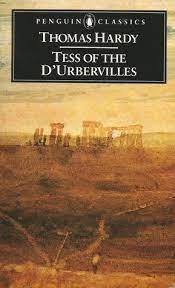
I have been under the weather of late, and so have had to take a knee away from fellow soldiers, and surround myself instead with a myriad of medicines to try and kill this latest round of coronavirus. I have had Tess to keep me company, though. I finished it again this evening. Not a fast-paced novel to be sure, but it contains some of the most beautiful nature writing I know of in English. Below is an example:
The only exericse that Tess took at this time was after dark; and it was then, when out in the woods, that she seemed least solitary. She knew how to hit to a hair’s-breadth that moment of evening when the light and the darkness are so evenly balanced that the constraint of day and the suspense of night neutralise each other, leaving absolute mental liberty. It is then that the plight of being alive becomes attenuated to its least possible dimensions. She had no fear of the shadows; her sole idea seemed to be to shun mankind–or rather that cold accretion called the world, which, so terrible in the mass, is so unformidable, even pitiable, in its units.
On these lonely hills and dales her quiescent glide was of a piece with the element she moved in. Her flexuous and stealthy figure became an integral part of the scene. At times her whimsical fancy would intensify natural processes around her till they seemed a part of her own story. Rather they became a part of it; for the world is only a psychological phenomenon, and what they seemed they were. The midnight airs and gusts, moaning amongst the tightly-wrapped buds and bark of the winter twigs, were formulae of bitter reproach. A wet day was the expression of irremediable grief at her weakness in the mind of some vague ethical being she could not class definitely as the God of her childhood, and could not comprehend as any other (75).
I differ markedly with Hardy on theological questions about God, but for the revealing of character via imagery and setting, Hardy is stunning. He recognizes beauty; he recognizes the spectacle of creation, but his naturalism occluded his seeing, at least from my view, the author of beauty.
Wisdom from Patton: When I was in a bookstore near Camp Shelby, Mississippi some time back, I picked up another book on Patton. Like a lot of soldiers, I have read shelves of books on military history, of various battles, and myriad campaigns. But the older I get the more I tend to relish biographies. Anyway, in this particular book on Patton, he (Patton) was quoted as saying, “I don’t measure a man’s success by how high he climbs but by how high he bounces when he hits bottom.”
Connection: A buzzword today in military chaplaincy, mental health, behavioral health, and other related areas is this: resilience. It’s so often said in my circles, I almost wish the thesaurus was bigger for it to garner some synonyms. But Patton put his finger on it via his one-sentence zinger.
Like scores of others, I’m certified as a Master Resilience Trainer, trained in Spiritual Wellness, and of course in my own theological background. But the bottom line is this: Resilience relates to the foundation of what it means to be human and how we relate to the transcendent. Otten in our Army literature, the soldier’s wellness measurements are divided into four main areas: 1) Spiritual; 2) Physical; 3) Social; and 4) Emotional.
I have no issue with that particular division. I would only add that these areas only make sense when we recognize that they exist because they are designed, and design presupposes a designer. To discount, ignore, minimize, or obfuscate the theological reality that pervades every worldview undermines the very resilience we are pursuing. Put plainly, there is always a God of the system in every paradigm for understanding human psychology. The very word psychology literally means the “language” (logos/λόγος) of the “soul” (psuche/Ψυχή).
Encouragement: Solomon penned, “for the righteous falls seven times and rises again, but the wicked stumble in times of calamity” (Pr 24:16 ESV). Resilience, bouncing back and continuing on to fight another day, getting back in the fight, etc. has a moral component, in other words, and that moral component is inseparable from the designer of transcendental morals, the one who is goodness himself, the Alpha and Omega (Rev 22:13).
Context: Recently I was reading through Isaiah again. It contains perhaps the most beautiful literary excellence in all of Scripture. Many of the psalms, of course, could easily lay claim to the same description. But In Isaiah 51 and 52, for example, God is speaking through his prophet Isaiah about the nation’s spiritual and moral condition:
17 Wake yourself, wake yourself, stand up, O Jerusalem, you who have drunk from the hand of the Lord the cup of his wrath, who have drunk to the dregs the bowl, the cup of staggering. 18 There is none to guide her among all the sons she has borne; there is none to take her by the hand among all the sons she has brought up. 19 These two things have happened to you— who will console you?— devastation and destruction, famine and sword; who will comfort you? (Isaiah 51:17-19 ESV)
The imagery is straightforward enough. The nation is morally wretched. Rotten. The people are in a stupor, as if drunk. They are drunk with sin. They cannot stand upright. Their balance is taken from them due to what’s controlling them. The people tend to think that it’s the other nations who are to blame for their condition. But it’s not other nations’ fault. It’s their own moral corruption, and God is using foreign armies, invasions, and their own state of being conquered as divine judgments for their sin and moral dissoluteness.
That is the power of Scripture; it does not sugarcoat what people and nations are like. It reveals not only what has happened, what will happen, but what always happens. God judges sin. We either bear the penalty ourselves or we flee to the one who has borne it for all who will come: Christ.
Segue and Encouragement: The cup of staggering, you see, was God’s judgment upon people for their sin, but it was designed to lead them to repentance and to a return to the one who ultimately redeems: Christ. Listen to God speak through his prophet Isaiah:
Thus says your Lord, the LORD, your God who pleads the cause of his people: “Behold, I have taken from your hand the cup of staggering; the bowl of my wrath you shall drink no more” (Isaiah 51:22 ESV)
You see, God himself would ultimately drink the cup of staggering. It was the cup of God’s wrath against sin. You remember Jesus’s words to Peter, right? “[S]hall I not drink the cup that the Father has given me?” (John 18:11 ESV) Christ did drink the cup of wrath. It’s called the cross. It’s where justice and mercy meet. It’s the demonstration of the cup of staggering being poured out upon the one who didn’t deserve it but became sin and the sin-bearer for all who will trust in Christ alone for redemption. All of Scripture coheres, you see. It’s telling one unified story of what God has done to both judge sin and offer reconciliation to us sinners.
The Danger: Ever been so familiar with something that you come to believe it’s less dangerous or threatening than it once was over you? The reason I pose the question is because I am trying to teach through Jesus’ Sermon on the Mount at our church. It is arguably the most oft-referenced but least-heeded sermon in world history. Just think, for example, of these familiar words from Christ himself: “You are the salt of the earth, but if salt has lost its taste, how shall its saltiness be restored? It is no longer good for anything except to be thrown out and trampled under people’s feet” (Mt 5:13 ESV). A danger, I think, is that we can quote something, reference something, give lip service to a doctrine, etc. but discount or underestimate its power.
Connection to Our Culture: For the last two weeks, I have not followed the news at all. I have to take a break from it periodically because I invariably end up shaking my head, saying, “There’s no way this is really happening in my country …” and yet, yup, it is happening. The 15 December 2023 video of a Maryland Senator’s staff person and what he did on camera in America’s Senate Hearing Room is surely enough to convince even the most Pollyannaish Americans that some people have clearly abandoned any sort of self-discipline, decency, and decorum. It was like something out of a parable of the absurd. Yet it was reality. It seems that any sense of shame has been abandoned and even scoffed at.
A Sincere Series of Questions: Here’s what this has to do with Matthew 5:13 that I quoted above. In that verse and in the whole passage of the Sermon on the Mount, Christ warns Christians that if their witness has lost its taste, it’s to be thrown out and trampled underfoot. That is, if one’s testimony undercuts his/her profession, he is actually an enemy of the truth, and is good for nothing but to be tread upon. It’s an image of judgment, of being turned over and abandoned by God. It is, in short, heartbreaking because it’s the wrath of divine abandonment. But that is what Christ taught.
And now some questions: First, have we come to the place as a culture where there is no fear of God? Second, if we have, do we actually have the temerity to assert that God’s standards change? (Hint: open theism is a longstanding heresy.) Third, what does history teach about the trajectory of nations who abandon God and mock the sacred? Fourth, will we survive to see God raise up faithful prophetic voices to call people back to the foundation of righteousness?
I have my own views, of course, but I write this with a heavy heart for a nation I, along with thousands of other patriots, serve and love, especially in terms of her (America’s) founding principles and documents, and the call to be a beacon of hope rather than something vastly different. There is danger—quite serious danger—in spitting in the face of all that is good, right, and holy. And I grieve for my country. We are better than this. May God grant us the ability to repent and return, because I fear the alternatives are much costlier.
Introduction: Carrie Jane closed her door to the car; I closed mine. And the question of whose music we’d listen to commenced. She said, “We need to fill our souls. Let’s listen to the Gettys.” She got no argument from me.
Then Keith Getty’s piano sounds streamed from the speakers, and Kristyn’s angelic voice poured like aural honey from the honeycomb. That is the power of music. I don’t know of a more unifying, powerful instrument to capture the core of a person or group.
Among my loves supreme is language. Scripture, the ultimate book, has much to say about language and the supremacy of the Word incarnate, and also of the power of language: “A word fitly spoken is like apples of gold in a setting of silver” (Pr 25:11 ESV). I’m much more at home with a copy of O’Connor’s short stories or with A Tale of Two Cities than I am most other things, but I concede that there is nothing quite like the power of some music to wield a nearly-divine effect upon our emotions. The first chord–sometimes just the first note–sounds the strings of our souls.
Question: Why do I raise this issue of the power of music? Is it worthy of such augmentation? Yes and amen. Why? Perhaps I can best explain my view via illustration.
Illustration: Today at church, after I had fumbled my way through trying to dive into the first verses of Jesus’ Sermon on the Mount in Matthew 5, I needed to be redeemed. I felt I had totally blown it in terms of teaching on such a magisterial text. I got choked up publicly. So many of my hours of study washed over me as I unpacked words so familiar to me. My years of reading of how Luther wept over his own sin while studying his NT in Greek, then translating it for his fellow Germans, of how he rediscovered the gospel of grace, of how he’d been caught up in Roman Catholicism as an Augustinian monk, of how he had the biblical courage to take on Roman Catholicism’s pomp and popery, overtook me, and the tears came, etc. For all his faults, Luther understood what it meant to be a sinner redeemed by the sufficiency of Christ alone. Any system was man-centered. The gospel was and is God-centered, and on behalf of sinners, and that distinction is at the heart of redemption.
So many hours of reading how Luther and other Reformers wrestled with the text of Scripture itself, and of how they came to understand the text by virute of what it clearly taught: it is God’s unmerited favor towards sinners and Jesus’ vicarious, substitutionary atonement for his people, and of our repentance of our sin and faith in Christ alone, that redeems us. It’s not saints, or Mary, or works, and most certainly not any self-professing vicar of Christ adopting the nomenclature of vicar or substitute or mediator. No, it is Christ alone. He is the only mediator. Popes are sinners; Christ is God made sin on behalf of his people; that difference is crucial and non-negotiable.
Then it happened … Today was so special in the morning service after Sunday school. We weren’t artificially divided by age or demograhic. There wasn’t a ‘traditional’ vs. a ‘contemporary’ service. I entered corporate worship service with saints of all ages, of all skin tones, of all maturity levels, of babes in Christ, and of seasoned saints. And we all sang together.
I was one of many with gray hair who sang adjacent to people much younger. And we lifted our eyes and we followed the talented musicians and singers in front of us. And they, too, were a congregation of called-out ones–men and women, boys and girls, black, white, brown, and yellow. Short and tall, thick or lean, they all sang. Why? Because they were the called-out ones, and they were gathered together in an assembly. That’s what the word denotes: called out and together. Congregation means just that: an assembling together, union, society.
We sang of the God-man, Christ the Lord, who was the promised seed of Jesse who was pierced for our transgressions and crushed for our iniquities. We sang of what it means to have walked in darkness but then to have been granted the ability to see the great light because the Light has shone on them.
We sang, in short, together. As a body. As a diverse body who comprised a congregation. We were not divided like slices of pie into children, youth, young adults, senior adults, etc. No. We were a body of ransomed believers singing to our Redeemer together.
Encouragement: What I am aiming for is surely evident. Songs sung by the body of the redeemed are precious and foundational. Young, old, and all of us in between. Girls, boys, men, and women–sinners all, but redeemed ones, singing of their common Redeemer. This is the biblical congregation–a song embodied.
I was at the kitchen table this morning and looking over my studies in preparation for teaching from Matthew 5, and I saw this handsome fellow browsing out back and chasing a doe.
Introduction: What an honor to be part of today’s event and be surrounded by remarkable patriots, and be reminded visually of the veterans and families who have come before us.
I was honored to place the Army wreath at the ceremony as a way of honoring my branch of service. To my left and right were men from the Navy, Air Force, Marines, Coast Guard, and Space Force.
When I am surrounded by men of this ilk, it still moves me. I relearn why I’d do it all again.
And we were surrounded by wonderful patriots like the Patriot Guard Riders, American Legion, families, and veterans from all the branches of service.
A choir sang Christmas carols. A high school Air Force JROTC color guard posted and retired the U.S. Colors.
CPT Tommy Clack spoke. I’ve heard Tommy speak several times before. Each time, however, his testimony moves me. He lost both legs and one arm to a grenade in Vietnam in 1969. Yet here he is, still serving. Speaking into a microphone held by his one remaining hand, dependent upon his wheelchair to move about, with his Army patches and quotes from John 15 on his gear, Tommy still serves.
Below are a few scenes from the cold morning. Thankful for all those who made it happen again with such honor, power, and selfless service.
A Hymn: I am no different than countless other lovers of great Christian hymns. One of the greatest is “Great Is Thy Faithfulness.” Its biblical referent comes from Lamentations:
The steadfast love of the Lord never ceases; his mercies never come to an end; they are new every morning; great is your faithfulness (Lam 3:22-23 ESV).
Slice of Life from the Airport: Recently I was in the airport to catch another flight, this time to the upper Midwest where I was flying in order to teach fellow soldiers in a curriculum I often use. Plus I was slated to link up with new leadership at a couple of units. I was very glad to be going and doing what I adore doing–ministering to soldiers and their families.
I was in uniform and went through TSA pre-Check quickly and without incident. I stopped at one of the breakfast shops and purchased a breakfast biscuit. I went to a quiet corner and sat down and ate my breakfast bisuit. After I ate, I walked over to the recycle bin and deposited the bag and wrapper from my breakfast there, and walked over to the water fountain to refill my water bottle.
I walked down the corridor to the terminal from which my flight was departing soon. I retrieved the James Sire book I was re-reading from my backpack and resumed reading. I had read no more than a page when a kind lady sitting behind me spoke to me.
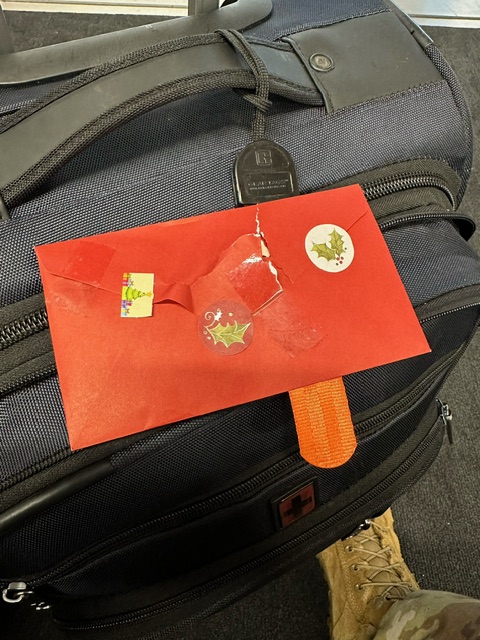
“Sir, may I bless you?” and she handed me a red envelope with stickers and tape on it. “Merry Christmas,” she said.
“Thank you, ma’am,” I said.
I put the envelope inside my backpack and returned to my book. I read for fifteen or twenty minutes, and then began thinking maybe I should open the envelope. I thought she might be offended if I did not open it. So I unzipped the pocket on my backpack and opened the red envelope.
When I did, I was floored. There was a kind message, two gift cards to a coffee shop, a Chick-fil-A gift card, and even some cash.
I am sure that my face showed how touched I was. I tried to gather myself, but I had been deeply touched. I put the contents back in the card, then back in the envelope, then back in my backpack. I folded my hands as if in prayer seemingly automatically, as if just to say, “Lord, thank you for people like this that speak into my life.”
Then the man came on the intercom over at the Delta desk for military members to board. I turned to the woman again as I put on my backpack.
“Ma’am,” I said, “I really appreciate it. Thank you, again.”
“Thank you for your service, sir. Merry Christmas,” she said.
And I boarded the plane, pulled out my book again, tried to read, but inwardly all I was doing was shaking my head in gratitude, thankful for the visible reminders that kindness endures.
Text: “But as he [Joseph] considered these things, behold, an angel of the Lord appeared to him in a dream, saying, “Joseph, son of David, do not fear to take Mary as your wife, for that which is conceived in her is from the Holy Spirit” (Matthew 1:20 ESV).
Why it matters: Why does understanding the accuracy of Jesus’ incarnation matter? Why does Matthew write of Holy Spirit overshadowing Mary? Why does he labor the fact that Joseph and Mary had not consummated their engagement and future marriage? Because it goes to the very heart of Jesus as the Christ. Christ simply means “Anointed One” or “Messiah.” Jesus took on flesh, but his incarnation was by way of God, not by Joseph. In other words, the human bloodline of sin was broken by divine fiat. This is fundamental to an accurate understanding of Christianity.
Remembering an old deacon’s prayers: When I was courting my wife and attending her church, I was brought into the fold by that congregation in a way I have ever since tried to emulate. That church body knew how to love folks, and they did it. I have never forgotten how I was loved there and I have tried to replicate that in my ministry now in our church. There was an old deacon at my wife’s home church who, when he prayed, always said much the same thing. It went something like this: “Lord Jesus, we come to you in thanksgiving for doing what we could never do for ourselves. By breaking the sin chain of Adam, we now have access to God …”
Folks, that was by a country man who never had a college education, but he had bull’s-eye theology when it came to Christology. He understood that God the Son’s conception via the Holy Spirit was the last Adam (Jesus) coming to do what the first Adam in Genesis failed to do—namely, obey perfectly the will of God. The gospel hinges on the perfect substitutionary atonement and righteousness of the God-man, Jesus, the Christ. He is the anointed one. He is the messiah.
This is why Matthew 1:20 is fundamental. This is why Christmas is to be celebrated. It’s because God has come to reclaim a cosmos that is now east of Eden due to the fall of man in Genesis 3. Christ has come “to his make his blessings flow, far as the curse is found,” as Watts penned. This is why Joseph was told that the Son in Mary’s womb was from the Holy Spirit–to show him (Joseph), to show the world, that God was keeping his covenantal promise to crush the head of the serpent by way of the seed of the woman, and that seed was Christ. Merry Christmas.
Introduction: I tend very much to avoid what I call “calendar theology” discussions. Why? Well, some folks can become rather heated and emotional regarding what they believe about when such-and-such will occur, and even about what has already occurred, and about ‘what’s next’ to unfold, etc. I am old enough to have witnessed countless prophecies of so-and-so being the antichrist, and about such-and-such being the mark of the beast. As just one example, I remember Harold Camping’s numerous predictions. Well, Harold has come and gone, of course, but his ilk has been replaced by more of the same. It’s a cottage industry in a way; it seems some in each generation are convinced their generation is special, that theirs is the one, that signs and wonders are there for the astute, and they can hear Gabriel licking his lips as he prepares to announce the next great event.
There are so-called Bible teachers and pastors who make a lucrative living off beating the calendar theology drum. Book after book is churned out about empires, about political figures, about the whore of Babylon, about personalities of the day, whether they be Barrack Hussein Obama, the various popes of Roman Catholicism, Bill Gates, Hillary Rodham Clinton, Elon Musk, et al. The list goes on. Some in each generation latch on, saying, “Yes, this is it.” Somehow passages from Ezekiel, Daniel, and Revelation find fulfillment in each generation’s calendar theologians.
Examples from 2 Thessalonians:
Even around A.D. 51 the apostle Paul was having to address calendar theology while the New Testament was still being written. Why? Because there was a lot of emotion, some persecution of Christians, and a falling away of many who professed to be believers but were revealed not to be. The first eleven verses of 2 Thessalonians 2 are clear in why Paul was so concerned for the recipients of his epistle. Folks were easily alarmed and often discouraged because their attention was fixed more upon political events than upon the gospel and the Lord Christ:
Now concerning the coming of our Lord Jesus Christ and our being gathered together to him, we ask you, brothers, not to be quickly shaken in mind or alarmed, either by a spirit or a spoken word, or a letter seeming to be from us, to the effect that the day of the Lord has come. Let no one deceive you in any way. For that day will not come, unless the rebellion comes first, and the man of lawlessness is revealed, the son of destruction, who opposes and exalts himself against every so-called god or object of worship, so that he takes his seat in the temple of God, proclaiming himself to be God. Do you not remember that when I was still with you I told you these things? And you know what is restraining him now so that he may be revealed in his time. For the mystery of lawlessness is already at work. Only he who now restrains it will do so until he is out of the way. And then the lawless one will be revealed, whom the Lord Jesus will kill with the breath of his mouth and bring to nothing by the appearance of his coming. The coming of the lawless one is by the activity of Satan with all power and false signs and wonders, and with all wicked deception for those who are perishing, because they refused to love the truth and so be saved. Therefore God sends them a strong delusion, so that they may believe what is false, in order that all may be condemned who did not believe the truth but had pleasure in unrighteousness (2 Th 2:1-11 ESV).
Paul loved the people. So he encouraged them. How did Paul do that? Listen to his very next paragraph to them: “So then brothers, stand firm and hold to the traditions that you were taught by us, either by our spoken word or by our letter” (2 Th 2:15 ESV). Stand firm.
Examples from Ephesians:
It’s the same verb phrase he uses repeatedly in the New Testament:
“Put on the whole armor of God that you may be able to stand against the schemes of the devil” (Eph 6:11 ESV)
“Therefore take up the whole armor of God, that you may be able to withstand in the evil day” (Eph 6:13a ESV)
” . . . and having done all to stand firm” (Eph 6:13b ESV).
“Stand therefore . . .” (Eph 6:14a ESV).
And on and on it goes.
The apostle John gives the same reminder in Revelation after Christ reveals what must take place prior to Christ’s second coming in judgment:
I, John, your brother and partner in the tribulation and the kingdom and the patient endurance that are in Jesus, was on the island called Patmos on account of the word of God and the testimony of Jesus. I was in the Spirit on the Lord’s day, and I heard behind me a loud voice like a trumpet saying, “Write what you see in a book and send it to the seven churches, to Ephesus and to Smyrna and to Pergamum and to Thyatira and to Sardis and to Philadelphia and to Laodicea. (Rev 1:9-11 ESV)
John writes that he was enduring persecution during a time of tribulation on Patmos for the sake of the gospel. The pattern seems so overt to me. Persecution is part and parcel of faithful Christian witness. Believers are not given a pass and removed from hardship. Try to sell the lies of the false prosperity gospel to Paul, or John, or Thomas, or Peter, or James, or Jeremiah, or David, or Hezekiah, or Josiah, or Moses, or Joseph, or Abraham, or Noah. Do you perhaps see a pattern?
Encouragement: David penned in Psalm 37:5, “Commit your way to the LORD; trust in him, and he will act.” And in verse 7, he reminds us of how to endure hardships: “Be still before the LORD and wait patiently for him; fret not yourself over the one who prospers in his way, over the man who carries out evil devices!”
The world has been in travail since Genesis 3 and the fall, dear ones. God controls his calendar. Let us just be faithful daily, standing firm in the faith that conquers, tearing down strongholds of Satan, edifying the saints, and heralding the good news of the message that saves because it’s dressed in the robes of the God-man who walked out of his guarded grave.