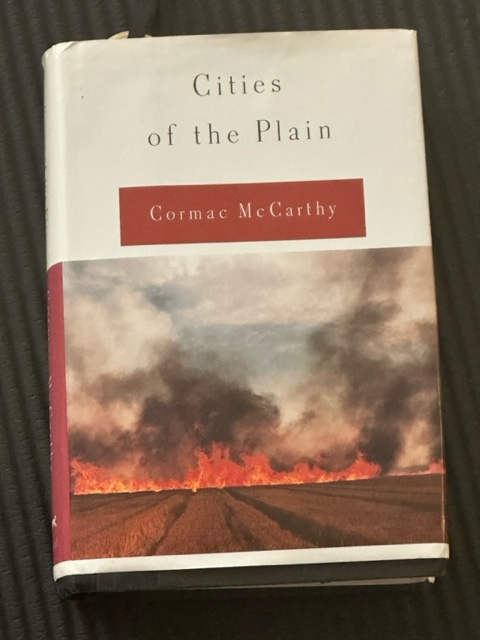
It is no secret to anyone who knows me well that one of my enduring favorite writers is Cormac McCarthy. He died this year, and I already miss the prospect that we might be blessed via more from his pen. But he left us an awful lot of profound literature. I read his works again and again. And each time the works are better.
Recently I finished The Border Trilogy again. The Border Trilogy is comprised of All the Pretty Horses,The Crossing, and Cities of the Plain. I have written before on All the Pretty Horses and The Crossing.
In the Border Trilogy, I think All the Pretty Horses is the most cohesive plot, The Crossing is the most beautifully written (accompanied by heavy profound philosophical musings), but Cities of the Plain, upon this most recent re-reading, continues to grow in my estimation for three reasons.
Fist, McCarthy is a master of masculine friendship and love. There is never anything homoerotic in these novels; it is nothing like that. For anyone versed in Scripture, a fitting comparison is the deep friendship between David and Jonathan. You never once see anything homoerotic in the relationship between David and Jonathan. What you do find is men who understand that true friendship is built upon trust and confidence in one another. You see them value the friendship and consistently act in ways aimed at shepherding, honoring, and trying to protect it. The relationship between Billy Parham and John Grady Cole in Cities of the Plain is just that. And the fact that so much of the novel is set in Mexico and Texas, and amidst the harshness, the desert stars, the red mountains, the arroyos, and grottoes of the region makes their adventures (and John Grady’s misadventures) still more compelling.
Second, Cities of the Plain contains passages that are so typical of McCarthy’s tropes in his novels, especially the wise wanderer who dialogues with the protagonist. Here’s one example from Cities of the Plain from near the end of the novel:
You call forth the world which God has formed and that world only. Nor is this life of yours by which you set such store your doing, however you may choose to tell it. Its shape was forced in the void at the onset and all talk of what might otherwise have been is senseless for there is no otherwise. Of what could it be made? Where be hid? Or how make its appearance? The probability of the actual is absolute. That we have no power to guess it out beforehand makes it no less certain. That we may imagine alternate histories means nothing at all (285).
You won’t find that level of poetic prose anywhere I am aware of except in possibly Faulkner and/or Flannery O’Connor. But I would argue McCarthy’s is more powerful, and that is quite a claim.
Third, no one writes landscapes better than McCarthy. What Melville and Conrad wrote of the sea, what Dickens wrote of all-things-London, especially prisons and tanneries and child labor conditions, what Faulkner wrote about the rage and endurance and suffering of both loving your area and simultaneously despising its worst characteristics, McCarthy writes best when he writes of landscapes and of how he uses them literarily to teach those who are able to hear and understand:
They sat against a rock bluff high in the Franklins with a fire before them that heeled in the wind and their figures cast up upon the rocks behind them enshadowed the petroglyphs carved there by other hunters a thousand years before. They could hear the dogs running far below them. Their cries trailed off down the side of the mountain and sounded again more faintly and then faded away where they coursed out along some rocky draw in the dark. To the south the distant lights of the city lay strewn across the desert floor like a tiara laid out upon a jeweler’s blackcloth. Archer had stood and turned toward the running dogs the better to listen and after a while he squatted again an spat into the fire (88).
The reading of beautiful language is a mysterious joy. I don’t understand how it does not move many souls. But for those whose souls rise upon waves of linguistic beauty, to those whose spirits fill when words are zephyrs, to those whose spirits press in to to hear souls speaking secrets of the deep, McCarthy’s words and worlds transport to depths unlike anyone else’s I know.
Text: The plans of the heart belong to man, but the answer of the tongue is from the Lord. 2 All the ways of a man are pure in his own eyes, but the Lord weighs the spirit. 3 Commit your work to the Lord, and your plans will be established. 4 The Lord has made everything for its purpose, even the wicked for the day of trouble. (Proverbs 16:1-4, ESV)
The four verses above remain some of the most powerful words for me each time I meditate upon them. There are at least four reasons why.
First, they teach that intentionality is real. Verse 1, for example, acknowledges the reality that the motives of man are just that–motives. Man’s will is central to his nature; he is not neutral; his appetites and desires to a large degree and extent define who and what he is. The way Jesus Himself phrased it in Luke 6:45 is, “for out of the abundance of the heart his [man’s] mouth speaks” (Luke 6:45, ESV). Some country wisdom I heard growing up: “What’s down in the well comes up in the bucket.”
Second, verse 2 reminds me that we easily deceive ourselves. I heard one of my students say recently something that has stuck with me: “We tend to judge others based on their actions but judge ourselves based upon our intentions.” I believe that qualifies as a truth bomb. Don’t we find it’s much easier to correct other people but find it more tempting to give ourselves a pass? We so often think ourselves and our motives are pure, but God “weighs” us, so to speak. He sees the truth. And He has ways of teaching us the truth about ourselves.
Third, verse 3 has notes by it in almost every copy of Scripture I have except in my preaching Bible (that’s the only one I don’t write in). Verse 3 goes right to the heart of the issue. Why should the believer do what he does? Because he’s committed to the Lord. How and why will God establish that work? Well, in short, via His means. He uses means to His ends. Think of it this way. Are believers commanded to pray? Yes, of course. Over and over again, we are taught to pray. But doesn’t God know the end from the beginning? Again, yes, of course. So, why pray? Because God ordains means to His determined ends. The prayers of the saints are part of His means to His ends. Philippians 2:13 emphasizes the same theme: “for it is God who works in you, both to will and to work for his good pleasure.” Believers are to “work out” our salvation with fear and trembling while simultaneously knowing that God superintends it all.
Fourth, I see the greatest comfort I know of in the Christian faith: God’s holy sovereignty. If I did not believe that God had made everything for its purpose, even the wicked, I don’t know how one could intellectually and honestly have hope. The world is so clearly fallen–and I see that I am just a microcosm of the world macrocosm–the cosmos screams out for redemption. That is, you and I (to use biblical language) groan due to the fallen nature of things.
But verse 4 of Proverbs 16 reminds us that this is not a random roll of the dice. Just the opposite. The creation is under God’s dominion. That means that even Hamas’ terrorism is being used by God. Even the wickedness of Hamas is under God’s control.
Consider the alternative. What if John Lennon was right, that “there’s no hell below us, above us only sky”? Well, what are you going to do about evil in that kind of sentimental theology? No one there to arbitrate. No right, no wrong, no heaven, no hell, just babies being decapitated and women burned alive and dragged through the streets like scenes from Homer’s Odyssey. John Lennon was a musical prodigy and I love listening to many of his and McCartney’s tunes, but the theology and worldview of “Imagine” is sentimental bilge. See how far Hamas lets you get away with the theology of “Imagine.”
Scripture teaches that “The LORD has made everything for its purpose, even the wicked for the day of trouble” (Proverbs 16:4, ESV). Everything.
Encouragement: In the interim I cling to some of the most beautiful lines in literature and in the Scriptures:
“Finally, brothers, whatever is true, whatever is honorable, whatever is just, whatever is pure, whatever is lovely, whatever is commendable, if there is any excellence, if there is anything worthy of praise, think about these things” (Philippians 4:8, ESV).
At the same time, let believers pray, while remaining deeply aware of our own fallenness and dependence upon God, but hearing from the Scriptures that God has made everything and rules every last bit of it, and none of anything He has made escapes His view or judgment.
Question: You remember the line of Herods from your studies of history, right? First, there was Herod I (a.k.a. Herod the Great) who was appointed by Rome, the empire that ruled the ancient Near East during Christ’s incarnation, life, death, burial, and resurrection). He was appointed king of the Jews by Rome. That’s a very important detail. By Rome. By human authorities, by human fiat, by human means.
Second, there was Herod Antipas, the son of Herod I. Herod Antipas governed Galilee at the same time as Pontius Pilate, the Roman governor, governed Judea. Again, this was during the time of Jesus’ public ministry.
There are other Herods, of course, like Herod Philip. And there was Herod Agrippa, the grandson of Herod I. He had John the Baptist beheaded for telling the truth. But for now, I want you to just concentrate on Herod I briefly, one of his sons, Herod Antipas, and Pontius Pilate.
Two Incidents: At least two glaring incidents are remembered in world history and church history involving these two Herods.
First, look with me at Luke 23:6-16. Why? Because this is one of the most significant conversations in history. This is where God the Son, Jesus Christ, is hauled before Pontius Pilate and Herod Antipas in order to see what the kingdoms of men plan to do with Him (Jesus).
The Setting of Luke 23: Here was Jesus, God incarnate, who had been doing miracles, saving people, restoring sight to the blind, healing leprosy, casting out demons, causing the lame to walk, rebuking the demonic spirits, forgiving sinful women and men, welcoming children to his kingdom, etc. and revealing Himself to be the promised Messiah, the Holy One of God.
But all this goodness was rather upsetting to the kingdoms of men. Why? Because the kingdoms of men hate truth, hate God, and aim to enthrone man as king.
When Christ came, He revealed all that. When you study the lives of Herod Antipas and Pilate, you see men that were consumed by hunger for the applause of men, with their own comfort, with their own power. Truth, after all, the innocence of Jesus, for example, could not be admitted. Why? Because that would change everything. The political thing to do would be to try and wash one’s hands of truth, acting as if it would not affect oneself or others, and aim to return to business as usual.
Pilate admitted he could find no fault in Christ (Luke 23:14). Herod admitted he found no fault in Jesus either (Luke 23:15). And so Jesus was released back to the mob of Jews crying for Jesus’ crucifixion.
And when you get to verses 18-25 of Luke 23, they are some of the most heartbreaking in world history. Why? Because we see mobs screaming for violence against innocence:
18 But they all cried out together, “Away with this man, and release to us Barabbas”— 19 a man who hadbeen thrown into prison for an insurrection started in the city and for murder. 20 Pilate addressed themonce more, desiring to release Jesus, 21 but they kept shouting, “Crucify, crucify him!” 22A third time he said to them, “Why? What evil has he done? I have found in him no guilt deserving death. I will therefore punish and release him.” 23 But they were urgent, demanding with loud cries that he should be crucified. And their voices prevailed. 24 So Pilate decided that their demand should be granted. 25 He released the man who had been thrown into prison for insurrection and murder, for whom they asked, but he delivered Jesus over to their will.
Don’t Miss This: Why is this incident crucial in world history? Because it reveals the heart of sinners and the character of God.
Christ was and is King, but the world hates that truth. So the world system, here personified by the mobs of screaming Jews, by Pilate, by Herod Antipas, by sinners, hates that truth. They hate God. They are not neutral or impartial or somehow ambivalent. No, they hate God. This is the clear testimony of history and of Scripture:
5 For those who live according to the flesh set their minds on the things of the flesh, but those who liveaccording to the Spirit set their minds on the things of the Spirit. 6For to set the mind on the flesh is death, but to set the mind on the Spirit is life and peace.7 For the mind that is set on the flesh is hostileto God, for it does not submit to God’s law; indeed, it cannot. 8 Those who are in the flesh cannot please God. (Romans 8:5-8 ESV)
That was Paul in Romans. But it’s the same teaching as Jesus gave in John’s gospel:
42 Jesus said to them, “If God were your Father, you would love me, for I came from God and I am here. I came not of my own accord, but he sent me.43 Why do you not understand what I say? It is because youcannot bear to hear my word. 44 You are of your father the devil, and your will is to do your father’sdesires. He was a murderer from the beginning, and does not stand in the truth, because there is no truth in him. When he lies, he speaks out of his own character, for he is a liar and the father of lies. 45 But because I tell the truth, you do not believe me. 46 Which one of you convicts me of sin? If I tell the truth, why do you not believe me? 47 Whoever is of God hears the words of God. The reason why you do not hear them is that you are not of God.” (John 8:42-47 ESV)
The fact that sinners deny this only reinforces the truth, namely, that sinners hate God, the truth of God, the ways of God, because the idea of spiritual neutrality is a damnable lie.
This is why we must be in Scripture. That’s the authority. Not the preaching of men. We are only wise teachers insofar as we rightly divide Scripture. If our eyes are not in the text of Scripture, we need to be discerning and courageous enough to admit that error and return to Scripture.
So we saw how Herod Antipas and Pilate responded when the King of kings was in their midst. And violence, murder, and demonic mobs continued to slaughter.
The Pattern of Militarism: This week, I have been saddened by the latest Islamic terrorizing militarism in Gaza. Babies have been stabbed by the terrorists. Mothers have been raped. Children have been gunned down. Bodies of Jews have been dragged in the streets. Boys and girls and women have been burned alive. And the terrorists post it on social media for all to see.
Why does this happen? Because unless and until men and women embrace the once-for-all sacrifice of the God-man, Jesus Christ, they will continue to steal, kill, and destroy and labor to erect kingdoms built upon lies.
What sets Christianity apart is the good news (εὐαγγέλιον, the evangelion) that “Christ died for the ungodly” (Romans 5:6 ESV).
Romans 3:9-20 is, in my view, the clearest example of how the kingdom of God distinguishes itself from the militaristic kingdoms of men:
9 What then? Are we Jews any better off? No, not at all. For we have already charged that all, both Jews and Greeks, are under sin, 10 as it is written:
“None is righteous, no, not one; 11 no one understands; no one seeks for God. 12 All have turned aside; together they have become worthless; no one does good, not even one.” 13 “Their throat is an open grave; they use their tongues to deceive.” “The venom of asps is under their lips.” 14 “Their mouth is full of curses and bitterness.” 15 “Their feet are swift to shed blood; 16 in their paths are ruin and misery, 17 and the way of peace they have not known.” 18 “There is no fear of God before their eyes.”
19 Now we know that whatever the law says it speaks to those who are under the law, so that every mouth may be stopped, and the whole world may be held accountable to God. 20 For by works of the law no human being will be justified in his sight, since through the law comes knowledge of sin. (Romans 3:9-20 ESV)
Encouragement: World history is, among other things, the record of what spiritual warfare looks like when it is played out via the actions of men. Ideas, in other words, have consequences. Demonic ideas result in demonic activity. Godly ideas result in godly activity. Darkness differs from light, because it hates the light. Satan, the prince of darkness, hates Jesus, the light of the world (John 8:12 ESV).
The same warfare that faced Herods, and Pilates, and the mobs of screaming Jews demanding the crucifixion of God in the flesh–that same spiritual warfare runs through our hearts and minds, too. And we are either part of the mobs of darkness, bloody with stones, scepters, and spears, or we are welcomed in by the Good Shepherd, who died in our place, so that He might forgive us sinners, ransom us sinners, reconcile us sinners, and show us that the kingdom of heaven suffers violence because we so often think politics and militarism will solve our problems. They won’t; only God in Christ is big enough for that.
Introduction: If you are a committed reader, you too may have had this experience: You find that rereading your favorite books, plays, poems, or non-fiction pieces is infinitely sweeter than your first reading. That has certainly been my experience. Some of my favorite novels are As I Lay Dying, Absalom, Absalom!, The Road, All the Pretty Horses, The Crossing, Huck Finn, Crime and Punishment, and Great Expectations. Each one I have read multiple times. And each time the book “gets better.” Well, how does that make sense? The books hadn’t changed, of course, but I had. I see more, have had more experiences, am older, and hopefully wiser than earlier. I have matured, and so I see the wisdom that the writers infused into their masterful works.
But so much depends upon the reader. The analogy is one Jesus Himself taught. He said that not everyone will respond to wisdom, to truth, to depth. Many will reject it. Why? Because, in the words of Christ Himself, not all people have ears to hear. That is, they are spiritually deaf to saving truth.
Jesus referred to them as pigs or swine as a metaphor (see Matthew 7:6, for example). They would trample the profound because they are incapable of appreciating it. They cannot discern any difference between gold and rubbish, between value and detritus.
Connection: Solomon taught the same principle in the following three lines:
The fear of the Lord is the beginning of wisdom, and the knowledge of the Holy One is insight. For by me your days will be multiplied, and years will be added to your life. If you are wise, you are wise for yourself; if you scoff, you alone will bear it (Proverbs 9:10-12 ESV).
The point is straightforward, of course. The wise person fears God. The fool, on the other hand, scoffs at the reality of God, and the fool thereby reveals his own folly. The contrast is clear: the wise person vs. the fool.
When Jesus was teaching in Matthew’s gospel, for example, he says again and again, “He who has ears, let him hear” (Matthew 13:9 ESV).
A Question: Why did Jesus quote Isaiah 6 at length in Matthew 13? Here’s the passage:
14 Indeed, in their case the prophecy of Isaiah is fulfilled that says:
“‘“You will indeed hear but never understand, and you will indeed see but never perceive.” 15 For this people’s heart has grown dull, and with their ears they can barely hear, and their eyes they have closed, lest they should see with their eyes and hear with their ears and understand with their heart and turn, and I would heal them.’
16 But blessed are your eyes, for they see, and your ears, for they hear. 17 For truly, I say to you, many prophets and righteous people longed to see what you see, and did not see it, and to hear what you hear, and did not hear it. (Matthew 13:14-17 ESV)
Again the principle is clear. It becomes clearer upon each rereading: Spiritual deafness is pervasive. Not all have ears to hear. You can labor and teach and write and preach and pray, but unless and until God grants people spiritual hearing, it’s unopened mail, so to speak. The message has been delivered but not received.
It’s pearls before swine, sometimes. The saving power is in the message, the content, not in the deliverer of the message. So often we can be swayed by charismatic speakers, teachers, writers, preachers, etc. but so often we find those men were wrong, dangerous, manipulative, and in it for themselves rather than for the truth. There is no shortage of fallen Christian so-called leaders, sadly.
Encouragement: I am encouraged, and I hope you are too, by this simple fact: Christ Himself was rejected by His own people. Over and over again they tried to throw Him off a cliff, or stone Him, or whip Him. And eventually, in the fullness of His appointed time, He went to the cross in accordance with the divine plan. And His every word proved true.
It is encouraging, therefore, to know that prophets are without honor in their hometown–just as with the Lord Himself, just as with Paul, just as with Ezekiel, just as with Daniel, et al.
Faithfulness is what’s vital, knowing up front that the pearls of wisdom are still to be offered, but also aware that there’s no paucity of pigs who will gladly trample them in the mud. But some, dear ones, will have ears to hear and eyes to see, and that is why the true prophet goes in hope and committed faith in the blessed assurance that ultimately, truth wins, and there will be a reckoning.
Biblical Connection: One of my favorite passages in Scripture is found in John’s gospel where Jesus tells a woman that He is the water of life. It’s a long conversation Jesus has with a quite fallen Samaritan woman. She was a sinner. Maybe you, too, can identify:
A woman from Samaria came to draw water. Jesus said to her, “Give me a drink.” (For his disciples had gone away into the city to buy food.) The Samaritan woman said to him, “How is it that you, a Jew, ask for a drink from me, a woman of Samaria?” (For Jews have no dealings with Samaritans.) Jesus answered her, “If you knew the gift of God, and who it is that is saying to you, ‘Give me a drink,’ you would have asked him, and he would have given you living water.” The woman said to him, “Sir, you have nothing to draw water with, and the well is deep. Where do you get that living water? Are you greater than our father Jacob? He gave us the well and drank from it himself, as did his sons and his livestock.” Jesus said to her, “Everyone who drinks of this water will be thirsty again, but whoever drinks of the water that I will give him will never be thirsty again. The water that I will give him will become in him a spring of water welling up to eternal life.” The woman said to him, “Sir, give me this water, so that I will not be thirsty or have to come here to draw water.”
Jesus said to her, “Go, call your husband, and come here.” The woman answered him, “I have no husband.” Jesus said to her, “You are right in saying, ‘I have no husband’; for you have had five husbands, and the one you now have is not your husband. What you have said is true.” The woman said to him, “Sir, I perceive that you are a prophet. Our fathers worshiped on this mountain, but you say that in Jerusalem is the place where people ought to worship.” Jesus said to her, “Woman, believe me, the hour is coming when neither on this mountain nor in Jerusalem will you worship the Father. You worship what you do not know; we worship what we know, for salvation is from the Jews. But the hour is coming, and is now here, when the true worshipers will worship the Father in spirit and truth, for the Father is seeking such people to worship him. God is spirit, and those who worship him must worship in spirit and truth.” The woman said to him, “I know that Messiah is coming (he who is called Christ). When he comes, he will tell us all things.” Jesus said to her, “I who speak to you am he” (John 4:7-26 ESV).
Daily Life: The point that Jesus was making, of course, was that He was the promised Messiah and that she should believe upon Him because He was her only hope. He could forgive sins because He was and is God. She went and told others about Him. Verse 39 of the same chapter, for example, says, “Many Samaritans from that town believed in him because of the woman’s testimony . . .” (John 4:39 ESV).
Recently I was hit with news that really put me back on my heels. I found out that funding was not available for military training for which I have been planning. The politicians in D.C. find funds to send billions of taxpayer-funded arms to Ukraine, and we have funds for countless story hours of abomination in our taxpayer-funded public libraries, but when it comes to professional development for American soldiers, nope, sorry, fresh out of funds. Interesting. It’s cliche to say, “Follow the money,” to find out what’s really important to the folks in D.C. but it bears repeating.
The Connection: What does a slice from my daily life have to do with Jesus’s conversation with the Samaritan woman in John 4, and with you? Simple: The woman was a sinner and I am a sinner. The woman did not deserve the offer of the water of life and forgiveness. Nor do I. But grace was granted her and she was faithful to bear witness to her encounter with the Creator of the water, the Creator of all things under heaven. The woman had gone to the well for her immediate needs and she was met by the Giver of eternal life.
Back in Iraq: When I was deployed to Iraq, there was a spring-fed pool of water on the border between Iraq and Syria that the locals called “Abraham’s Well.” I used to escort soldiers and contractors and civilians out there regularly, offer a short homily and the Lord’s Supper. Why? Because amidst all that sand, all that stone, all that carnage, there was this little spring-fed pool of water in the middle of the desert. Palm trees and green shrubs grew up around it. Goats came regularly to drink from it, their shepherds standing overwatch with their staffs. And it is a place I will never forget because God, even in the desert moments, remains. And maybe I am to learn that I was too enamored of my career and not enough consumed by the Shepherd.
*And no, the picture above is not from Iraq. For security reasons, I will not share pictures of that place. This creek is simply one I walk regularly each week back in the States. I just thought the water metaphor would be more obvious.
It’s one of the catchiest tunes in the history of rock-n-roll. And when Stephen Stills and Neil Young and the other bandmembers created this now iconic tune, the 1960s were undergoing cultural upheaval and chaos, as the foundations of a civilzation were being destroyed.
Here are the wonderful lyrics to Buffalo Springfield’s classic tune, “For What’s It’s Worth”:
There’s something happening here But what it is ain’t exactly clear There’s a man with a gun over there Telling me I got to beware
I think it’s time we stop Children, what’s that sound? Everybody look, what’s going down?
There’s battle lines being drawn Nobody’s right if everybody’s wrong Young people speaking their minds Getting so much resistance from behind
It’s time we stop Hey, what’s that sound? Everybody look, what’s going down?
What a field day for the heat (Ooh ooh ooh) A thousand people in the street (Ooh ooh ooh) Singing songs and they carrying signs (Ooh ooh ooh) Mostly say, “Hooray for our side” (Ooh ooh ooh)
It’s time we stop Hey, what’s that sound? Everybody look, what’s going down?
Paranoia strikes deep Into your life it will creep It starts when you’re always afraid Step out of line, the men come and take you away
We better stop Hey, what’s that sound? Everybody look, what’s going down?
You better stop Hey, what’s that sound? Everybody look, what’s going down?
You better stop Now, what’s that sound? Everybody look, what’s going down?
You better stop Children, what’s that sound? Everybody look, what’s going down?
Description: When I read the news today on my computer I was again left speechless. One article described Disney’s determination to force homosexuality upon every possible show, character, storyline, and theme park:
Another article described how illegal aliens in America gang raped girls in Minnesota this week. You might remember the leftists in Minnesota who insisted upon defunding the police. Well, here you go. Should you wish to endure the filth, here’s the article:
Pink hair, a goatee, and he’s angry at you. Yup. Can’t make this stuff up.
Sometimes Only Songs Will Do:
Bob Dylan captured the chaos well in one of his many classics when he wrote the following:
The line it is drawn The curse it is cast The slow one now Will later be fast As the present now Will later be past The order is rapidly fadin’ And the first one now Will later be last For the times they are a-changin’
Final Thoughts: Prophecy is a dangerous calling, but I don’t think you have to be a prophet to see that the West is amidst revolution. The foundations of civilization, of critical thinking, of reality itself, are being deliberately destroyed. And it seems the few wise and mature have vacated. Now the mobs with seared consciences storm the halls left standing and demand you worship.
One could say it is sad what is occurring. But I don’t see it turning around anytime soon. It seems the West will withstand anything as long as a threshold of comfort is met. But I wonder how long it’ll be before the illegals come for more daughters, more sons, and the wokesters succeed in forbidding moms and dads from raising their own children, but will have mandatory twerk parties and pronoun camps for the urchins.
The West is reaping the whirlwind from jettisoning God, revelation, and reason. In its place, the pagans, drunk on the lies of secularism, progressivism, and postmodernism, execute the reign of terror disguised in make-up, dyed hair, and rainbows. So put on your Buffalo Springfield song again, turn it up loud, and remind yourself while the barbarians grow nearer your own door, “Something’s happening here.” Something’s going down, alright: it’s called the West.
Context: I have a buddy who adores birds as much as I adore trees. I am grateful to him for sharing his pictures with me of his beloved birds. Here are a few of them:
Encouragement: When I slow down and concentrate on the intricacies and irreducible complexities of birds–large, small, or tiny ones–it staggers my little mind. And I revert to the comforts I find in language. It is language that reminds me of birds, yes, but more of their Creator.
I think of Exodus 19, for example, where God speaks to Moses on Sinai. Israel had just been miraculously delivered from Egyptian captivity: “You yourselves have seen what I did to the Egyptians, and how I bore you on eagles’ wings and brought you to myself. Now therefore, if you will indeed obey my voice and keep my covenant, you shall be my treasured possession among all peoples, for all the earth is mine; and you shall be to me a kingdom of priests and a holy nation” (Exodus 19:4-6a ESV).
God essentially paints Moses a linguistic picture, saying, Don’t forget that deliverance is like being borne upon eagles’ wings, Moses; so, don’t forget. Remember who the Deliverer is. Remember His power.
Introduction: I remember as a boy when I tried to read the Bible and struggled to remain interested when I got to the genealogies. The “begat passages,” as I used to call them, kind of lulled me to disinterest. I thought to myself, “Let’s get to the good stuff, the action, the story. What’s the point of all the passages about family lineage and all the begats?”
It’s Different Now: I was a child then and I thought as a child. Now I’m on the older side of the scale and have been through the Bible many times. I won’t say that the “begat passages” are by any means my favorite but I do think I have begun to understand a bit of what God is revealing to his body, the church, by way of the genealogies.
Today in Matthew: This morning I was reading in Matthew 1. It is, of course, one of the genealogies in the Bible. But Matthew 1 is the genealogy of the God-man, Jesus Christ. And here is something I hope encourages believers and challenges the skeptics out there: genealogies matter because they reveal how God keeps his promises.
Matthew 1’s first words are “The book of the genealogy of Jesus Christ, the son of David, the son of Abraham” (Matthew 1:1 ESV). For people who don’t have a proper hermeneutic (principle of interpretation), they might immediately put them off because they don’t understand what Matthew is laboring in chapter 1 to demonstrate.
The whole point of Matthew’s gospel is that Jesus (the Christ) is the promised Messiah. His human incarnation is demonstrated via the Holy Spirit and Mary. But Jesus did not have a divine origin because he is eternal. Jesus in his human incarnation has a birthday, if you will, but Jesus as God almighty does not have a divine birthday, because the triune God of Father, Son, and Holy Spirit is eternal. There never was a time when Jesus was not, in other words.
Names Matter: Jesus’ name matters because his office matters. That is, Matthew tells us “they shall call his name Immanuel” (Matthew 1:23b ESV) because of its meaning: God with us. See it? God has come. God has revealed himself by way of the incarnation. He has come to dwell among us in order that may behold via eyewitness accounts over the course of years, how Jesus/Immanuel/God with us, was and is God in the flesh. The Son took on flesh and fulfilled the promises of the Old Testament. The whole Bible and the whole storyline of the Bible was leading up to the God-man, Jesus the Anointed One, the true King, Immanuel.
Matthew stresses why this is so important: “All this took place to fulfill what the Lord had spoken by the prophet” (Matthew 1:22 ESV). See it? To fulfill.
Encouragement: To state the obvious, we live in a fallen world where promises made are seldom kept. But there is One who cannot lie because he is holy. He is holy, holy, holy (cf. Isaiah 6). Christ is the fulfillment of the promises of God (Luke 24). Look to him, because he is utterly and supremely trustworthy. He is the fulfillment of the true, the good, and the beautiful.