Johnny Cash and Thoughts on Vocation

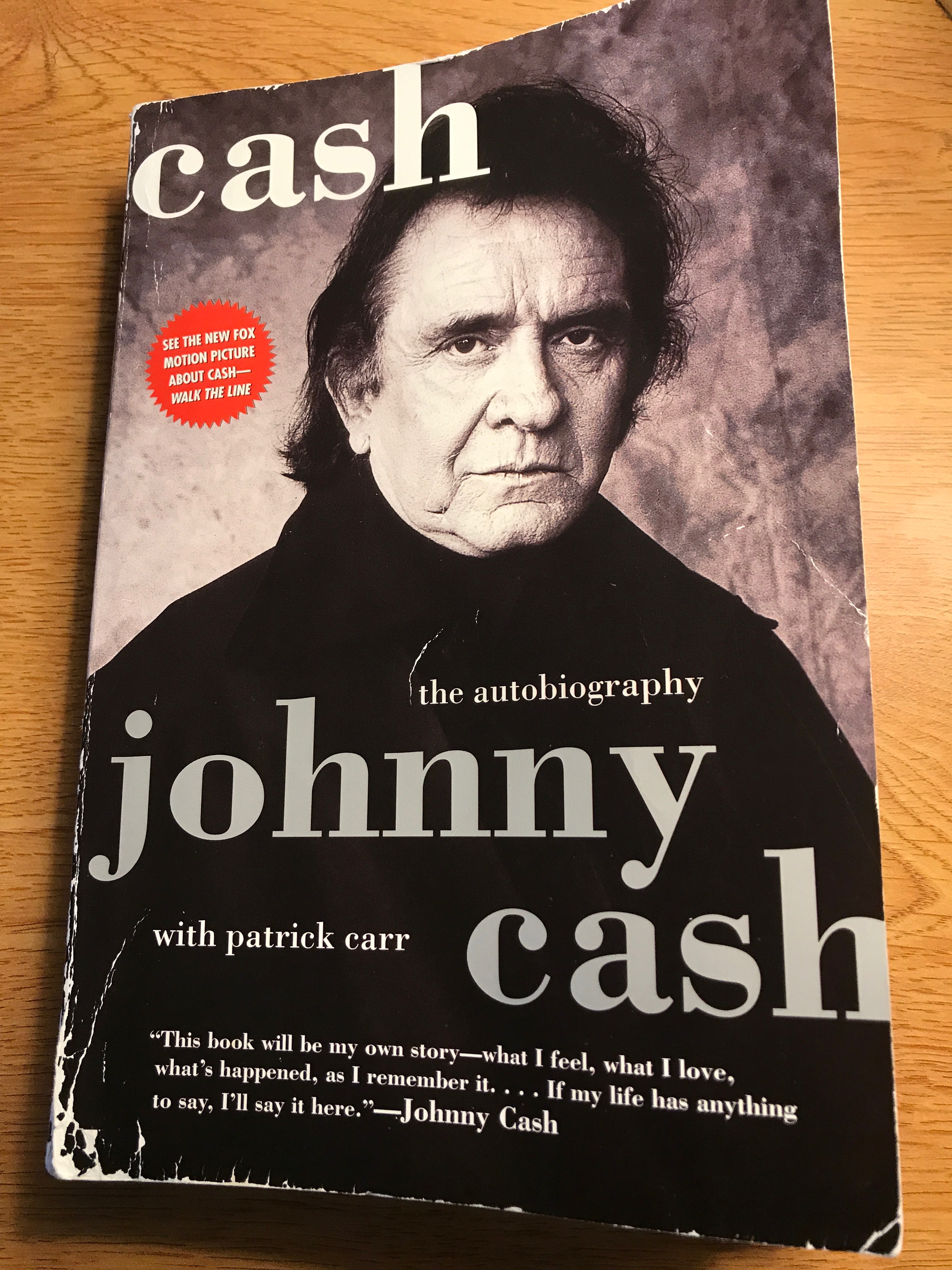
Over the last few days, I completed reading Johnny Cash’s autobiography cash (ibid.) and I respect him and his music even more now than I did before. It has to do with his determination to follow his vocation with simple (not simplistic) truthfulness.

Vocation—(n.) a summons or strong inclination to a particular state or course of action

I remember sitting down with a professor when my family and I moved for me to attend seminary several years back. We met with a scholar from the church history department. My wife and I went into the professor’s office and exchanged pleasantries for a bit. He asked me which writers and thinkers most influenced me. Then he asked me to describe my vocation. It was then I discovered his aim. It was for me to understand what I really valued. By whom and to what was I called?

I relearned through that conversation years ago something I again appreciated in Cash’s autobiography. It is this idea of vocation.

This idea of vocation/calling shapes Cash’s music. He is not glamorous. He is not flashy. He is not adorned. He is simply (not simplistically) “the man in black” with his black Martin guitar, his black boots, his deep Arkansas-Tennessee voice, his simple lyrics about love, loss, self-destruction, rescue, redemption, Jesus’ work on behalf of sinners, marriage, forgiveness, restoration—all with ever-present focus.

His country music attests to his worldview. It bears witness to his efforts to answer and follow his vocation.

There were dark times, of course. He battled amphetamine and opioid addiction. He battled the bottle. He battled lust. He was not a perfect husband or father. But he pressed on; he followed his vocation. He did not sell out to style over substance.

When he saw that much of so-called country music had degenerated to donning a cowboy hat, wearing tight jeans, boots, and speaking with a southern accent … well, he stayed true to what he knew—the old gospel tunes, Hank Williams Sr.’s tunes, the Carter Family mountain music, Bill Monroe, and the other pioneers.

He kept to the timeless truths he had learned the hard way … from growing up poor in the South, picking cotton, listening to the panthers screaming at night in Arkansas and to the whistle of the trains as they cut through the farmlands.

He stayed close to his heart for telling the truth musically. He fought to maintain his allegiance to his vocation. Towards the end of his autobiography, Cash writes about his awareness of his own mortality:

Not that I believe you have to “grow old gracefully.” I go along with Edna St. Vincent Millay’s idea that it’s okay to go out screaming and scratching and fighting. When death starts beating the door down, you need to be reaching for your shotgun.

And when you know he might be in your part of town, which is true for anyone my age, you should be taking care of business. Quit gazing out the window at the lake and start telling your stories” (p. 273).

 Cash died in 2003, but I think his contributions will endure due in large measure to his faithfulness in following his vocation, and not losing his soul to this world. I am grateful.

 

Johnny Cash, October Sands, and Family

There’s a line in Moby Dick that sticks with me. No, it’s not “Call me Ishmael.” It’s this one: “Yes, as every one knows, meditation and water are wedded forever.” Why? Short answer: I have found it to be true. Something there is about the sounds of waves meeting shore; something about the way moonshine bathes the sea’s surface in white, and you can see the dark below and the light above, and you seek to discover some truth therein.

Perhaps it’s something about the strands of white and the impressions they hold for a moment: footprints of walkers, runners, kite fliers and tan seekers, young and old, working and retired—all there until the next wave or footprint or toddler with an orange shovel and matching pail.

I had my family, Johnny Cash’s autobiography, and a week of sun-drenched days and moonlit nights. Tonight is the full moon but it was nearly impossible to tell it was not full already, it was that bright.

Sitting on the balcony looking down towards the pool, I watched a gray squirrel climb a palm tree. Until he spotted me watching him, he seemed on a mission. I watched children play in the Gulf of Mexico while Zac Brown’s “Free” poured from a Bose Wave Music System, and many of us sang along, even if to ourselves.

I swam with my son and rode the waves in from the sandbar. I heard his boyish voice say, “Hey Dad, watch this!” wave after wave, afraid I’d miss seeing him.

I watched my wife’s skin absorb the sun and turn brown almost immediately. I read my Johnny Cash autobiography and listened to his last album filled with gospel songs about hurt and redemption and heard his voice say, “The Man Comes Around,” in a voice like no one else’s.

I watched my immediate and extended family work to provide and continue to make memories. And it’s all so simple: sunlight, water, sand, each other, music, ice cream, walking at night with headlamps on our foreheads, chasing the crabs on shore, their black eyes glowing in our beams of light. And still, the moon above. The sand like a white ribbon. The sounds of the water lapping at your ankles and retreating. Children’s voices. An occasional firecracker. The silhouette of lovers walking beside one another.

Melville was right; meditation and water are forever wed in a dance. And it is a good thing to be able to participate, to wade in and belong.

Roads to Redemption in the Stories of Denis Johnson

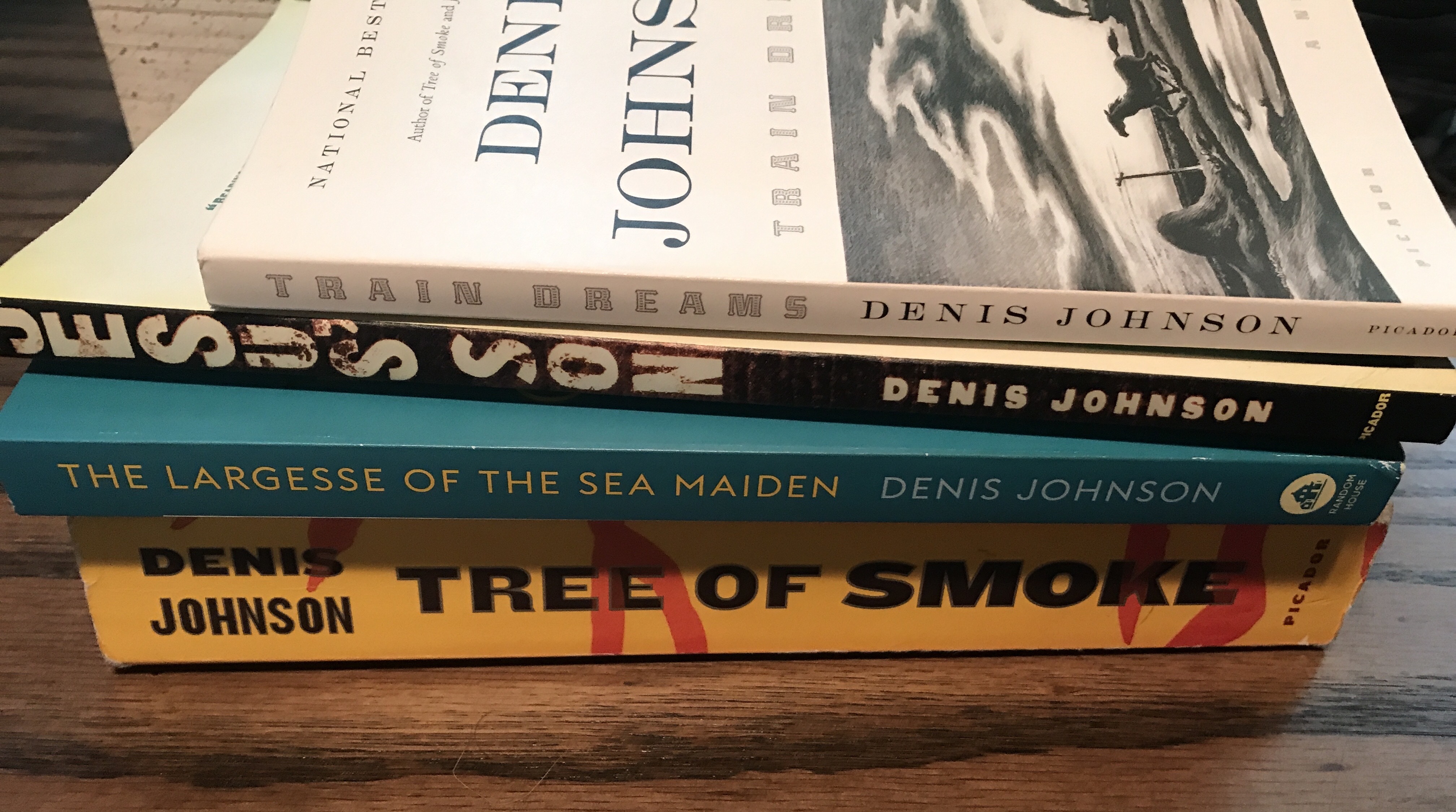
Tree of Smoke, Johnson’s long novel published in 2007, won the National Book Award. Its subjects were Vietnam, conspiracies, and myriad struggles to discern what is the “really real.” I read this novel over the last few weeks as I have worked my way through the fictional works of Johnson.

Perhaps it was because I still have an appetite for Vietnam stories. Though that was the war of my parents’ generation, in high school I read Vietnam stories and novels, and got hooked on them. Philip Caputo’s A Rumor of War and Going After Cacciato were books I was assigned to read, but I actually enjoyed those. And Tim O’Brien’s The Things They Carried, though it has been years since I have read it, still remains with me. Robert Stone’s Dog Soldiers is another fine book about the many fallouts of the whole Vietnam era from which I have benefited.

Even though I was too young at the time to have understood Vietnam when it ripped America apart, the scores of novels and memoirs I have read of that war have hopefully helped me understand a terribly divisive time in America’s history, especially with regard to issues related to war, the dangers of trusting mainstream media, drugs, feminism, secularism, and the loss of shame. The list could go on.

The late 1960s and early 1970s still shape my parents’ generation. They can recall JFK’s assassination, Watergate, and Charles Manson like I recall the Challenger explosion, the attempted assassination of Reagan, and the Islamic terrorist attacks of 9/ll.

I know that is a lot of background to explore the fiction of Denis Johnson. But context is critical. No one writes in a vacuum. Johnson’s novel Tree of Smoke was, to me at least, not his best writing. In my view, it was too long, and he lost track of his main idea. But that was the first piece of Johnson’s that I read. Its backdrop was Vietnam, the effects upon brothers and families, upon men and women with each other, and upon how people very often lose their way.

They lost belief. Does that sound banal? Perhaps. But Johnson’s characters can rip your heart out when you see them unravel existentially and flounder in trying to put themselves back together again.

Here is an example of the protagonist (Skip Sands) thinking about who he is and what he is about, about how he is to make his way in the world of Vietnam’s horrors and the pervasive lies surrounding him:

Skip regretted the role handed him at the end, that of traitor to the rebellion. At the end the colonel had sought reasons not just for an operation gone wrong, but for the breaking of his own heart, had looked for betrayal at the very center of things in the shape of some classical enormity, and what could have been more enormous, more darkly Roman, than betrayal by one’s own house, by his nephew, by his own blood? A soul too wide for the world. He’d refused to see his downfall as typical, refused all collaboration with the likes of Marcus Aurelius: “You may break your heart,” the old emperor had written, “but men will go on as before.” He’s written himself large-scale, followed raptly the saga of his own journey, chased his own myth down a maze of tunnels and into the fairyland of children’s stories and up a tree of smoke. (p.515)

But it was not in his long novel Tree of Smoke that most impressed me. It was his short stories.

The Largesse of the Sea Maiden contains amazing short fiction. Johnson, you need to know, is not a gentle writer. That is, he addresses life at its extreme moments, as if the extremes are oracles revealing mysteries not otherwise spoken.

In the short story “Strangler Bob,” (from the Sea Maiden collection of stories) for example, the first-person narrator describes his mindset while at the county jail and courthouse. Like many scenes in Johnson’s fictional world, this character is amidst addicts, rebels, dreamers, and rebels:

While I was kept there I wondered if this place was some kind of intersection for souls. I don’t know what to make of the fact that I’ve seen men many times throughout my life, repeatedly in dreams and sometimes in actuality—turning a corner on the street, gazing out the window of a passing train, or leaving a café just at the moment I glance up and recognize them, then disappearing out the door—and it makes me feel each person’s universe is really very small, no bigger than a county jail, a collection of cells in which he encounters the same fellow prisoners over and over. (p. 99)

And in his novella Train Dreams, Johnson explores the experiences of Robert Grainer, a common railroad laborer in the early 1900s in Idaho, Oregon, Washington, and Texas. Uneducated but hardworking, he marries, becomes a father, loses his wife and child in a fire, becomes a recluse, howls at the mountains with the wolves, battles insanity, a gives a dying man a drink of water from an old shoe. Yes, this is the world of Denis Johnson’s fiction, and it may shake you, too.

Lastly, my favorite Johnson stories came from his collection Jesus’ Son. This collection—again—explores lives of men and women on the edge—not just on the edge of society and laws, but on the edge of sanity. Characters hitchhike across America, find themselves in and out of hospital ERs, dives and bars, car crashes, and cabins for junkies. But they also serve as characters who illuminate the beauty in life that escapes the attention of most people.

I don’t think for a moment that Johnson would advocate for going through life on drugs or alcohol (he himself got clean after a long battle with both substances in the 1970s and into the 1980s) but in his fiction, Johnson does not shy away from using the extreme experiences—both comic and tragic—he was privy to in order to shock us into realities we would otherwise suppress. But those realities matter; they are important. They are sometimes those oracular insights—about ultimate things, and how we can know redemption is not just possible, but actual, if we will follow the signs.


What Is Your Worldview?

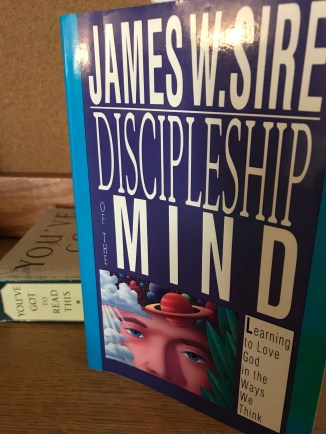
Seven questions reveal a lot … if they are the right questions. In his book Discipleship of the Mind: Learning to Love God in the Ways We Think, James Sire asks the right ones. 


In a world ripped apart and often characterized by (pardon the poor grammar) Us vs. Them, Sire excels in this book by demonstrating that all of us have a mental map of the world, a set of assumptions about the big questions and answers of life. We may not be conscious of our own worldviews at all times, but learning to be aware of ours and the worldviews of others—be they politicians, writers, entertainers, teachers, lawyers, philosophers and theologians, etc.—helps clarify what we think, why we think the way we do, and why we behave the ways we do. 


The questions he asks us to ask are fundamental questions that go a long way in revealing each person’s worldview. In a world ripped asunder via politics, race-baiting, shouting matches, and ad hominem attacks, Sire’s book may encourage you, too. 


Sire’s seven questions that elucidate each person’s worldview follow. Each time you listen to a politician, read a newspaper article, listen to the lyrics of a song, watch a film, ask these questions about the person’s or persons’ views behind what is being promulgated. What worldview are they operating from? How would they answer these questions?


1. What is prime reality—the really real?
2. What is the nature of external reality, that is, the world around us?
3. What is a human being?
4. What happens to a person at death?
5. Why is it possible to know anything at all?
6. How do we know what is right and wrong?
7. What is the meaning of human history?  


And perhaps most important of all, Sire’s definition of worldview: a set of presuppositions which we hold about the basic makeup of our world. 


One of the passions of my life is literature. Sire dedicates an entire chapter to worldview analysis of literature. In one chapter he contrasts the worldviews of the Christian poet Gerard Manley Hopkins in his poem “Pied Beauty” with the atheistic writer Thomas Hardy in his poem “The Darkling Thrush.” 


The worldview of each writer is manifested. Hopkins, a Christian writer, sees the world as the creation of the infinite-personal God, and beautiful colors and creatures in life as indicators and evidences of God’s nature being inseparable from the true, good, and beautiful. God exists, his creation exists, our minds exist, and we reflect God’s glory because we are created as his image-bearers.


Hardy, writing from an atheistic worldview, sees a bird dying along a fencerow at dusk as symbolic of man’s darkening hopes with regard to life and the future. The universe is a closed system, there’s no God beyond it, and all that exists is material, etc.—yet here we are, trying to make sense of why we feel empty and lonely in a dark world. Well, when we explore Hardy’s worldview, it’s no wonder. Why write poetry if we are just material in a material world? 


If you are curious about why we people think, create, and behave the ways we do, you are curious about worldviews, and an excellent place to begin is with Sire’s book.

The Gritty Fiction of Larry Brown

Occasionally I discover a writer whose works have endured thus far because they are true, not because they are necessarily pretty. If you appreciate the writings of Harry Crews and Flannery O’Connor, you may appreciate the gritty fiction of Larry Brown.


 Today I completed reading Brown’s novel The Rabbit Factory. Like everything else I have read from Larry Brown, this narrative explores the trials of (mostly) poor, white, hard-drinking, hard-living southerners who long for better lives. But each character is trapped—almost powerless to extricate himself/herself fully from a taunting, overwhelming web of evil. Better lives remain out of reach due to unwise choices, bad luck, fate, and/or formidable evil. 


This is not reading for the faint of heart. There is much violence herein.  And there is sex. And there is physical abuse. And there are scenes upon scenes with bourbon, beer, gin, and marijuana use. But these scenes are not there for shock value. These things, I would suggest, are tropes for lesser writers (Hunter S. Thompson and Norman Mailer, e.g.) but not for Brown.


Brown excels in his depiction of down-and-outsnot to sentimentalize them, but to reveal our possible connectionto them. He shows the sense of how actual people battle demons that we don’t often speak about to one another—demons of childhood traumas, wounds from abusive fathers, and loneliness that aches. His characters long to accomplish that for which they are convinced they were born but they flounder amidst cruel realities that reveal they have fallen far short. 


And on the stories go–of fighters, licentious wives, hit men, lonely female country cops, men and women who press on against formidable external odds and plaguing internal demons. 


If you’ve ever driven through the U.S countryside and seen neon Bud Light signs in front of roadside bars, and seen pickups parked out front, and you’ve thought of those men and women inside as if they were obviously beneath you … you might have thought, “How sad. Why can’t they be like I am?” Well, this book is not for you. Your life is zipped up nicely; theirs are apart at the seams. 


But if you’ve driven by those places and thought, “Yep, I am a lot like those folks on the inside—ugly, trying to drown my pain in my own way, in a mess … but determined to push through,” then this book might grip you. You might find we sinners are a lot more similar than we care to admit. 


Exposing facades of composure is what Brown does so well. But he does not do it via the high and mighty in our world but by exploring the downtrodden and morally bankrupt. 


Reading Larry Brown makes the honest person ask himself a hard question: Am I responding to other people like a Pharisee or like a fellow sinner?

Reflections on Hawthorne’s The House of the Seven Gables and Hawthorne: A Life (Part One of Two)

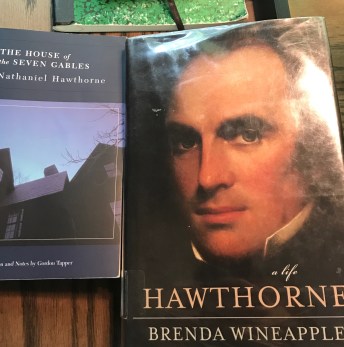
IMG_3178.JPGOver the last few weeks I reread a book by an American writer I have admired for many years, Nathaniel Hawthorne, and his novel The House of the Seven Gables. But I also read a lengthy biography of Hawthorne by Brenda Wineapple. I have provided a threefold approach to the novel and the biography using the following format: Summary, Analysis, Assessment. If you are a reader of serious literature and/or of its masters, I hope you benefit from what follows. I hope you will read (and or reread) Hawthorne’s works yourself. I recommend reading his short stories first, then moving on to The Scarlet Letter and other novels. There is much more to Hawthorne’s works than Hester Prynne’s scarlet A.

The House of the Seven Gables:

 At the risk of oversimplification, the novel explores the power of the past, and some people’s attempts to preserve it, pervert it, yield to it, and/or manipulate it. The “house” of the novel’s title is a house with seven gables, yes, but also a symbol for creation itself—once beautiful but now decaying due to the fall of the universe and all mankind. Does beauty exist anymore? If so, by what standard is beauty to be understood? Is love possible? What worldview best explains the way the world is—chaos or Christianity?

A few quotes from the novel may help to reveal what the novel centers upon:

Nothing gives a sadder sense of decay, than this loss of suspension of the power to deal with unaccustomed things and to keep up with the swiftness of the passing moment. It can merely be a suspended animation; for, were the power actually to perish, there would be little use of immortality. We are less than ghosts, for the time being, whenever this calamity befalls us. (141)

Intellectual honesty requires readers know up front that this novel is not light fare. Hawthorne was a serious thinker and writer; his canon of literature attests to that. In the above passage, the issue is how to capture the fleeting nature of human experience. How can the artist arrest motion and present his art to a world swept up in the quick, fast, and silly? Artists labor to speak to the deep things of life, but the trivial things invariably occupy most people’s time. More accurately stated, most people fill their free time with silliness and distraction.

A second quote from the novel may further illustrate Hawthorne’s concerns:

It seemed to Holgrave—as doubtless it has seemed to the hopeful of every century, since the epoch of Adam’s grandchildren—that in this age, more that ever before, the moss-grown and rotten Past is to be torn down, and lifeless institutions to be thrust out of the way, and their dead corpses buried, and everything to begin anew.

As to the main point—may we never live to doubt it!—as to the better centuries that are coming, the artist was surely right. His error lay, in supposing that this age, more than any past or future one, is destined to see the tattered garments of Antiquity exchanged for a new suit, instead of gradually renewing themselves by patchwork; in applying his own little life-span as the measure of an interminable achievement; and, more than all, in fancying that it mattered anything to the great end in view, whether he himself should contend for it or against it. (157-58)

Summary: As you can tell from the above quotes, the novel is concerned with the past. (Notice how Hawthorne capitalized it.) How we view the past is crucial. What are the standards we should bring to bear when thinking about the past? What should we preserve and what should we erase and/or deemphasize? (I’m thinking in terms of architecture here.) And what about literature? Should we preserve the Classics by Milton, Chaucer, Shakespeare, Sophocles, Homer, Dante, and Tolstoy, for example? Or should we consign these thinkers to “the past” written by those “oppressive white males,” and instead only read today’s writers, many of whom focus on race, class, sexual proclivities, and gender and neglect what Faulkner called “the human heart in conflict with itself”? Hawthorne’s novel explores these underlying issues.

Analysis: How does Hawthorne demonstrate the questions posed above? In short, he explores them via Hepzibah, Holgrave, Clifford, and Phoebe, four of the major characters in the novel. In my view, these four characters embody an angle from which Hawthorne explores how to view the past. Does it cripple us via family and generational curses? That is, are we helpless to overcome the power of the past? Should we seek to carve out a present by neglecting the past and the so-called lessons of history? Should we tiptoe along the surfaces of life, pretending all is well? Contemporize it for a moment: In selfies, isn’t the message most often, “I’m so happy!”? Hawthorne’s characters from the 1800s would not have known the meaning of “selfies,” but some of his characters embodied their takers’ worldviews. If man is the measure of all things, in other words, what you get is, well, man. Don’t curse the heavens if you worship at the altar of man.

Assessment: It will come as no surprise that I am still reading Hawthorne’s fiction—thirty years after I discovered his fiction. Where does Hawthorne fit? He has been called a Dark Romantic, like Edgar Allan Poe. He disavowed Thoreau’s pantheism and Emerson’s paganism. Feminists celebrate Hester Prynne as a brave woman, a martyr for women’s sexuality in a man’s world. Some angry self-professing atheists see Hawthorne as an author who called out some Puritans for their hypocrisy. Where do I fall in my view of Hawthorne’s oeuvre? In sum, I would agree that he is a Dark Romantic. His view of man—his anthropology—is realistic. He sees that man is a sinner by nature, by inclination, by deed, and by choice. I do not see evidence, so far in my studies of Hawthorne, at least, that he was a Christian. He seemed to disavow biblical Christianity several times, in fact (I will explore this more in Part Two). An issue that fascinates me is this: If Hawthorne acknowledged sin, man’s fallenness, the fallenness of the universe of all of mankind, what prevented him from embracing the gospel? Hawthorne was a master, at least in my view, of exploring our sinfulness, but he was less ready to explore the Redeemer. As a result, his writing profoundly explores man’s problem but without proposing a solution, one he would have found in the gospel.


(Part Two coming soon)


A Paean for CJ

FullSizeRenderIt was when I pulled out of the driveway that I knew. I knew I had to write it. Let me explain. She was sitting there with the dogs, watching me pull away to drive south again to Fort Benning for surgery this Thursday. I knew I had to write it. I can get it across on the page, things I don’t say as often or as well as I should—namely, that I am grateful for her, for her steadfastness, for her loyalty, for her feistiness, for her prayer life, for her deftness at organizing our lives, and on and on. I had to write it. To write what exactly? A paean to my wife who makes me better than I would otherwise be.
I learned an awful lot during my seminary years. And one of those lessons came by way of my favorite seminary professor. He was teaching us seminarians about personal discipleship. He was stressing that we could learn lots of theological precepts and still lose our marriages. Then he made this profound remark: “Don’t wait till Mother’s Day to realize if you have a Proverbs 31 wife.” Dr. Cutrer, my professor, could have ended class that moment. He was that gifted in teaching via example.

Proverbs 31:10-31 is perhaps the most obvious set of verses in Scripture where a godly wife is praised. King Lemuel uses synonymous parallelism in Hebrew poetry to make the point of how valuable a godly wife is. Here is just one example from verse 10: “An excellent wife who can find? She is far more precious than jewels” (Proverbs 31:10, ESV). Pretty straightforward, right? An excellent wife, according to Scripture, is worth more than fine jewels, and this was written circa 1,000 B.C. in an ancient Near East context, so precious jewels perhaps sparkled more in people’s thinking than they might today.

But what made Dr. Cutrer’s lesson for us more poignant was that Jane, his precious wife, was in class with him. She was at his side, serving alongside him to show us seminarians what an enduring commitment looked like. In short, the precept was theological (that God created, ordained, and loves biblical marriage) but also fleshed out in real lives. Theology was not just to be cerebral but incarnational. And that is why I had to write today—not primarily about theology but about my wife. Following are three examples of why I felt compelled to share.

 Example one: I love to work outside in the yard. Where I’m from, folks call it “piddlin’.” It is a catchall phrase. In my case, it usually involves doing something in the soil. From my mom and my maternal grandfather, I inherited a love for the earth—the smell of soil, a love of colors in nature, of flora, of things growing, etc. Some guys like to peruse sports cars; I like to walk through the garden section at Lowe’s, if that gives you an idea.

When I was outside piddlin’, my wife, CJ, pressure-washed both of the decks on the back of our house. We live in the woods, and so spiders and carpenter bees and all sorts of other creatures like to try and stake a claim on the decks of the house. So while I was out in the yard, my wife had gone down to the basement, hauled up a pressure washer, and sprayed off two decks. I don’t know of many husbands who would have complained. This one didn’t. Score one for the Proverbs 31 wife.

Example two: I have a surgery this week at Fort Benning to reconstruct my right shoulder. I’ll be operated on here, and then return to my barracks room to rest and recuperate, and hopefully, return home for a few days of convalescence. No big deal, right? No need for my wife to drive three hours south. Yet when I told her that I was good, that I had a buddy down here who had promised to look after me if anything goes wrong, she got … well, feisty. “Are you kidding me?” she asked, not really wanting any reply I might have offered. “I’ll be there. You’re having major surgery. Do you really think I’m staying home? Good grief, Pirtle.” Yep, not the brightest husband moment. Score another one for the Proverbs 31 wife.

Example three: I was in a church recently where a teacher was teaching on a couple of verses from one of the New Testament epistles. As part of his lesson, he cross-referenced a passage from another letter but when he cross-referenced the second passage, he did not explain the context of the passage at all. The passage was about dietary laws, not about what he was trying to emphasize. And I was troubled because context is crucial. A fundamental rule of correct interpretation is to know, understand, and teach the correct context. Put bluntly, we are never to rip verses out of context. Anyway, I was troubled but I did not say anything until my wife and I were talking after lunch. I told her what had transpired and she asked me this: “Will you just commit to pray about it (talking to the teacher) this week?” She knows I don’t like conflict, but she was right. Not only should I have gone to the teacher, but I should also have been praying and prayerful as I did it. But I had not. My wife was right on both counts and I was wrong. Score another one for the Proverbs 31 wife.

When I pulled away today to drive back down, she was on the driveway with the dogs. She would undoubtedly go in when I pulled away, make sure the kids were okay, straighten something in the house, perhaps read the book she’s working on currently, prep for the coming week, and wait for me to call and tell her I had made it to Benning again.

I have made it here now and reflected some on how much better I am because of her, on how far I still have to go, on how humbling it is to be chastened and loved by one who loves and remains alongside me despite knowing my many weaknesses.

Her parents (my in-laws) I have grown to love and respect more with each passing year, and two of the greatest blessings they gave this world were daughters, both of whom love the Lord. They (my in-laws, sister-in-law, and wife) know, too, that Proverbs 31 is not just for Mother’s Day homilies. It’s for us stubborn, sinful husbands who don’t tell you enough that you are more precious than jewels.

Reflections on Kidd’s Biography of a Founding Father

IMG_9452

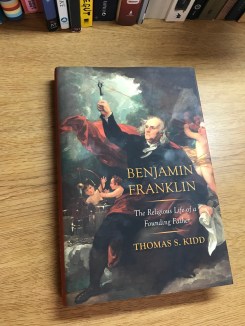
This week I read a history of one of the most influential men in American history, a Founding Father, printer, author, autodidact, aphorist, statesman, scientist, friend of Calvinist George Whitefield, and inveterate ambassador of discovery, education, and self-improvement. Biographies are among my favorite areas in which to read deeply, and Thomas Kidd’s bio of Ben Franklin did not disappoint.

Following is a form to provide a brief book review:

1. Overview

2 Quotation

3. Main idea

4. Questions raised/reflections

Overview:

 Kidd divides the book into nine chapters: 1) Child of the Puritans; 2) Exodus to Philadelphia, Sojourn to London; 3) Philadelphia Printer; 4) Poor Richard; 5) Ben Franklin’s Closest Evangelical Friend; 6) Electrical Man; 7) Tribune of the People; 8) Diplomat; and 9) The Pillar of Fire.

Kidd provides a clear overview of Franklin’s Calvinist upbringing and deep knowledge of the Bible; his prodigious work ethic and self-discipline; his staggering output of pamphlets, articles, ads and booklets as a printer; his deftness with proverbs; his lifelong friendship and theological foil with Christian evangelist George Whitefield; his discoveries in electricity; his educational and political honors and appointments; his government service; and his final days wrestling with the question of the exclusivity of the Christian gospel.

Quotation:

 Consider the following commentary by Kidd re Franklin’s self-help moralism:

If Whitefield preached transformation by God, Franklin advocated gradual reformation by daily effort, with biblical precepts as a guide. No internal change or divine regeneration was needed. Whatever the lingering influence of his Puritan heritage, this was a point on which Franklin clearly departed from the Puritans, and from their evangelical successors like Whitefield and Jonathan Edwards. In this focus on harnessing daily habits, Franklin was setting foundational precedents for that distinctively American, quasi-religious genre, the self-help movement. Franklin’s “The way to Wealth” and his Autobiography were ur-texts of that movement. (161)

Kidd excels in demonstrating the rich theological culture that existed in America in the middle of the 1700s due mostly to the robust evangelism of Calvinists like Jonathan Edwards and George Whitefield amidst the literacy rate of the nation seeking to separate from George and English dominion.

Main Idea:

 Kidd maintains his focus throughout the book on Franklin’s internal struggles. He (Franklin) was saturated with biblical knowledge but he never would concede the divinity of Christ, his virgin birth, or that salvation was by grace alone. Franklin sifted the Bible for moral precepts, acknowledging Jesus’ incomparable greatness, but would not, as far as historians can tell, ever trust in Christ and the gospel completely. Whitefield and Franklin corresponded for decades, and all the while, Whitefield pleaded for Franklin to trust in Christ alone, but Franklin persisted to trust in his own deeds as meriting favor with God, a clear indicator he had not embraced the gospel.

Questions raised/reflections:

 It is interesting to study a man as brilliant and gifted as Benjamin Franklin, one who was largely self-taught, one who explored the Greek and Roman classics, the Bible, philosophers like Locke, Hume, and Kant, theologians and pastors like Jonathan Edwards and George Whitefield, and never seemed to lose his zeal for discovery and learning. Despite his experiences of man’s butchery in the American Revolution, the slaughter of Indians by misguided zealots, and some of America’s birth pangs, he continued a rebel soul up until his end in this life. I wish he has listened more to his friend Whitefield and believed the Scriptures, rather than just quoting them when they suited his rhetorical purposes.

Lastly, if you wish to learn of this Founding Father, this contradictory man, this gifted writer and satirist, read Kidd’s bio of Franklin. Kidd writes so well that you may wish the book had been even longer.


Thoughts on Orwell’s 1984

IMG_1995This week I read George Orwell’s 1984. Published in 1949, the close of WWII was less than four years prior. Unimaginable horrors were replete: Hitler and the Third Reich; Nazis; the slaughter of 6,000,000 Jews; President Truman’s authorizing the dropping of atomic bombs upon Japan four years after Pearl Harbor, Hawaii was attacked by Japanese kamikazes; Mussolini’s fellow fascists in Italy; Franco’s fellow fascists in Spain; Lenin and later Stalin in the USSR; Mao in China … the list of totalitarian/socialist/communist tyrants in the 20th century alone staggers the mind. And Orwell’s 1984 still retains cogent warnings.

Published in the middle of the 20th century, 1984 imaginatively concretizes the horrors of tyranny, big government, and totalitarianism/socialism/communism by focusing on an ordinary man (Winston Smith).

How will Winston (a type of Everyman) endure when oligarchy replaces republicanism? Can the human soul endure when God is jettisoned and secular power replaces him? And what of beauty? Is literature possible in a world when bureaucrats determine the curricula? Will Shakespeare and Dickens survive in 1984’s world of Telescreens and Newspeak? Short answer: no.

Governments don’t stir the soul; reading Shakespeare’s Romeo and Juliet, however, does. When the media are merely arms of the government, and the masses (what Orwell terms the “proles” for proletariat) know only what government wants them to know, wisdom goes underground. And so do truth, goodness, and beauty.

The terms Orwell coined in 1984 endure. Big Brother, Thought Police, and Newspeak are just some of the examples. If you control the language, you control the message. And today, look at college and university campuses where Leftists demand “safe spaces,” and being called by pronouns that are in contradiction to their gender. Professing themselves to be wise, they’re fools. And it is shameful.

These examples from our day illustrate what happens when a culture abandons God, abandons reason, and abandons self-discipline. Orwell’s 1984 is still important.

First, are you paying attention to phrases en vogue today? Ever heard the phrase “safe spaces”? A couple of years ago, I was at military training with my unit and a female officer asked me if I would step out of the auditorium because she wished to speak to only female soldiers. That seemed understandable to me. But what caught my attention was when she said, “We are creating a safe space.” Huh? A space is now safe when any and all potentially dissenting views are prohibited. Verboten. Forbidden. Not tolerated. What is demanded is conformity.

Second, there is a loud and mean push in contemporary politics and discourse that demands—instead of reasons. Leftists demand a Christian baker, for example, go against his deeply held religious beliefs. If he won’t, they smear him as a bigoted moral monster. If he won’t contradict biblical morality, they set out to destroy him. So much for their so-called tolerance. In 1984, the individual is crushed by Big Brother and oligarchy. Power is stolen from the individual and reserved only for the all-powerful State. If the individual dissents, he/she is crushed via torture and/or indoctrination.

Third, Orwell dramatizes in 1984 what happens when people don’t know history. What they know is what the media have force-fed them. Instead of wisdom with regard to historical understanding, they have platitudes and bromides: WAR IS PEACE, FREEDOM IS SLAVERY, and IGNORANCE IS STRENGTH, for example. Clichés are not arguments; assertions are not arguments; platitudes are not arguments. But if the masses only parrot the media they ingest, shibboleths and slogans are what we get.

In 1984, a novel now 70 years old, I encountered a warning we should heed. We are drowning in information rather than standing upon wisdom.

We would do well to read deeply, to think through Orwell’s warnings from decades ago. We would do well to actually know and understand history. We might discover how we got to such a sorry place with regard to our conversations with one another. We might rediscover that masterpieces like Romeo and Juliet, David Copperfield, and 1984 were not produced by bureaucrats or governmental committees.

A Reading Log

IMG_1886We all have our struggles. One of mine is sleeplessness. But I’ve found at least some benefit: I can read during the nights. I’ve begun maintaining a reading log. Nothing fancy, but it helps in at least three ways. First, it helps me maintain a ledger of what I’m reading. Second, I am better able to see patterns among books and thinkers. (Some writers are worth more of my time; others have already consumed too much of it and I move on.) Third, a reading log provides a means of evaluating ideas.

Over the last several months, I have not written much blog-wise due to my current location with the military, but here is a list of some of my recent reading. In the left column is the book; the middle column lists the book’s author; and the third column is my response–usually just a fragment, phrase, or sentence or two. At the bottom are some of the volumes I’m still reading due to their length and/or weightiness. Hope you profit. My thanks to fellow readers who have pointed books and writers out to me that would have otherwise escaped my attention.

Book: Author: Response:
Suttree McCarthy Among the saddest books I have ever read. It may also be the richest book I read in terms of its delight in language and the fecundity of words. McCarthy is—his dark vision aside—a wordsmith on par with Joyce and Shakespeare.
Cormac McCarthy’s Nomads Andersen & Kristoffer A master’s thesis that was large on jargon and intellectual posturing and short on coherence and clarity.
Resolutions: Advice to Young Converts Edwards My only complaint is that I waited this long to read it. Edwards was certainly a theologian/philosopher, but in this volume, you also see he was a pastor with a love of discipling God’s people.
On Reading Well Prior A reminder that some of the world’s greatest literary pieces are explorations of the biblical worldview. A truly good book about books.
The Battle for the Beginning MacArthur I know of no other living Christian writer who is as biblical and clear as John MacArthur. In this volume, he tackles head on the mutually exclusive worldviews of biblical creation vs. macroevolution and materialism. An important book.
The Stranger Camus When I read it as an 18-year old, I thought it masterful. Now, er, hardly. A sad book about life without God, life without hope, and life without redemption.
In the Year of Our Lord Ferguson One of the best books I’ve read in recent memory. The bottom line up front: the true Christian church must always keep her focus on the truth, the gospel, Christ, and purity. Today’s pagan headlines are merely tomorrow’s fertilizer. Keep a biblical perspective.
The Brief Wondrous Life of Oscar Wao Diaz Reminded me why I don’t enjoy postmodernism or post-postmodernism. With its trendy style of blending genuine pity with trendy pop-culture and profanity and gender politics, this is just what literary committees adore, but it makes for poor literature. Who will want to read this modish stuff in a few years? Egads.
Killing Jesus O’Reilly This could be helpful for skeptics of the Christian worldview.
Killing Lincoln O’Reilly Very enjoyable. I learned even more to appreciate Lincoln and to pity him.
Killing Patton O’Reilly Leadership for Patton was what he seemed born for. He was a patriot, a very fallen and cruel man, but also courageous like few others. When hell stared him in the face, he spat and kept right on marching. And I thank him and those he led.
Animal Farm Orwell Communism/Progressivism/Socialism fails—everywhere and always. But dogs return to the vomit. And people often act like animals.
The Catcher in the Rye Salinger Hard for me not to gush here. In my view, one of the best novels ever, esp. with regard to narrative voice, point of view, and tone. A masterpiece.
Exit West Hamid People are not reducible to religion, ethnicity, and politics. The human heart is the problem; we are sinners and we need a savior—and government is not the savior. Ever.
Kidnapped by the Taliban Joseph There are good and bad folks everywhere. Sometimes good intentions lead you into bad situations. But grace can still appear and even endure.
I Know Why the Caged Bird Sings Angelou An anthem to the artist to sing—if for no else than himself/herself. Some will listen.
Tom Sawyer Twain I preferred Huck Finn. But similar episodes and themes are here—innocence vs. experience; corruption; escape vs. responsibility.
Blood Meridian McCarthy Perhaps the most violent book I’ve ever read (again). Horrific and beautiful. McCarthy descends into the pits of evil and reprobation, and takes us with him. There he writes in graphic detail. But it is so heartbreakingly beautiful in its expression that you endure the rapacity and cruelty and cannot see life the same way.
The Sun Also Rises Hemingway Immature adults taking themselves way too seriously and drinking way too much alcohol get mad at the state of the world, but refuse to take responsibility. This was a much better book when I read it as a 19-year old, if that helps. Probably the last time I’ll do this one.
The Sound and the Fury Faulkner A watershed book in terms of its use of interior monologue, non-linear time, flashbacks, stream of consciousness, etc.
Books Are Made Out of Books Crews A book about the books that have shaped Cormac McCarthy. Appreciative of this book.
A Long Obedience in the Same Direction Peterson Beautifully written by a man gifted with discernment, biblical maturity, and a pastor’s temperament.
Facing the Music Brown A book of Larry Brown’s short stories. Kind of like Harry Crews’ fiction, these are stories of down-on-their-luck southerners who ain’t got no quit in ‘em. Excellent fiction.
Larry Brown: A Writer’s Life Cash A biography of Larry Brown, of his determination, struggles, literary triumphs, and isolation necessary to create.
Everything that Rises Must Converge O’Connor It’s Flannery O’Connor. Read it. Then read it again.
Hitler’s Religion Weikhart Excellent, readable, researched book of Hitler’s worldview (pantheism).
Hillbilly Elegy Vance No matter how successful we are in the world’s eyes, we never really leave behind the boy or girl we were at 12. Our childhood affects us till we die.
A Wrinkle in Time L’Engle Childhood imagination sometimes portends divinity.
Desperadoes Hansen Literary western genre. Beautiful language. A bit slow going, at least for me.
Light in August Faulkner Rich in interior monologue. A slow read for me. The preacher was my favorite character.
Killing the SS O’Reilly There is no bottom to man’s evil.
Love Thy Body Pearcey Read Nancy Pearcey’s books. You do yourself a disservice if you don’t. Logical, persuasive, and clear. Excellent.
Go Set a Watchman Lee Even the folks we think of as ‘good’ are sinners.


Currently I’m reading Don Quixote and The Collected Stories of Lydia Davis. Both are excellent. Maybe this helps encourage you. It at least helps me to keep track of some of my reading life and helps me plot my future reading goals. “Take up and read.”