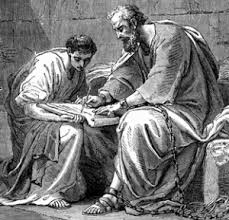
Chaplain Daily Touchpoint #254

Bottom line up front: The Biblical View of Reward

Introduction: Colossians 3 was one of the passages I was studying. Specifically, verses 18-25. I don’t understand it when folks say they can’t understand Scripture; letters like Colossians are replete with practical items. For example,

22 Bondservants, obey in everything those who are your earthly masters, not by way of eye-service, as people-pleasers, but with sincerity of heart, fearing the Lord. 23 Whatever you do, work heartily, as for the Lord and not for men, 24 knowing that from the Lord you will receive the inheritance as your reward. You are serving the Lord Christ. 25 For the wrongdoer will be paid back for the wrong he has done, and there is no partiality. (Colossians 3:22-24, ESV)

In modern parlance, we might say, “Keep it real” or “Be genuine.” Stated negatively, it would read like, “Don’t be a hypocrite, because God sees, and we will answer.” Stated positively, it would read like, “Work hard and properly because rewards are meted out via God’s standard, commensurate with what we did properly and for God’s glory.”

What the passage does NOT teach is that we merit favor with God by way of our works. What it does teach is that if we are Christians, our works will bear witness that we’re being transformed by the sovereign grace of God into vessels that reflect Christlikeness. As Paul writes in one of his other New Testament letters, “For we are his workmanship, created in Christ Jesus for good works, which God prepared beforehand, that we should walk in them” (Ephesians 2:10, ESV).

Encouragement: When we think upon Colossians 3:22-24, we see clearly that we’re to fear the Lord, to labor diligently for the Lord, and to trust the Lord to reward redeemed people. God crowns his own graces. That is, the fact that God would reward us sinners after rescuing us is grace upon grace. How much more, therefore, should our labors reflect said grace. We are told plainly not to aim to please men in a sycophantic way; rather, we are to labor faithfully because we know that we are ultimately evaluated by the scales of the Righteous and Holy One.

Sunday Morning Girls

As I pulled out of the garage and backed down the driveway, our sweet neighbors had two Sunday morning girls munching their sod. When the girls spotted me photographing them, they raised their heads, and cocked their ears. Their black eyes focused upon me, and their legs swelled readiness.

They are familiar deer, so they did not bolt. They watched me back the car down the drive. At the bottom, I put the gear shifter into ‘D’ from ‘R’ and ascended the hill.

Pretty ones, I’ll not harm you.

The rains have fallen much over the last three days, and we are grateful. The grasses are greening again, the leaves on the hardwoods deep-green from the lightning and nitrogen. You can hear the creeks running across the road and also behind the house.

The fawns will appear on this Spring stage soon–in their spots and frantic energy and skinny shaking legs, close to their moms, shaking with youthful energy, thirsting for summer’s lushness. And their sundry thirsts–those hundreds and thousands of creatures’ thirsts–will be slaked.

And 100% of it will be via the hand of providence. 100%.

Chaplain Daily Touchpoint #253: We Are What We Love

Bottom line up front: We are what we love.

Introduction: A book I read last year has remained in my thoughts. It’s been like a kernel in the mind, something that remains and calls for attention. The book was J.K.A. Smith’s You Are What You Love. One of the gems in Smith’s book follows: “ . . . . since our hearts are made to find their end in God, we will experience a besetting anxiety and restlessness when we try to love substitutes. To be human is to have a heart. You can’t not love. So the question isn’t whether you will love something as ultimate; the question is what you will love as ultimate. And you are what you love” (Smith, 10).

Connection to Our Everyday Lives: In designing teaching curriculum on moral leadership and ethical decision making for soldiers, many of the scenarios I’m posing soldiers revolve around the issue of the standard by which they make decisions. Is that standard permanent? Is it subjective or objective? If you say it’s objective, why does it change to reflect culture? What sources undergird that standard? In sum, ethics cannot be reduced to mental gymnastics about what came first, the chicken or the egg. We must think maturely about moral leadership and the foundation for ethical decision making.

Scripture: Psalm 115 puts it so clearly:

Not to us, O Lord, not to us, but to your name give glory,
for the sake of your steadfast love and your faithfulness!

2 Why should the nations say,
“Where is their God?”
3 Our God is in the heavens;
he does all that he pleases.

4 Their idols are silver and gold,
the work of human hands.
5 They have mouths, but do not speak;
eyes, but do not see.
6 They have ears, but do not hear;
noses, but do not smell.
7 They have hands, but do not feel;
feet, but do not walk;
and they do not make a sound in their throat.
8 Those who make them become like them;
so do all who trust in them
. (Psalm 115:1-8, ESV)

Verse 8 is such important theology: We become like what we love/worship. That was Smith’s thesis in his book. That’s the issue here in this psalm. Will we love truth, or will we love idols? That’s the always-fundamental issue, is it not?

Encouragement: May we love the truth rather than the idols. May we recognize that truth is revealed in Scripture, and that the Word became flesh and dwelled among us (John 1). There is a holy standard—fixed, unchanging, and altogether holy. May we love what we ought to love.

Warning: This Gets a Bit Highbrow …

Introduction: Plus ça change, plus c’est la même chose. The more things change, the more they stay the same. Why do I say that? Well, I’m going to try to accomplish two things in this piece. First, I’ll show the main takeaway of what God says via the apostle Paul in Romans 1. Second, I’ll show how it is demonstrated live on camera. No, I’ll not be the one on camera. Rather, it is two men who are hugely successful in their respective fields. Bret Weinstein is an evolutionary biologist who denies the existence of God. The second man is media giant Tucker Carlson, who claims to be not only a theist but a Christian. Their worldviews are in conflict. Weinstein is a materialist; Carlson is a theist. Let me break it down visually:

Weinstein vs.Carlson:
No God vs.God exists
Reality is reducible to material substance vs.Reality is both material and immaterial; the supernatural is real, too (not simply imagined).
Darwinian evolution vs.Biblical creation
Values are ‘useful’ but ultimately ungrounded on anything but the desire for power and continued existence. vs.Values are unavoidable, and they are grounded in God and in our nature as beings created in God’s image and likeness.
Good & evil are ‘narratives’/stories we tell ourselves. vs.Good & evil are realities we all know intuitively, and their parameters are defined by God in Scripture.

Text of Scripture: Romans 1:18-23, ESV is the passage I promised in my opening. Here it is:

18 For the wrath of God is revealed from heaven against all ungodliness and unrighteousness of men, who by their unrighteousness suppress the truth. 19 For what can be known about God is plain to them, because God has shown it to them20 For his invisible attributes, namely, his eternal power and divine nature, have been clearly perceived, ever since the creation of the world, in the things that have been made. So they are without excuse21 For although they knew God, they did not honor him as God or give thanks to him, but they became futile in their thinking, and their foolish hearts were darkened. 22 Claiming to be wise, they became fools23 and exchanged the glory of the immortal God for images resembling mortal man and birds and animals and creeping things.

The link to Tucker’s video:

I was walking outside as part of PT when I listened to this recently. Let me say a heartfelt thank you to both men. Tucker was a gracious host, sometimes pithy and witty, and at other times a very sloppy theologian, but was kind throughout. Bret was likewise very kind, respectful, measured, but absolutely inconsistent in his worldview. Here is what I mean: How can a materialist ground words and concepts like ‘good’ and ‘evil’? How can he justify using the value-laden terms like “We should do this …” or “We shouldn’t do that”? What role does ‘should’ have in a universe where all is material? We are, in Weinstein’s worldview, sometimes (on the good days, you know) cooperating germs, grown-up cosmic dust, that for some reason wants to have an audience via podcasting and the writing of books and teaching in the academy.

As a Christian, I was embarrassed by some of the unfortunate things Tucker said about the Old Testament and New Testament contradicting one another; they do not contradict. They reveal a progressive story of Creation, Fall, Redemption, and Restoration, but they most certainly do not contradict one another. The Old Testament is the gospel concealed; the New Testament is the gospel revealed, as has been said countless times in church history.

Again, my heartfelt thanks to Tucker for broadcasting his debate with Bret. I’m grateful for the levels of respect demonstrated by both men. But what I took away from it all is that PhD. so often just means “Piled Higher and Deeper.” In other words, there was so much sloppy thinking, so much self-referential absurdity, so much contradiction by Weinstein that I had to laugh more than a few times.

I commend this episode of Tucker’s podcast to you, and welcome thoughtful feedback, as Romans 1 was on full display by the materialist interviewed by Tucker.

Chaplain Daily Touchpoint #252: Solomonic Wisdom about Mission Creep

Text: It’s a short psalm from Solomon. Its wisdom remains:


1 Unless the Lord builds the house,
    those who build it labor in vain.
Unless the Lord watches over the city,
    the watchman stays awake in vain.
It is in vain that you rise up early
    and go late to rest,
eating the bread of anxious toil;
    for he gives to his beloved sleep.

Behold, children are a heritage from the Lord,
    the fruit of the womb a reward.
Like arrows in the hand of a warrior
    are the children of one’s youth.
Blessed is the man
    who fills his quiver with them!
He shall not be put to shame
    when he speaks with his enemies in the gate. (Psalm 127, ESV)

The Matter of Definition: “Mission creep” is military jargon for a loss of focus upon the initial mission. Mission creep is usually accompanied by many qualifiers and exception clauses, to such a degree that the initial point of the mission gets blurred, obfuscated, or even lost.

Question: When it comes to our ethical and moral leadership, how much more important is it that we fight to prevent mission creep? In plain language, we ought to be diligent to “keep the main thing the main thing.” The fundamentals, in other words. “Putting first things first” is the way a curriculum I often teach soldiers phrases it.

To revisit the question, then, When it comes to our ethical and moral leadership, how much more important is it that we fight to prevent mission creep? This is one more example of God’s wisdom for all who will heed it. Solomon, a man who was often the sage (and other times the fool), he reminds us in the 127th psalm that it is possible to “labor in vain” (Ps 127:1a, ESV).

How’s it possible to labor in vain? Well, if we labor for the merely temporal, we forfeit the eternal. As Paul phrases it, “So we fix our eyes not on what is seen, but on what is unseen, since what is seen is temporary, but what is unseen is eternal” (2 Cor 4:18, ESV).

Christ himself phrases it this way: “For what will it profit a man if he gains the whole world and forfeits his soul? Or what shall a man give in return for his soul?” (Mt 16:26, ESV)

Teaching: Throughout the 127th psalm Solomon emphasizes the same theme: We can work ourselves to the bone, but if we’ve built on foundations of sand, the edifice is fatally compromised and will both fail and fall. Why? Because it was not founded upon the truth. It was a house of cards.

Encouragement/takeaway: Let us admit that the easiest thing in the world is to be distracted. This is surely the Age of Distraction. That’s mission creep by another name. Mission effectiveness, hearing “Well done, good and faithful servant/[soldier]” requires laboring for that which endures because it is founded upon truth.

Chaplain Daily Touchpoint #251: When Mimesis Is Good

Question: Ever heard the expression, “He/she is one-of-a-kind”? Probably so. We can be tempted to think that originality is invariably a good thing. But I know of no one who does not model himself/herself on others. And I would like to proffer the thesis that imitating the right people is not only biblical and mimetic, but wise.

Scripture: There are paragons galore from which I could pick. But Paul’s words in Philippians are so clear when it comes to this theme of imitating the right people–not just anybody, but the right people:

Brothers, join in imitating me, and keep your eyes on those who walk according to the example you have in us. For many, of whom I have often told you and now tell you even with tears, walk as enemies of the cross of Christ. Their end is destruction, their god is their belly, and they glory in their shame, with minds set on earthly things. But our citizenship is in heaven, and from it we await a Savior, the Lord Jesus Christ, who will transform our lowly body to be like his glorious body, by the power that enables him even to subject all things to himself. (Philippians 3:17-21, ESV)

Teaching: Did you catch Paul’s command to imitate the right people? It’s right there in verse 17. First, he tells the Philippians to join in imitating him (Paul). Why? Is that Paul’s hubris surfacing? No. On the contrary; Paul had grown to hate his former pride and Pharisaism. He was the meekest of Christians now, pastoring, planting churches, arguing with skeptics in the synagogues, and offering reasoned defenses of the faith with skeptics and all who would listen.

Second, he tells the Philippians that many “walk as enemies of the cross of Christ” (v. 18). In other words, know that you have people working against God and against God’s people. So, be wise. Be vigilant. Be diligent. Be steadfast. Be of good courage.

Encouragement: Mimesis is simply imitating those you admire. It’s right and proper. You could aim to be original in everything, but you might just end up being a new kind of failure. Paul tells us not to do that. He tells the Philippian believers the same lesson he tells believers today: Imitate the godly heroes of the faith. Imitate their depth, their wisdom, their service, their love, their courage, their faithfulness.

Chaplain Daily Touchpoint #250: It’s So Easy (& Tempting) to Miss

Text: “that I may know him [Christ] and the power of his resurrection, and may share his sufferings, becoming like him in his death, that by any means possible I may attain the resurrection from the dead” (Philippians 3:10-11, ESV).

Context: A prison letter, that’s what Philippians is. The apostle Paul was writing to this congregation of Christians in Philippi (present-day Greece).

Paul had several reasons for writing to them:

  • to thank them (1:3)
  • to remind them of the faithfulness of God, especially amidst trials (1:6)
  • to encourage them to love and serve one another (1:9)
  • to remind them to have courage amidst opposition (1:27-30)

The list could easily continue of reasons Paul wrote to these people he loved.

Teaching: I would guess that Philippians 4:13 is one of the most decontextualized and misapplied and misinterpreted verses in all the Bible: “I can do all things through him [Christ] who strengthens me.” It’s often reduced to kitsch on jerseys, helmets, and coffee mugs. And many folks have no idea what the letter of Philippians is all about. It’s written by a Christian man who is incarcerated for telling the truth in a pagan world system, and that system’s leadership hated the truth and the heralds of that truth. Here, that herald is Paul in the 1st century A.D.

That’s why it’s so easy to miss this whole verse: “that I may know him [Christ] and the power of his resurrection, and may share his sufferings, becoming like him in his death, that by any means possible I may attain the resurrection from the dead” (Philippians 3:10-11, ESV).

When’s the last time you heard of Christians being taught that verse fully and in context?

More often than not, Christianity gets pitched like it’s candies of blessing for children rather than divine doctrine for theological battle.

Paul teaches that we are to embrace suffering that comes by virtue of laboring faithful in Christian ministry. We’re to count the costs, in other words. We’re to know that because Christ suffered, his people will suffer. It’s not all sunshine and rainbows. Christianity is not candies of blessing for children but rather divine doctrine for theological battle.

Encouragement: To be encouraged from the Scriptures is foundational, but that entails not glossing over the hard parts, not ripping verses from their context, not turning verses into t-shirt slogans, but instead living them out via transformed lives as those who’ve counted the costs, who’ve spent times of depth in the Scriptures, and who, by God’s grace, are allowed to fight on another day.