If you enjoy satire by a short story master, join me as we look into Eudora Welty’s gem, “Why I Live at the Post Office.”
Thanks for tuning in and subscribing. I appreciate it.
Tolle Lege.
If you enjoy satire by a short story master, join me as we look into Eudora Welty’s gem, “Why I Live at the Post Office.”
Thanks for tuning in and subscribing. I appreciate it.
Tolle Lege.


Stillness speaks.

Visual sermon.

Gray squirrel on the cross ties.

Sunlight dancing on leaves.




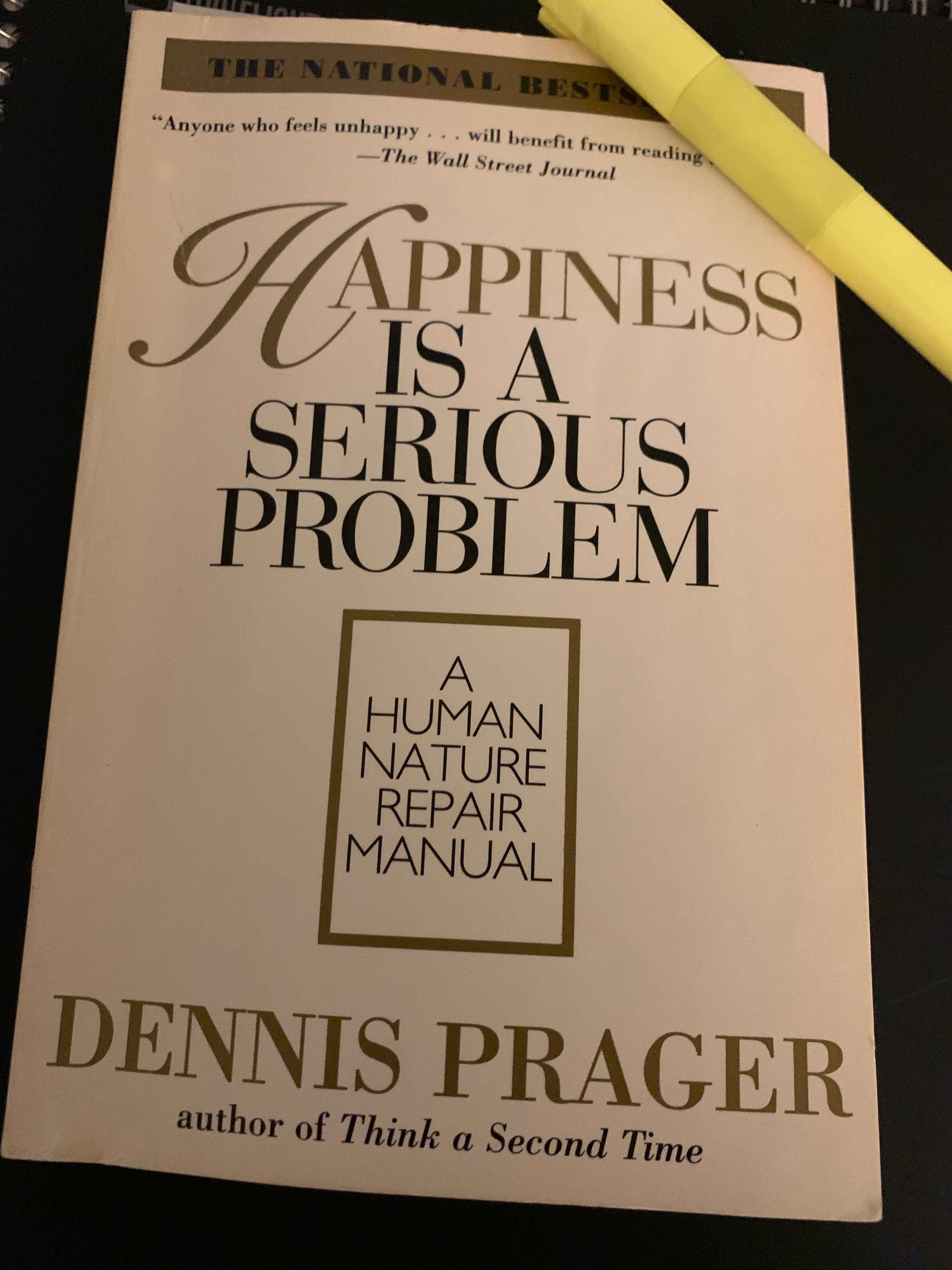
A few years ago I was reading a survey of influential writers through church history, and the writer commented that some books are worth a profound sentence or two. I tend to agree. The counter-argument is easily anticipated. “Why read an entire book just for a profound sentence or two?” Well, wisdom is often conveyed via the proverb, the maxim, the aphorism. I read more than anyone I know and even the best of books have some slow parts (Shakespeare’s tragedies, I would argue, are obvious exceptions to the generalization).
This week I read another of Dennis Prager’s books: Happiness Is a Serious Problem. I devoured the book. Prager is a conservative thinker, theologian, radio host, and writer. His book, Still the Best Hope, is a gem I wish everyone would read.
But when I read Happiness Is a Serious Problem, this was the part worth the price of the whole book:
This is where the modern secular world often undermines people’s happiness. A purely secular understanding of existence can only mean that the world ultimately has neither purpose nor meaning. This is not the place to argue which view of the universe–the religious understanding of a purposeful universe or the secular understanding of a random one–is more accurate. There is, after all, no way to know. What is knowable is the consequences of the two views.
If there is no God, no Higher Being, no ultimate guiding hand that imbues creation with meaning and purpose, then creation does not have those qualities. As much as we may find our work, family, friends, and social causes a source of meaning, a secular universe means that there is no ultimate meaning to any of these things. We have made up all these meanings in order not to despair. It is quite difficult to be happy if we stare into the mirror each morning and see only the random product of meaningless forces, stellar dust that happens to be self-aware (105).
The rest of the book is worth the time and investment, but those two paragraphs approach the heart of the issue.
As I try to minister to a generation who has largely bought the secular lie that they are just cosmic dust but should, for some purely subjective non-anchorable reason, feel their lives have significance, this binary seems so obvious.
Definitely worth the read in my view. Tolle Lege.

‘Twas a few decades ago when I met my bride-to-be. There were several things about her that struck me right off. But one particular characteristic was overt: she was brutally honest. She called a spade a spade. I could tell right away I would not have to wonder what she was thinking about any issue.
This morning after breakfast I checked my phone to read the text messages that had come in during the night. One was from her. It read in part, “Good morning my love already up and worked out read my Bible but most importantly prayed for you . . . ” No fluff. Just a sweet early morning greeting with a snapshot of her morning and a reminder that she had already prayed for me.
Because it was a text, the grammar was not the heart of the issue. (Anyone who knows me knows that my blood pressure spikes at the pervasiveness of atrocious grammar.) The heart of the issue was what it revealed about her, about her prayer, about her commitment to petition the Lord on behalf of her husband.
As I completed my morning regimen, I did my PT (physical training), my studies in Scripture, and prayed, I was encouraged by the wife God gave me.
Solomon wrote “An excellent wife is the crown of her husband” (Proverbs 12:4, ESV). She is a crowning achievement, a visual symbol of that which is beautiful.
This week my bride and I will celebrate over two decades of marriage together. I used to think I loved her thoroughly when we were younger and thinner and I could still hear and my hair was brown instead of gray. I did, of course.
But as the years have worn on, there are deeper beauties I have grown to treasure, too. And one of those deeper beauties is her commitment to brutally honest prayer.
When you wake to find your wife has texted you that she’s already prayed for you that morning, and you have a day of military duties ahead and ministry obligations that often remind you of man’s fallenness and of this world’s brokenness, it is salve for the soul, cold water to a thirsty spirit, to be reminded that “He who finds a wife finds a good thing and obtains favor from the LORD” (Proverbs 18:22, ESV).
Happy early anniversary to my Carrie Jane. You are loved.



“Sir!”
I didn’t hear her because I had my music playing out of my phone as I was walking. Plus, I’m deaf as a post, too, so there’s that.
“Sir!” she said again, walking briskly towards me.
She was a girl, out for a jog on the sand track. Her brown hair was in a ponytail, and she wore a black tanktop, pink running shorts, and running shoes.
“There’s a snake over here, and I wanted to make sure you saw.”
“Oh,” I said. “Thank you.”
I had been walking under the oaks and letting my memories of the live oaks from childhood take me where they would. I don’t know why but I’ve a fascincation with live oaks.
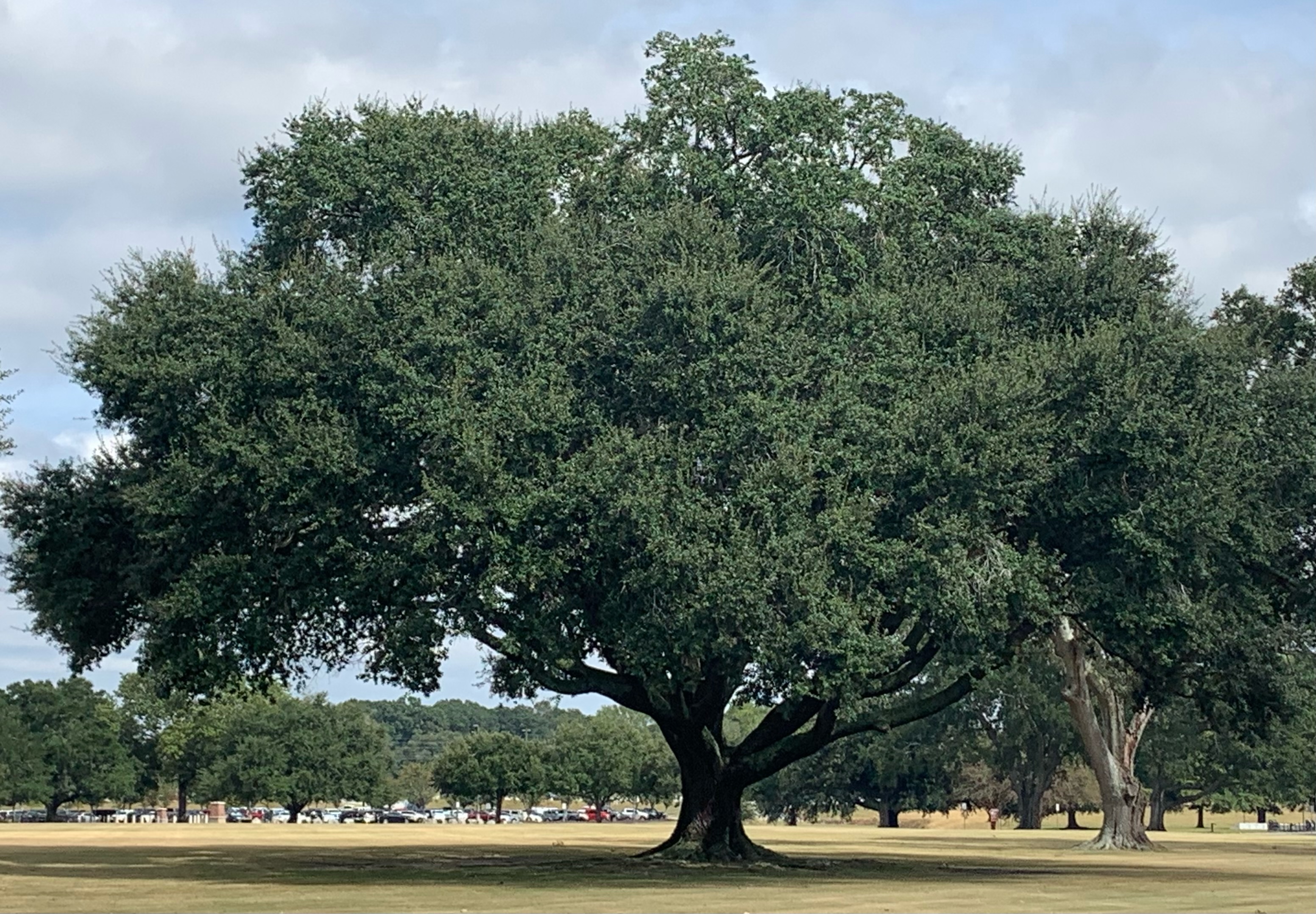
I love just about everything I’ve learned of them, how and why they develop the ways they do, why their wood is so valuable, why they take so long to mature, how they reproduce, how and why the acorns are shaped differently from other varieties of oaks, etc.
“Is he poisonous?” she asked.
“I’m not sure. But I’m sure someone will know.”
I snapped a picture with my old i-Phone, and the serpent slid away from me, wanting to be left alone.
The three of us parted. The girl resumed her jog. I resumed my walk. The serpent made off into the grass.

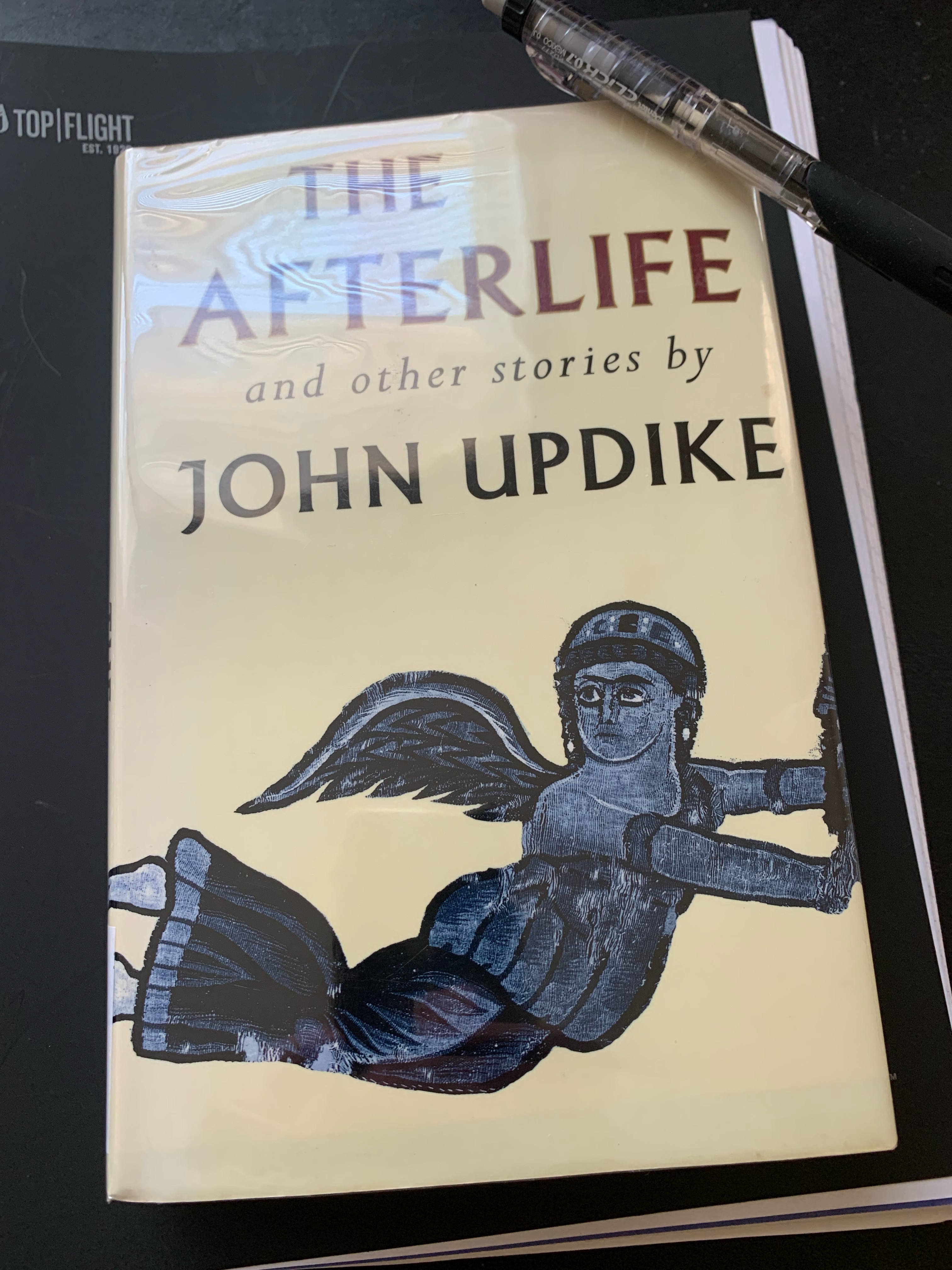
Again, my thanks to my buddy Greg for keeping my book habit going. He sent me another volume of a writer I never tire of reading: John Updike. Thank you, Greg.
I am not quite through this volume you sent me, but should be by the end of this week.
The stories I have read so far are typically Updikean. They’re meticulous examples of Updike’s precision and detail. I know few writers (perhaps Nicholson Baker in this generation, or Flaubert or Dickens in earlier generations) who name fashion (women’s and men’s) with such accuracy. I find myself looking up words all the time with Updike, but the labor is more than worth the work.
The same Updikean themes are evident in this volume of stories, too: marriage, divorce, appearance vs. reality, accomplishment (or lack thereof), God vs. the void, adulteries of various kinds, hope vs. despair, and death.
No small ideas with Updike, in my view. He used the mundane as his canvas in order to display the profound.
Art is about particular detail, arranged intentionally, crafted to herald messages and meaning to those with eyes to see and ears to hear.
And few crafted so well as John Updike.
Came home for the first time in a long time. ‘Twas so good. My favorite time of year, too. The weather was perfect.
Read some more of King Lear, a Poe short story, some C.S. Lewis, and studied Hebrews.
Played with the dogs (and cat). Piddled on the property. Saw the fam, too.
Relished the colors of the leaves, the crispness in the air, the cerullean sky.


Grateful.
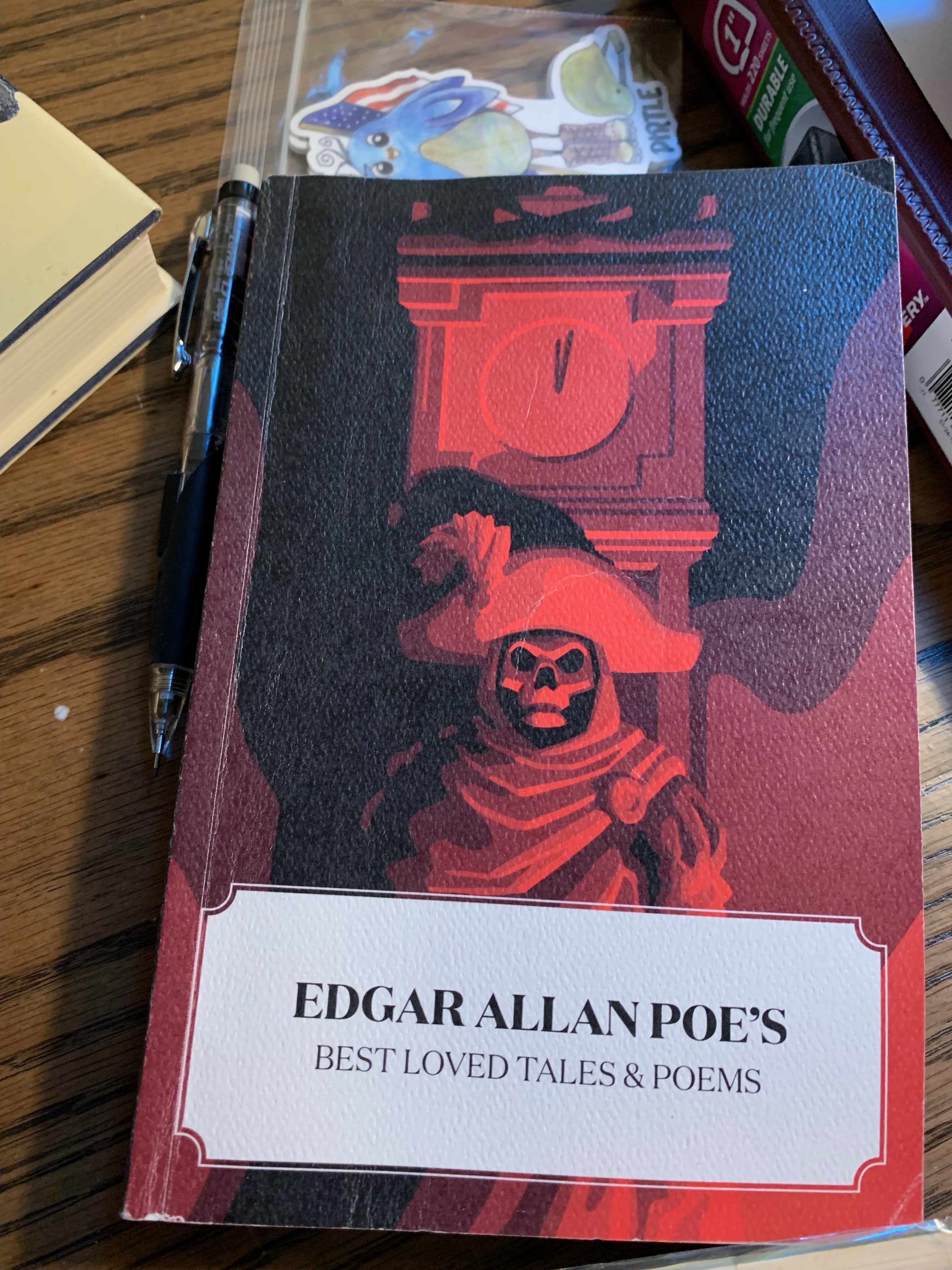
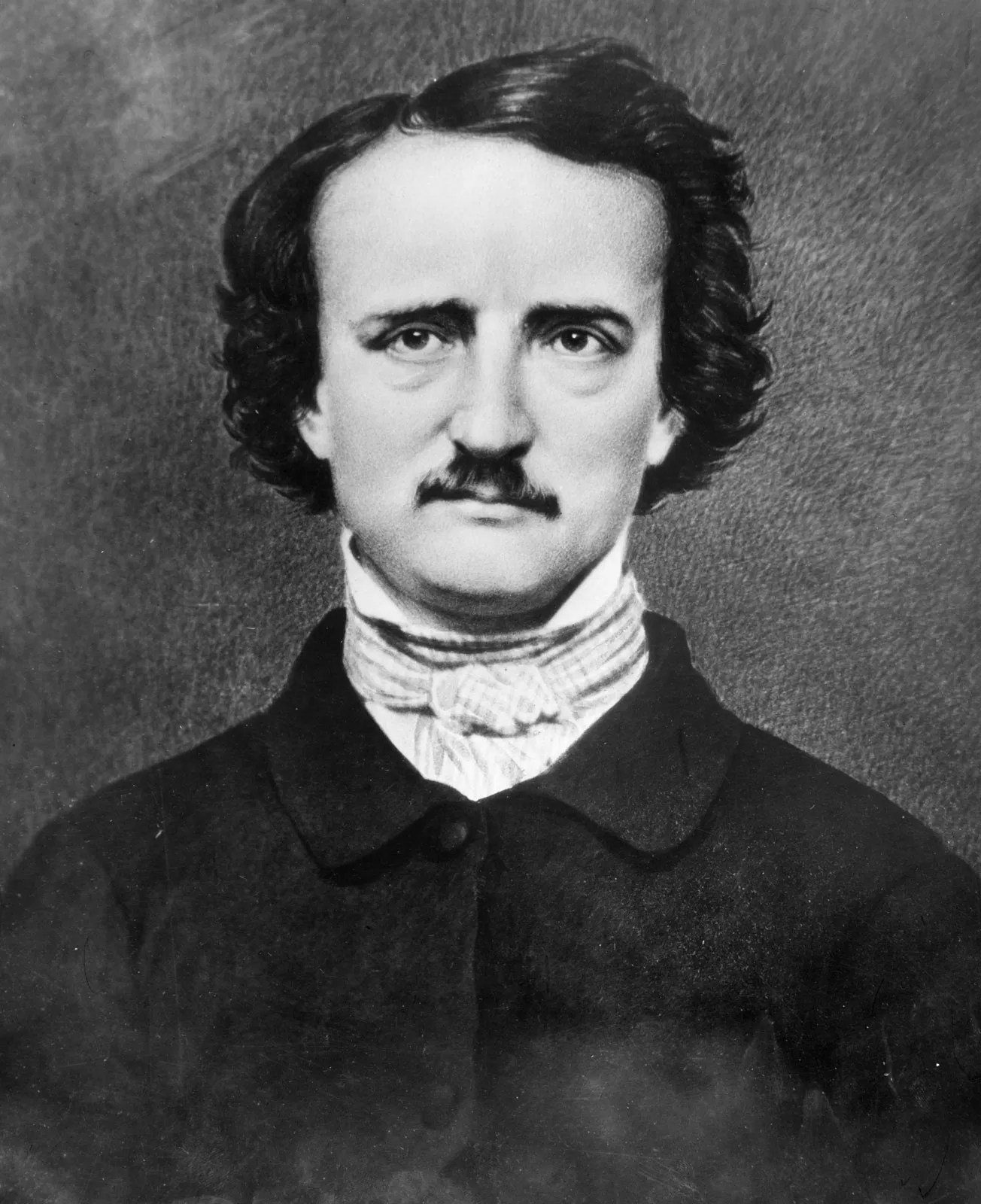
Reread “The Pit and the Pendulum” today by Edgar Allan Poe.
Some of the Poeesque word selctions:
I will not spoil the short story’s ending. But it is, shall we say, a cliffhanger.
I remember one time after having visited Whitman’s apartment in Camden, NJ, I made a literary pilgrimage to some of Poe’s old domiciles in Pennsylvania.. They were, as one might expect, masonry, dark, dank, often underground, and cloistered.
I have not made my mind up regarding Poe, and about where he stood. He seemed to be open and susceptible to perhaps too much and was perchance ill-equipped at moderation.
But he spun some magically tantalizing and horror-laden tales from realms of existential torture. About that, there is no doubt.


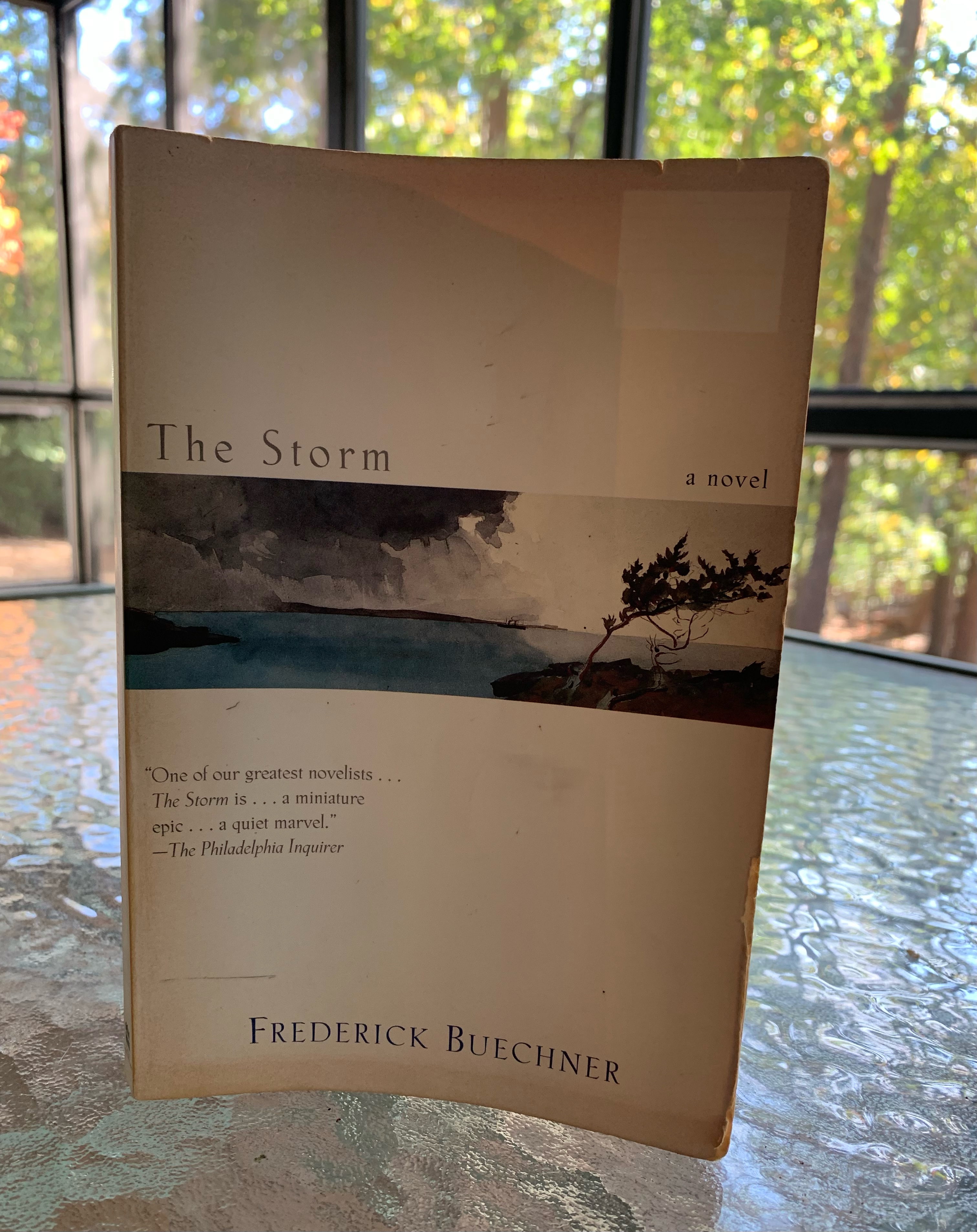
Fred Buechner’s novel The Storm centers on whether life’s storms have overarching meaning, whether (pun intended) the souls men of women, boys and girls, are within the sovereign wise counsel of God and his providence or whether this seemingly random, chaotic, temptest-tossed life is, in the end, merely a storm with no God of the storm.
It’s a slow book, at least it was for me, despite its brevity (199 pages). It centers on a handful of characters, all trying to come to grips with their broken lives. Kenzie, the protagonist, is a man who cannot forgive himself for his adulteries and for his secret life. He pines for forgiveness, crying out (to God?) for forgiveness, for atonement.
He sees unbelievable beauty and brokenness in the world and in himself and in others. How to explain such beauty? Is it all just random matter in motion? Is beauty an illusion? Is the longing for a metanarrative a fool’s errand? Are we all just mad here, after all, a la Carroll’s Alice in Wonderland?
I’ve read all but one or two other books from Buechner’s pen, and I suspect, based upon his substantial body of work, he believed in God and his providence, but that he (Buechner) was often double-minded and unstable in many ways (James 1:8). And the storm as a trope was the fitting image, the allusions to Shakespeare’s romance of the same name notwithstanding. Kenzie is the Prospero-type protagonist. Here is a glimpse into Kenzie’s thinking late into the novel:
For a moment he thought that for the third time in his life he was going crazy. If the world wasn’t coming to an end as he had once thought it was from the arrangement of knives and forks on his brother’s table, it was at least coming apart. He was coming apart. If the young woman beside him was telling the truth, it meant no more than that she was Kenzie’s illegitimate daughter. But maybe it was the young woman who was crazy. In that case how could he know whethere she was telling the truth or not, how could she herself know, how could anybody know anything for sure? Maybe there was simply no truth to tell, no order to things, no fixed point to give him his bearings, but only confusion and chaos. He could feel his calp going cold as ice and was afraid that he was about to start weeping (114-15).
This is why, in my view, The Storm is about pining. It’s about the human longing for the metanarrative, if it exists, that explains both the comedy and tragedy that characterize human history.
 MIND & MATTERS