





Reminders of what?
“God’s works of providence are his most holy, wise, and powerful preserving and governing all his creatures, and all their actions” (WSC, 11A).
Reminders of what?
“God’s works of providence are his most holy, wise, and powerful preserving and governing all his creatures, and all their actions” (WSC, 11A).
The transliteration is koinónia. It is κοινωνία in the Greek. It is usually translated into English as fellowship. Synonymns are “sharing in communion” or “participation/fellowship in the spirit.” Why the dive into words? In short, because they matter. In Scripture, the word occurs twenty times. Each time, it is associated with fellowship, enjoying a common joy communally because the members share a common relationship of Christian bonds.
This weekend I was able, once again, to be with some folks I adore. A couple from class opened their home to us and we brought food and the appetites. The hosts, too, prepared food and their home, and the Lord used the koinonia to encourage his saints.
We gathered ’round the tables spread with the labors of the ladies. The host prayed. We dug in. We laughed. We ate ham and potatoes and macaroni and apple pie and brownies and sweet potatoes and ice cream, and some sipped coffee or drank sweet tea. And some of us went back for seconds. More casseroles, meatballs, dirty rice, broccoli and cheese, and on and on. It was all delightful–the food, the beautiful home, the sunny Saturday afternoon.
I was sitting on our hosts’ back porch with six or seven other men, plates of goodness on our laps, and we chatted of the blessings of our church, of the gospel, and we watched three whitetails cross quietly across the backyard, just inside the line of trees. I am like a boy still when it comes to relishing nature. I watched the deer as they in turn watched us. I love to see them and the way their black eyes pulse with awareness, the way they stomp to alert the other deer that, “Hey, watch out. There are people over there!” kind of communications. Their long taut ears rotate back and forth like brown satellites, absorbing the intel.
Then a hummingbird came up and started feeding from the lilies behind the house, too. Beautiful. Little trumpet-shaped lilies just a few feet the other side of the screened-in porch. The hummingbird’s silent wings flapped soundlessly but with breathtaking rapidity.


And earlier that day, a friend from the group, my buddy Jim whom I call my Barnabas, had emailed me photos of his favorite birds, the ruby-throated hummingbird, and it was again witnessing natural theology displayed, God speaking through the things he has made.


Sometimes when I think on such things, I look back in shame at the time I was a secularist. I had no one to thank for beauty. The universe in a secular worldview is just a cosmic accident, after all. It makes no sense to thank matter. Gratitude only makes sense if the world is superintended by personality. In other words, it’s God’s world and he has communicated part of his nature by the things he has made (all of us creatures).
That’s why poets write of trees and breezes and dawns and gloamings and why sonnets are penned of beautiful women the poets loved and why poet e.e. cummings wrote spring was puddle-wonderful and mud-luscious.
As I drove back to my place this evening, the cup of my soul was full. I had fellowshipped with the saints; I had talked with a sweet friend of our common love for all things C.S. Lewis; I had been encouraged by fellow men and women who see the world as God has revealed it, broken but beautiful, awaiting redemption.
Lilies, whitetails, hummingbirds, food, fellowship … and, well, koinonia. It’s enough to make you say, Thank you. And to understand why gratitude is fitting.
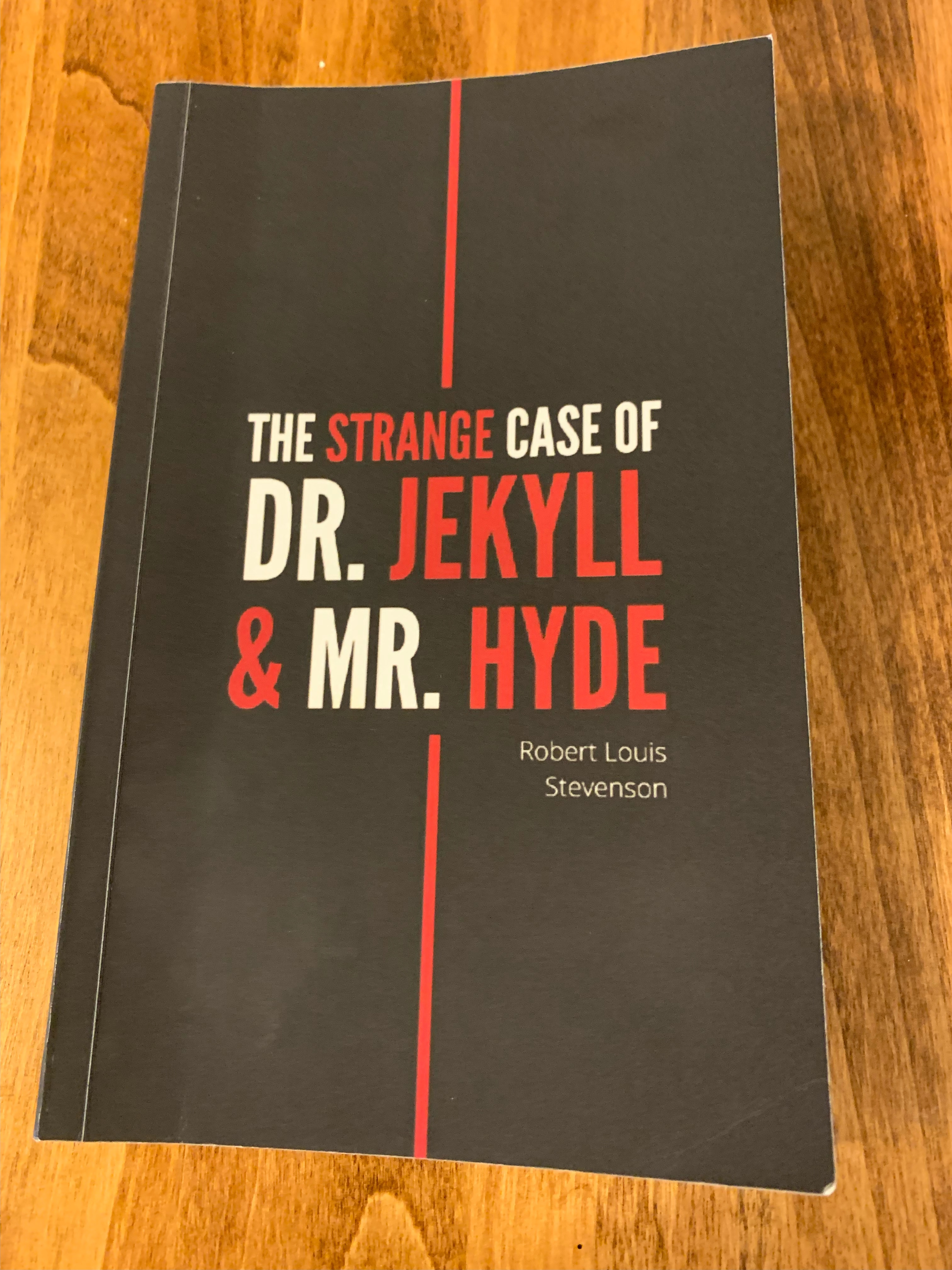
Piece 1: I don’t think I had ever read Stevenson’s The Strange Case of Dr. Jekyll & Mr. Hyde until this week. Not sure how I missed it but it reminded me of a theological truism: man is capable of both great good and great evil. For much of the novella, I was confused. Who was being critiqued? Was it Jekyll, Hyde, Utterson, or Lanyon?
I am a rather dedicated reader, so I hoped I was not guilty of not paying close enough attention to the story as I read and pondered. Eventually, however, the story came into clearer view for me, like I was emerging from a fog onto a clear sea with the shore again in view.
Stevenson was exploring dualities of good and evil, of course, but also worldviews. Is the universe a closed system? Is there no transcendence? If so, on what grounds is anything objectively good or evil? Objective good and evil presuppose a transcendent standard by which to define the terms.
Were the universe a closed system, who gets to define what is ghastly, sordid, or wrong? Why would Hyde’s behavior in the novella be deemed evil in a closed universe? If one were logically consistent, he could not use moral categories because there would be no God or objective morality.
But the fact that we are repulsed by Hyde’s behaviors demonstrates the Romans 1 and Romans 2 salvos of truth–that the law of God is written on our hearts and that we are without excuse.
Piece 2: This week I received an email from a member of our Sunday school class with a devotional in it that came from reading the Old Testament prophet Amos. Specifically, Amos 6:1 was explored. That verse reads, just in the first part of the line, “Woe to those are at ease in Zion.” Why the oracle of woe? Because God is, because he is holy, and because he judges sin. He cannot overlook sin. Otherwise he would not be holy.
Amos is replete with the image of God setting a plumb line in the midst of his people (7:8). In Amos we see that God is, that God is just, that God deals with sin and with us sinners. It’s not a closed universe. There is objective good and objective evil.
Hyde was a moral monster, to go back to Stevenson’s novella. But that is the wicked human heart. Amos the prophet called out to his generation, and his word still calls out to each generation with the offer of the gospel of hope. But we have to embrace it via repentance and faith in the true God, the true Christ, the true gospel.
Piece 3: Today I was leading a small Christian worship service with some young soldiers. One of the lieutenants said to me as we chatted, “Chaplain, I was at your last service. I really liked it. You taught the Bible, not other stuff.” Then I asked him to tell me his story. He was a college graduate, and married. He and his wife have their first child due in a few months. Then he told me something that really resonated with me. He said, “We found a solid church. And they sing the great hymns. It’s not all the drivel. And they root everything in the Bible. My wife and I love it, chaplain.”
Takeaway: I reflected upon this week’s ministry, and after having read about Jekyll & Hyde, and having gone back and read through Amos again, and pondered on the encouraging words from that lieutenant today, and having thought about how many of the great hymns teach biblical theology, and lamented the drivel that so often characterizes so much ‘praise and worship’ music currently, I still was encouraged.
I was encouraged. Why? Because some do see. Some have spiritual eyes and ears to know the truth when they hear it. They recognize that the universe is not closed, that God has spoken, that judgment is real, and that God has indeed set a plumb line in his world.
Most of all, perhaps, I was encouraged because I’d taught from Luke 8 today before I’d chatted with the lieutenant. And the last verse I’d focused on was verse 15: “As for that in the good soil, they are those who, hearing the word, hold it fast in an honest and good heart, and bear fruit with patience.”
Holding the truth fast in an honest and good heart. That’s a work only God can begin and complete in our hearts–our hearts, which are so often more like Hydes than Jekylls. But thanks be to God, God has done what we neither would do nor could do without divine grace–quickened the spiritually dead, created Pauls from Sauls, rebuked Jonahs to go to Nineveh, after all, with the great good news of the gospel.
From my Barnabas, my encourager-friend, Jim, here are some August beauties:











Scripture: Today in my time of study I came again to one of my favorite phrases in Scripture, balm in Gilead. It comes of course from Jeremiah 8. The prophet is grieving for his people, for his nation. He knows exile and captivity are coming quickly because of the people’s sin, because of their refusal to repent and return to the Lord. And Jeremiah asks this question: “Is there no balm in Gilead?” The question is rhetorical, of course. The answer is yes, there is a balm. There is a Savior. The Savior is the Lord.

Segue: I am blessed, especially over the last 10 months or so, to have a job and a ministry unlike any I’ve ever had. I’m surrounded by folks, many of whom I adore. I’ve met guys that I don’t think will every leave my memory or my affections. They are unbelievably fit, at least physically. They are hungry to prove themselves. They are eager to make an impact. I see them perhaps better than they see themselves. Many of them are future leaders, perhaps even world leaders. They are gifted, charismatic (leadership-wise, not in the Pentecostal sense), and they long to cast a long shadow. For some it is just vanity; for others it is a recognition that they’ve been entrusted with giftings.
Encouragement: But on a personal note, perhaps my greatest blessing over the last near-year has come by way of a man that I sense God provided to me (and to others) because we needed him. I have a boss who is not just a boss. He is a man with a gift unlike anyone else I’ve ever worked for. I want to work hard for him. I want to please him. I want to earn his approbation. I long to make him and this organization look good. It’s not bootlicking or obsequiousness. I have always worked hard for my bosses. But this man is different. He works as hard or harder than we do as his soldiers. He does not boast about his accomplishments. He talks to us like we are his friends. He does not condescend. He has offered to pray with and for me and my family. Things like that.
Takeaway: Why do I share such personal matters? Because it is important to encourage those who need it. It is important to say, “There is good about; there are good men (and women) in positions of power.” There are seven thousand who haven’t bowed the knee to Baal. The Lord has stationed warriors, stalwart warriors, in this world. The sons of Korah wrote, “Even the sparrow finds a home, and the swallow a nest for herself,” and I just want to utter a similar sentiment, though with less poetry: I am thankful for the opportunity and my aim is to be faithful to those who are faithful.
The way my day began I could scarcely have improved upon. I had been able to get home this weekend and see my wife and one of the children. I had had a home-cooked meal. I had played with my dogs. I had watched the deer just outside the kitchen window. I had piddled in the yard. I had listened to my wife play piano and sing in church. I had been with my Sunday school class and pressed on in the crucial book of Hebrews. I had sat beside my son in church. I ate lunch with my family at a restaurant just down the road from the church where the burgers are great, the sundaes are on point, the chicken is fried just right, and the employees come and ask if they can clean your table. It was, as cliche as it sounds, a good day. Then I drove back down to post where I work.
For the first two hours on the road, no issues. Just normal Sunday afternoon traffic on interstates and highways I know as well as I know my own hands. When I got south of the city, still everything seemed normal. But when Interstate 85 and 185 split, both sides of the interstate were stopped. A blue GSP vehicle was parked in the grass median. Cars coming north were backed up as far as I could see. For miles. It was sunny at the time and I could see well over a mile. And as far as I could see, vehicles were stopped.
Because I was driving south, and because the accident was not on my side, I was just one of the many who passed the tragedy, but not without looking: it seemed a car had clipped a motorcyclist. The interstate was full of leather-clad motorcyclists, scores of them. They had pulled off the interstate beside the crumpled car and the invisible motorcycle. The rider (riders?) of the motorcycle was/were not seen. I don’t know if he/she/they was/were under the crumpled car, obliterated, smeared on the interstate, or perhaps had been catapulted into the woods parallel to the interstate.
A sick feeling attacked my stomach. None of us drivers could not look, however. It seemed impossible not to look. And still, the motorcyclists came. They rode slowly up the emergency lane to come stand alongside the interstate and await the helicopter (surely!) that would arrive, and ambulances, and firetrucks, and EMTs, etc. It was horrible. And it must’ve happened just seconds before I came upon it.
And my mind was trying to come to terms with what I was seeing: lives had surely been obliterated. Biographies were being run through the minds of the friends of the deceased. The miles of drivers, cursing the traffic’s dead-stop, had no idea what they’d eventually discover, that lives had been snuffed out up ahead.
And it occurred to me that the habitual is so often a distraction from death. I will die, too, I said to myself. This man (I’ve no way of knowing it was a man, of course; I’m only surmising) on the motorcycle is gone. His friends are parked along 185 now, on their phones, cooking in the GA sun in their black leathers, telephoning their network, trying to share the tragedy and trying to come to terms with it all.
Just like that, I say to myself, driving my car south to post, it can all end. And it’s over. Live well, live fully, live coram Deo, live with the reality of who God is and that this life is temporary, live faithfully.

Today some of the guys in our unit met for our midweek lunch and Bible study. We are beginning the New Testament Letter of James, Jesus’ half-brother (Matthew 13:55; Galatians 1:19). James was not only a devout follower of the Lord Jesus but also a leader in the 1st century Christian church, a period when persecution was real, not a sermon illustration.
The guys gathered into the room. We had pizza and fellowshipped. We caught up on each other. And then I began with the big picture of James–that it was written by Jesus’ half-brother, that it is perhaps the most practical of New Testament books, that it is concerned with action, with living out Christianity amidst hostile environs.
My guys are my congregation, in a sense. Admittedly, I don’t have fellow elders; nor do we have a written church covenant; nor do we own any property or have a steeple or a narthex or a pulpit.
But what we do have is men and women who take time out of their days each week to gather with fellow believers (and/or future believers) and pray and break bread and open our Bibles and sit under the authority of Scripture. We read the Scriptures straight through, book after book. We read, talk about what we read, interpret the words and ideas in their proper contexts, and flesh out how to apply what God has revealed.
And week after week, we are seeing new faces. Guys are seeing what the gospel is, who the gospel is, and what the gospel does.
In Psalm 23, David wrote a lot about how God prepares a table before the believer, and he does it in the presence of the believer’s enemies. Then David penned one of the most beautiful images in literature: “you anoint my head with oil; my cup overflows.” Stunning in its specificity and detail. God anoints the heads of his sheep. He does it by way of the oil of blessing. And at this table in the presence, the believer’s cup overflows. It’s a picture of the faithfulness of God, of Shepherd and sheep, of the goodness of God and his care of his people.
Today when I was cleaning up after Bible study and talking with a friend, inside my spiritual cup was overflowing. We had enjoyed a table in the presence yet again. And we did so by looking into James’ letter, to see how trying to live out the life of the cross in a pagan culture looked in the 1st century under Roman occupation and how it looks today in 21st century under paganism and the politicization of nearly everything.
It is so striking to me how at Bible study, we have male and female, black, white, Hispanic, Oriental, young and old, from rich backgrounds and poor backgrounds, some super-educated and others less so–but we are one in Christ. No special victim statuses or groups. No alphabet identities. It is about how Christ came for us sinners.
And if you have ever been gripped by that amazing grace of the gospel, and been granted spiritual eyes to see, your cup may overflow, too. Why? Because God is good and he gives good gifts to his chilren. And because we get to be part of his cosmic plan to reconcile all thing to himself through the crucified and risen Son.
I look forward to several weeks ahead with as many soldiers as the Lord will send to glean from James the tactics, techniques, and procedures for the Christian life. We will again gather at the table in the presence and be fed heaven’s manna and filled with cups of God’s overflowing good news.
This evening as I sat down to write, thunderstorms had passed within five minutes. The thunder remains audible. The lightning seems to have passed.
Lightning during daylight hours arrests my attention uniquely. As I was driving home from work, several patterns zippered across the sky directly in front of me. Silver-white electric zippers zagged from above and made me feel my finitude.
Does anyone dare to shake his fist at the heavens during a lightning storm? Remember Lieutenant Dan in Forest Gump, raging Lear-like in the waves, and winds, and deluge? Raging against it all. Against the war. Against losing his legs. Against ________? A Vietnam Ahab, raging against his white whale.
After I worked out and ate a light meal and cooled off, I opened a book I’m reading, Geoff Dyer’s Zona. It is surely a different sort of read for me. It’s about a movie from 1979, Tarkovsky’s Stalker. I’ve not read much Dyer before. And I have not seen all of Stalker yet. It is dark thematically. It reminds me, so far, of Cormac McCarthy’s The Sunset Limited. What I appreciate about Dyer is his attention to detail. He sees the mist over mud puddles in Russia. He writes beautifully of how Tarkovsky’s musical score compliments the angst of the characters. He notices how water can be both baptismally significant and a place to drown.
Then my thoughts recalled a recent conversation I had with a peer who laughed at me when he asked what I was reading and I told him, “Dickens … again.” I love the works of Charles Dickens, especially Great Expectations and Bleak House and David Copperfield. “Ah,” he said, “I only read non-fiction, books that teach me something,” he said. I did not respond. Clearly we see the world quite differently. Not everything should be a how-to manual. So it goes.
Then my thoughts went to a scene from very early in the morning. We’d formed up, just before we took off for PT (physical training). I listened to the guys’ conversations. Almost all of them were allusions to movies they’d seen over and over again. No, not Tarkovsky’s Stalker. Pulp. Drivel. The sorts of movies my students know about, and, I’m ashamed to admit, most people I know.
It’s why, I suppose, one of the many reasons David Foster Wallace, before he killed himself, penned Infinite Jest. It was, he said, intended to be a sad book. Other than the overt Hamletic allusions, it centers on the endless river of drivel, distraction, and emptiness.
Tomorrow the weather here is to be cloudy, muggy, and hot. Nothing new. But at noon I am opening the New Testament Letter of James to my fellow soldiers. We will read what the half-brother of the Lord Jesus said about counting it all joy when we meet trials of various kinds (James 1:2). We will read about wisdom and its source and how, should anyone hunger for it, might be fed.
But it all strikes me as ironic. It’s in a book, after all—this message about trials and about counting it all joy and about wisdom. A book. To be read. To be studied. It would be a tragic thing, would it not, to instead choose to watch a movie? It would be like watching lightning through another’s eyes, like smelling thunderstorms via a surrogate, like recognizing you had wasted it when you had opportunity to attend.
Image, right? Video, pictures, photos, memes–the visual. I appreciate the gift of the visual. Undoubtedly. But for me, language trumps it. Words win. Language. The power of the written and spoken word.
Returning to my apartment today after a day at the lake with my fellow soldiers, the sun threw golden fingers all over the pines and kudzu-filled scrubs along the ditches, and the grasses were deep green from lightning and thunderstorms over the last four days. I smelled the mimosas and dogwoods and honeysuckle, pungent as almost nothing else haunting memory.
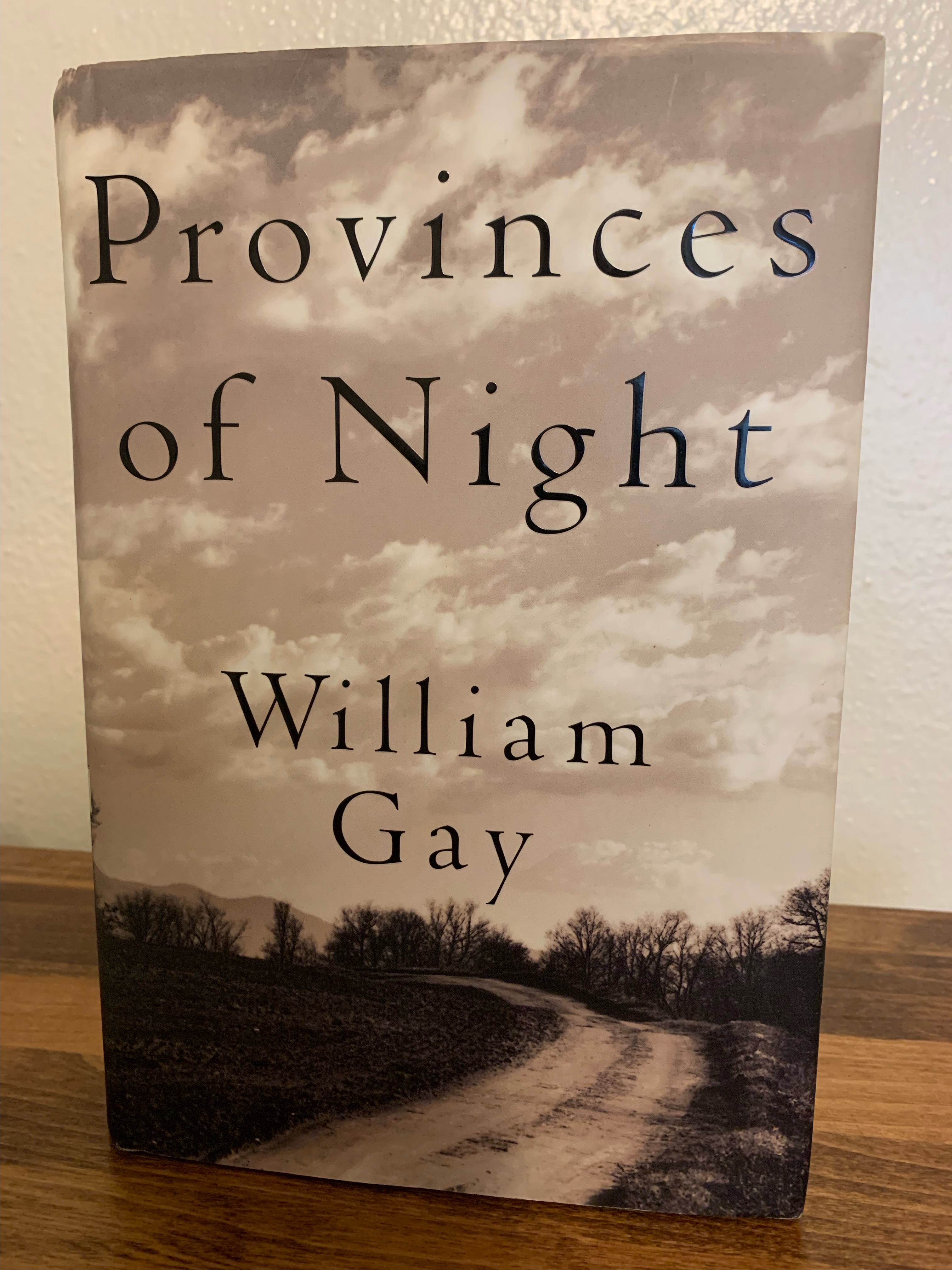
When I got in and cooled off, I opened one of the novels currently on my list, William Gay’s Provinces of Night, and read this, and realized once again why, first is the word:
There was something oddly restful about the fireflies. He couldn’t put his finger on it but he drew comfort from it anyway. The way they’d seemed not separate entities but a single being, a moving river of light that flowed above the dark water like its negative image and attained a transient and fragile dominion over the provinces of night. (161)
This series of sentences follows a tender series of scenes in which a young man, Fleming, and a lass, Raven Lee, have met, and they’ve grown curious about one another and about their possible future and their possible roads ahead. And then the image of the fireflies, temporary in their fleeting deluvial dominion, sums it up. Beautiful. And all in words.
I am under no illusion that most folks will ever turn to the word for their wisdom or joy. It does, after all, take work.
But when I open a novel this fine, or read of King Lear once again, howling madly at his undoing and of Cornelia’s exiled love, or swing upon birches with Robert Frost, or raft the Mississippi with Huck and Jim, or see Boo Radley behind every ghostly elm with Scout and Jem, first for me is the word.
Press on, wordworkers. I’m with you.
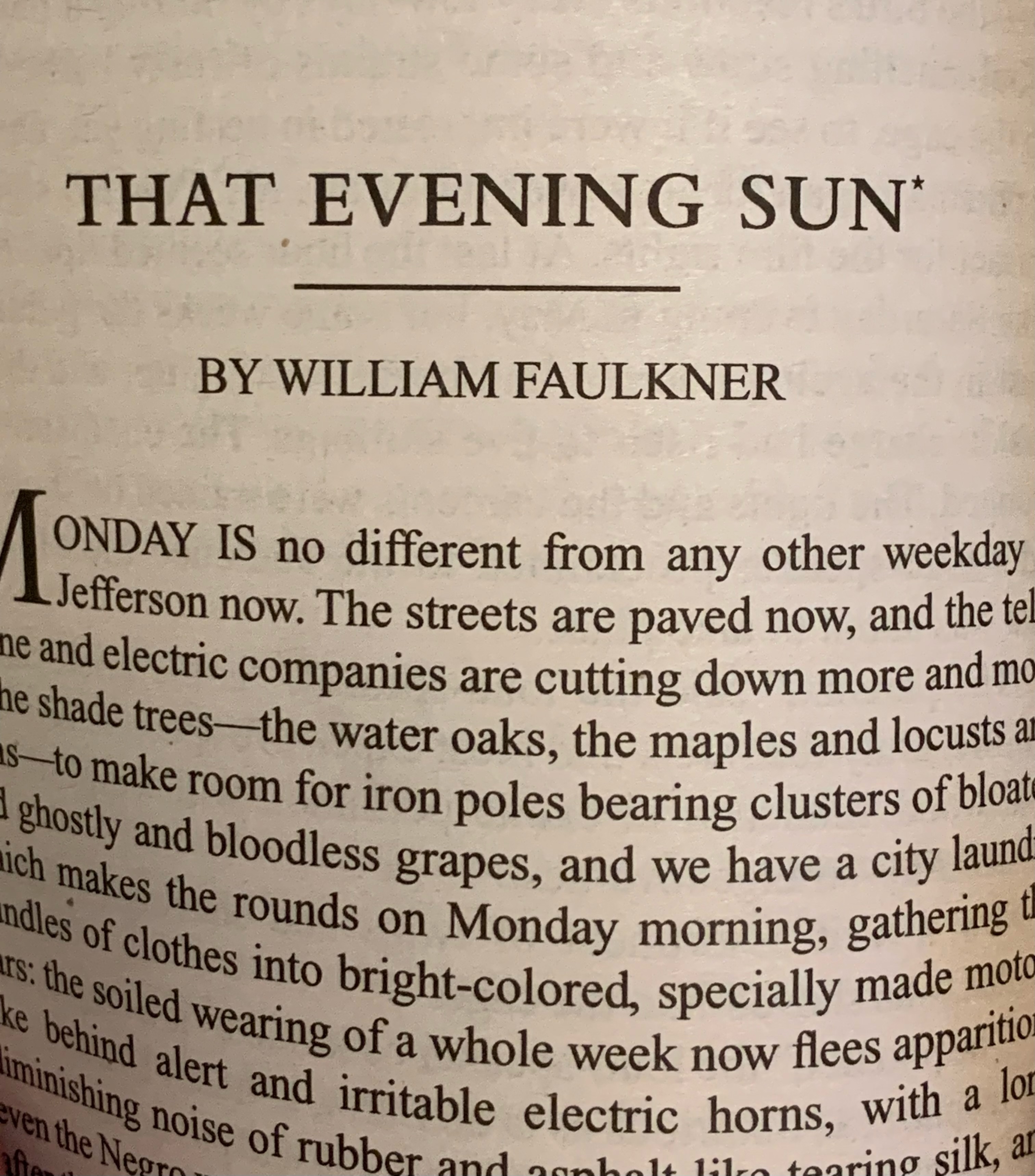
It was my freshman year in college, when I was seventeen, that I discovered the literary world of William Faulkner. Decades have passed since then and I still read him with amazement and respect.
Today I read “That Evening Sun,” a tragic tale of a doomed black woman, who fears she’s going to be murdered by Jesus.
Jesus is her husband. Nancy, the protagonist, is pregnant—by a white man. In Jefferson, MS. In the MS of Faulkner’s era. In a world where lines between white and black were as overt and common as ditches along the roadsides or train tracks.
Nancy’s terrified of being left alone. She tries to persuade the Compson children to remain with her, to not abandon her to Jesus.
The Compson children are familiar to Faulkner readers: Quentin, Jason, Caddy, etc. And there’s Dilsey, the Compsons’ normal servant, too, well known for her prominent role in The Sound and the Fury. They’re all here, trapped in their doom.
“That Evening Sun” plays upon familiar Faulknerian terrain: traditionaism plaguing whites and blacks; the individual, essentially helpless amidst the mob; violence; silence amidst suffering; divisions between social classes; the divisions within society; but, most important, the divisions within each individual heart.
It’s a sad story, terribly sad, because the unvoiced takeaway in the last few lines is that Nancy, innocent in some respects, is going to be killed by Jesus, and no one is going to do a thing to change it.

 MIND & MATTERS