Introduction: I was reading a book of theology and cosmology recently. In it the author quoted atheist Carl Sagan. I’m old enough to remember Sagan’s melodramatic program Cosmos. Here’s what Sagan wrote: “In our obscurity, in all this vastness, there is no hint that help will come from elsewhere to save us from ourselves.” That’s from Sagan’s Pale Blue Dot book. You get the idea straightaway: We humans are flying solo out here on this globe known as earth. No pilot. No architect. Just material in motion. Cosmic dust. As John Lennon sang,
Imagine there’s no Heaven
It’s easy if you try
No Hell below us
Above us only sky
If the materialists are right, it’s pretty soul-crushing. You’re not special. I’m not special. We’re all just molecules in motion. Flotsam and jetsam afloat on a pillow of meaninglessness.
Isn’t it ironic, however, that Sagan aimed to convince others of his view? Why work so hard in life if you really believe, deep down, that you’re nothing, and I’m nothing, and we’re all nothing? Seems paradoxical at best.
Why would John Lennon ask us to try and imagine that we’re cosmic dust but then ask us to love one another instead of blowing one another up? Seems like a fair question, right?
Consider the Christian Alternative inPsalm 8:
When I look at your heavens, the work of your fingers,
The moon and the stars, which you have set in place,
What is man that you are mindful of him,
And the son of man that you care for him?
But v. 6 of the poem teaches us that we’re not cosmic dust, but that God has created each of us imago Dei, and has given us dominion and stewardship of His creation. That’s a far cry from Sagan’s depressing materialism.
Encouragement: “What’s down in the well comes up in the bucket,” is some country wisdom I grew up hearing. That’s very good theology. Why? Because as a man thinks, so is he. Let us labor to learn from the wise and eschew the foolish. You’re not a cosmic accident. You’re the creation of the good and sovereign God. Our duty is to know Him and His revealed will, and Scripture is where you’ll discover both. Sagan’s a believer now, too, by the way.
Introduction: 1 Samuel 8 explains the crux of much of the Bible as a whole. It’s the historical record of how Israel demanded a king. And, well, they got one. But that king was not God. That king was wicked Saul.
Below are some ruminations on this profoundly important Old Testament event:
First, the baton was passed to the wrong person. Samuel had faithfully served as prophet (1 Sam 3:20) and judge, but he was now old (1 Sam 8:1) and his sons were not up to the task of Godly leadership. God says of Samuel’s sons that they “turned aside after gain” (1 Sam 8:3, ESV). They “perverted justice,” the text says (ibid.). Again, you see where this is headed. The people who should have been Godly weren’t. They were concerned about money, not the things of God.
Second, God gave the people their druthers as judgment. When the elders approached Samuel to demand a king “to judge us like all the nations,” God gave them what they asked for. To use a cliche, they got the leader they deserved. It grieved Samuel profoundly. Why? He saw what was coming. He knew Saul was going to destroy people. But God gave the people over: “Obey the voice of the people in all that they say to you, for they have not rejected you, but they have rejected me from being king over them” (1 Sam 8:7, ESV). Folks, if that doesn’t break your heart, I don’t know what will.
Third, God told the people up front via his truthteller, but the people were undiscerning, harrd-hearted, and refused to listen: “And in that day you will cry out because your king, whom you have chosen for yourselves, but the LORD will not answer you in that day” (1 Sam 8:18, ESV). In other words, God is saying through his truthtelling prophet Samuel, “See? I told you so.”
Takeaway: Do we think this pattern somehow skipped our days? Do we think, “That’s other people, not us! We’re smarter than those people.” Um, okay. Folks, Sauls are nothing new. They’re the result of sinful, blind, stubborn people demanding what makes them feel good rather than what’s true and good for them. And God gives people over at times as judgment. That’s not feel-good theology, but it is Bible 101.
Intro: It was a long time ago now, but it was my first semester in seminary. One of my first classes was Spiritual Disciplines. After class began the first day, the professor who was to become a mentor to me, spoke some of many words that I still carry with me. “I teach several other courses, but this is my favorite one. ‘Why?’ you might ask. Because you can learn a great deal of theology but lose your first love, why you’re here, and why God called you to serve.” Bam! It was a mic drop moment for me. He then assigned us the 6-7 books we had to read for that term—some great stuff from John Owen, Richard Baxter, J.I. Packer, and more. I devoured that stuff. It’s still on my shelves in my library at home today.
That professor has since gone on to be with the Lord, but I want to share a story about the first exam he gave us in that course. He told us how he memorized Scripture and walked us through his method. One of first pieces he memorized was Psalm 19. So, here’s how this relates to the exam: “I want you to use the English translation of your choice, memorize Psalm 19, then write it out word-for-word on a piece of paper. Then, grade yourself via the honor code by opening your copy of the actual text, and mark down any/all errors. The point is not to be pedantic; the point is for us all to remember the lessons of Psalm 19. Theologically speaking, it’s about general and special revelation. But in plain terms, it’s about why I’ve designed this course. Because you can learn a great deal of theology but lose your first love—about why you’re here, and why God called you to serve.”
Until that term, I had not memorized Psalm 19, but I did then. And it’s still with me today. Sometimes when I don’t know how to pray as I ought, or when I’ve blown it spiritually, or if I’m angry, sad, or depressed, Psalm 19 washes over me. I see God’s general revelation in nature but then His special revelation in Scripture. In Army parlance, we might term them implied and specified tasks. That is, there’s the big picture evidence of what to do vis-à-vis the mission. And then there are all the associated tasks that are linked to that to be successful. Here’s Psalm 19 (ESV):
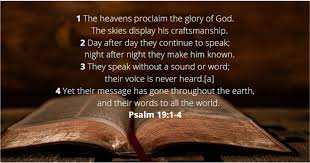
1 The heavens declare the glory of God, and the sky above proclaims his handiwork. 2 Day to day pours out speech, and night to night reveals knowledge. 3 There is no speech, nor are there words, whose voice is not heard. 4 Their voice goes out through all the earth, and their words to the end of the world. In them he has set a tent for the sun, 5 which comes out like a bridegroom leaving his chamber, and, like a strong man, runs its course with joy. 6 Its rising is from the end of the heavens, and its circuit to the end of them, and there is nothing hidden from its heat.
7 The law of the Lord is perfect, reviving the soul; the testimony of the Lord is sure, making wise the simple; 8 the precepts of the Lord are right, rejoicing the heart; the commandment of the Lord is pure, enlightening the eyes; 9 the fear of the Lord is clean, enduring forever; the rules of the Lord are true, and righteous altogether. 10 More to be desired are they than gold, even much fine gold; sweeter also than honey and drippings of the honeycomb. 11 Moreover, by them is your servant warned; in keeping them there is great reward.
12 Who can discern his errors? Declare me innocent from hidden faults. 13 Keep back your servant also from presumptuous sins; let them not have dominion over me! Then I shall be blameless, and innocent of great transgression.
14 Let the words of my mouth and the meditation of my heart be acceptable in your sight, O Lord, my rock and my redeemer.
Encouragement/takeaway: Those first (6) verses are what we call in theology general revelation. They say, in short, that God has revealed Himself to all men, everywhere. There is no “innocent man on a remote island,” etc. And then the following verses are special revelation; they unpack the specifics of Scripture, God’s revealed will, the posture of humility before the holy, what discipleship looks like, the requirements of the gospel, etc. Specified tasks and implied tasks, in other words.
My professor was teaching me and those other men all those many nights ago in the lecture hall, about how to keep the main thing the main thing, how to not lose focus, how to persevere in the faith, but it all goes back to maintaining that first love, that call to love God and those He puts in our path. I miss you, Dr. C. I truly do. And one of my goals is to see you again one day, and say, “Thank you.”
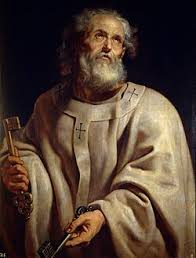
Questions: For what is the Apostle Peter most known? Is it for his walking on water? For his impetuousness? For his being crucified upside down under Rome in the 1st century A.D? For his threefold denial of Jesus on the night of His betrayal? I don’t know the answer, but I suspect it’s not for his (Peter’s) teaching in his two epistles. And yet Peter’s two epistles are packed with wisdom.
Therefore, I would like to explore just three verses from 1 Peter 2. Specifically, I would like to concentrate of Peter’s teaching on two specifics:
Transparency
Discipleship
Text: “So put away all malice and all deceit and hypocrisy and envy and all slander. Like newborn infants, long for the pure spiritual milk, that by it you may grow up into salvation— if indeed you have tasted that the Lord is good” (1 Pt 2:1-3, ESV).
Teaching: There’s so much in these three verses about the essential marks of Christians–transparency and lives of discipleship/learning/renewal.
See the commands from Peter? What does he say we’re to put away? Malice, all deceit, hypocrisy, envy, and all slander. How much church drama could be prevented if we all did what we’re taught right here?
Deceptivenss should be no part of Christian ministry; all should be open and transparent. We should welcome open books, open examination, and open dialogue. Do our churches welcome that? Is there a climate of openness and transparency? Per Scripture, churches should.
Secondly, Peter teaches us to grow up into salvation. That’s discipleship. We pay a great deal of lip service to discipleship in church circles often, but people know it when they encounter true depth rather than mere blatherskites. “What you win them with is what you win them to,” is a phrase I think captures the idea. If discipleship is reduced to sentimental story hour, don’t be surpised if you have intellectual pygmies rather than equipped saints. But if your discipleship goes verse-by-verse through Scripture, if the regulative principle of worship is practiced, and if there’s a climate of transparency and oversight, watch the Lord bless that ministry.
Takeaway: Transparency and discipleship. There’s no substitute, if the longing is for a biblical body of called-out saints.
Question: Ever heard of a counterfeit? Perhaps it was a piece of paper currency (see below, e.g.). This is the way counterfeit is defined:
c. 1300, countrefeten, “pretend to be,” from countrefet (adj.), Old French contrefait “imitated” (Modern French contrefait), past participle of contrefaire “imitate,” from contre- “against” (see contra-) + faire “to make, to do” (from Latin facere “to make, do,” from PIE root *dhe- “to set, put”).
The Apostle Peter wrote to address, in particular, Christians dispersed across what is now present-day Turkey. Why? To encourage them to persevere. But there was a way they’d know if they were the real deal.
Textfrom 1 Peter 1:
3 Blessed be the God and Father of our Lord Jesus Christ! According to his great mercy, he has caused us to be born again to a living hope through the resurrection of Jesus Christ from the dead, 4 to an inheritance that is imperishable, undefiled, and unfading, kept in heaven for you, 5 who by God’s power are being guarded through faith for a salvation ready to be revealed in the last time. 6 In this you rejoice, though now for a little while, if necessary, you have been grieved by various trials, 7 so that the tested genuineness of your faith—more precious than gold that perishes though it is tested by fire—may be found to result in praise and glory and honor at the revelation of Jesus Christ. (1 Pt 1:3-7, ESV).
Observations: Will we notice how understated Peter’s opening salvo is? These persecuted Christians, dispersed across Turkey, fearful of political persecution, might be grieved just a bit by “various trials.” Um, yes! We need to know our church history; we need to know what it cost to be a believer in their generation. It could easily have cost them their lives, and the lives of their families. In sundry cases, it did.
How different from our day! For that, we should be grateful, right? Or should we? A case could be made that fake Christianity (i.e., no Christianity at all) is a plague upon the house of professing Christianity in much of the West. That is, nothing stinks quite like hypocrisy.
Encouragement: This is what Peter’s teaching us, dear ones, namely, that our genuineness will be tested.
May we come forth like the man David described in Psalm 19:14, ESV: “Let the words of my mouth and the meditation of my heart/be acceptable in your sight, O LORD, my rock and my redeemer.”
Press on, Christian pilgrim, and prove you’re the real deal.
Context: Rome, Italy. Circa 60-68 A.D. The Apostle Peter pens two letters of the New Testament. Their themes revolve around several related themes: perseverance, endurance, suffering, and contending for the truth amidst false worldviews. For this short piece, I just want to focus on perseverance.
Text from 1 Peter 1:
3 Blessed be the God and Father of our Lord Jesus Christ! According to his great mercy, he has caused us to be born again to a living hope through the resurrection of Jesus Christ from the dead, 4 to an inheritance that is imperishable, undefiled, and unfading, kept in heaven for you, 5 who by God’s power are being guarded through faith for a salvation ready to be revealed in the last time. 6 In this you rejoice, though now for a little while, if necessary, you have been grieved by various trials, 7 so that the tested genuineness of your faith—more precious than gold that perishes though it is tested by fire—may be found to result in praise and glory and honor at the revelation of Jesus Christ. 8 Though you have not seen him, you love him. Though you do not now see him, you believe in him and rejoice with joy that is inexpressible and filled with glory, 9 obtaining the outcome of your faith, the salvation of your souls. (1 Pt 1:3-9, ESV)
Connections for Us: No matter how many times I go through this text, it encourages me because Peter, a man who was such a saint of the Lord also had some really bad days and nights. He denied the Lord three times, e.g. He walked on the water . . . for a bit. But then, once again, his faith waned. We could go on. Peter was, dare we say it, a fellow sinner, a man with feet of clay. Can you relate? I certainly can.
Encouragement/takeaway: In the opening salvo of his first letter, Peter reminds us of a few things:
God keeps His people (1 Pt 1:3)
We are guarded by no one less than the triune God (1 Pt 1:5)
Perseverance is rewarded (1 Pt 1:6-7)
In short, we are to press on in persevering faith, knowing that our Commander is good, gracious, and sees our labors. Rest in that truth, and work hard.
Introduction: I was again focused on Mark 15, and Mark’s account of the crucifixion of Christ. The mockery of Christ was staggering:
A placard with “The King of the Jews” was affixed to the cross above His head called the titulus (Mk 15:27).
Criminals were crucified on both sides of Him (Mk 15:27)
The crowds mocked Him still, even as he was on the cross: And those who passed by derided him, wagging their heads and saying, “Aha! You who would destroy the temple and rebuild it in three days, save yourself, and come down from the cross!” (Mk 15:29-30, ESV)
“So also the chief priests with the scribes mocked him to one another, saying, “He saved others; he cannot save himself. Let the Christ, the King of Israel, come down now from the cross that we may see and believe” (Mk 15:31-32a, ESV).
Let that sink in. The King had come to save a people from every tribe, tongue, people, and nation. And yet the religious leaders, the political establishment, and the vast majority of people rejected Him.
And what was revealed was the stony hearts of the people. They were in love with their traditions, with their perceived power, with their sin.
Mark uses powerful verbs in illustrating the naysayers’ natures; he says they “mocked” and “derided” Jesus.
Can you fathom the evil of taunting the Holy? Can you fathom the evil of dressing the Lord Jesus in a purple cloak and crowning Him with a crown of thorns (Mk 15:17) and kneeling before Him–but all in mockery?
And Scripture says the crowds spat upon Christ (Mk 15:19).
Public shame. Mockery. Taunts. Then made to carry a cross until He had to have help, on his ascent up Golgotha (Mk 15:21).
One great hymn describes it this way:
“Bearing shame and scoffing rude, / In my place condemned he stood, / Sealed my pardon with his blood: / Hallelujah, what a Savior!” (“Man of Sorrows”)
And yet . . . this was God’s plan from before the foundation of the world. Here’s the way Peter lays it out:
“Men of Israel, hear these words: Jesus of Nazareth, a man attested to you by God with mighty works and wonders and signs that God did through him in your midst, as you yourselves know—this Jesus, delivered up according to the definite plan and foreknowledge of God, you crucified and killed by the hands of lawless men. God raised him up, loosing the pangs of death, because it was not possible for him to be held by it” (Acts 2:22-24, ESV).
Encouragement: There are many, many reasons I am a follower of Christ. And I am glad to provide those reasons to any sincere questioner. But one of the most comforting of those reasons is found here: Christianity is clearly of divine origin. If this were a manufactured religion, it would make man the hero rather than a God of the cross. But Christianity alone has the God of the cross who came for sinners, and who died in our stead, and then triumphed over judgment, proving Himself to be the sole sufficient, acceptable offering to God. It hinges on His penal substitutionary atonement for all who will come in repentance and faith.
Bottom line up front: Do We Scoff at Theological Treason?
Intro: I was in Mark 15. This is the section in Mark’s gospel where the crucifixion of Christ is recorded. No matter how many times I go through Scripture, I cannot get through the crucifixion accounts in the gospels without tears. But before we get to the actual crucifixion of the Holy One, I wonder if we could just focus on events just prior to that horror.
Text:Pilate Delivers Jesus to Be Crucified
6 Now at the feast he used to release for them one prisoner for whom they asked. 7 And among the rebels in prison, who had committed murder in the insurrection, there was a man called Barabbas. 8 And the crowd came up and began to ask Pilate to do as he usually did for them. 9 And he answered them, saying, “Do you want me to release for you the King of the Jews?” 10 For he perceived that it was out of envy that the chief priests had delivered him up. 11 But the chief priests stirred up the crowd to have him release for them Barabbas instead. 12 And Pilate again said to them, “Then what shall I do with the man you call the King of the Jews?” 13 And they cried out again, “Crucify him.” 14 And Pilate said to them, “Why? What evil has he done?” But they shouted all the more, “Crucify him.” 15 So Pilate, wishing to satisfy the crowd, released for them Barabbas, and having scourged Jesus, he delivered him to be crucified. (Mark 15:6-15, ESV)
Teaching: Just look at how much we know about Barabbas from this text alone. First, he was already imprisoned because he was a criminal. Second, we learn not only that Barabbas was imprisoned, but that one of his crimes was murder. And yet the crowd was mad with rage. They demanded the crucifixion of the only righteous man to have ever lived. Even Pilate, Roman governor of Judea from 26-36 A.D., conceded that Jesus was wholly innocent. Barabbas was indeed a criminal. But Jesus? No; He was simply holiness in human form, the ultimate truth-teller, the innocent lamb going to slaughter for us sinners.
Encouragement: Do we scoff at theological treason? That is, should our hearts not burn within us over how sin affects our natures, how crowds can quickly become mad, unhinged, and bloodthirsty? It was treason to crucify the innocent and to free the guilty. But what’s even more staggering is the fact that God was saving sinners by bearing the judgment of the criminals in order that guilty sinners might go free. We are a race of Barabbases, you see. We’re the guilty ones. And yet, “For our sake he made him to be sin who knew no sin, so that in him we might become the righteousness of God” (2 Corinthians 5:21, ESV). At Calvary, God saves us from God, in other words. It’s all of God—from beginning to end—and redounds unto God’s glory.
Introduction: At my core, I’m a man of the soil. I tend to be suspicious of perceived elites–whether they’re that (‘elites’)– labeled that way taxonomically due to wealth, status, power, looks, or whatever.
I’m very much at home with folks who know what it’s like to have worn dungarees, shelled peas with Grandma, and used a weed eater/trimmer when it was known as a sling blade. Some folks are ashamed of sweating and of having shopped at Walmart. I’m not one of those. (I’m a soldier. I sweat daily, and there’s no telling how much money I’ve spent at Walmart over the last 40 years. Maybe their actuaries could tell you.)
Slice of life: Once again I was blessed to be part of serving the saints in a small called-out assembly. They were like me–sinners, hungry for the word from the Lord, hungry to know someone cares about them and puts in the work on their behalf.
We were in Matthew 24 this morning at our assembly. The precious saints again turned out, and we assembled under the authority of Scripture. In short order, we came to highly-controversial sentences:
Then . . . this:
So when you see the abomination of desolation spoken of by the prophet Daniel, standing in the holy place (let the reader understand), 16 then let those who are in Judea flee to the mountains. 17 Let the one who is on the housetop not go down to take what is in his house, 18 and let the one who is in the field not turn back to take his cloak. 19 And alas for women who are pregnant and for those who are nursing infants in those days! 20 Pray that your flight may not be in winter or on a Sabbath. 21 For then there will be great tribulation, such as has not been from the beginning of the world until now, no, and never will be. 22 And if those days had not been cut short, no human being would be saved. But for the sake of the elect those days will be cut short. 23 Then if anyone says to you, ‘Look, here is the Christ!’ or ‘There he is!’ do not believe it. 24 For false christs and false prophets will arise and perform great signs and wonders, so as to lead astray, if possible, even the elect. 25 See, I have told you beforehand. 26 So, if they say to you, ‘Look, he is in the wilderness,’ do not go out. If they say, ‘Look, he is in the inner rooms,’ do not believe it. 27 For as the lightning comes from the east and shines as far as the west, so will be the coming of the Son of Man. 28 Wherever the corpse is, there the vultures will gather. (Mt 24:15-28, ESV)
So what? The So what? is this: Don’t be a fool; be discerning. Be wise. Be a man/woman of understanding and redemption.
Encouragement: Christian pilgrim, are you down? Same here. Are you overwhelmed by the news of your day? Do you feel the temptation to give in to evil, to feel like ‘this present darkness’ overpowers you?
Takeaway: Have you ever read about when Paul was in prison in Rome? Have you read of Bunyan imprisoned in England? Have you read about when Edwards was fired from his church in Massachusetts? Have you read about how he (an intellect like few others) was fired from the church he served for decades? Have you read of Spurgeon’s spiritual darkness in London, or of Sproul and MacArthur, fighting for the sovereignty of God in Orlando, FL and Los Angeles, CA in the 1970s-2000s?
Probably not. It’s glossed over. But it was real. There were warriors in our past. When you think of how the medical Dr. Lloyd-Jones left off his career in medicine to be a doctor of men’s souls, it puts steel in your Christian spine. May we learn from these faithful ones–learn to persevere, endure, and discern wisdom from folly, the genuine from the false, and depth from distraction.
Text: “But to Hannah he gave a double portion, because he loved her, though the LORD had closed her womb” (1 Samuel 1:5, ESV).
Bottom line up front: Very often the Lord uses most significantly those whom He first places in the crucible of suffering.
Historical context: 1500s B.C. The Lord was about to bring about the last of the Old Testament judges, Samuel. But before Samuel’s birth, we get the massively important story of his mother, Hannah. Hannah was loved by her husband, Elkanah. Scripture attests that Elkanah had two wives, but he especially loved Hannah, so much in fact that “he gave her a double portion” of the sacrifices (1 Samuel 1:5).
Hannah’s barrenness: But despite Elkanah’s love for Hannah, the Lord closed Hannah’s womb for a season. She could not bear a child. Peninnah, the other wife, was able to conceive and bear children. But Hannah? No. Why? The Lord had closed her womb (1 Samuel 1:5, 6). It seems safe to say that the Lord was using Hannah’s present circumstances of suffering to bring about providential blessing.
Hannah’s response: She wept; she fasted (1 Samuel 1:7-8). She pleaded with the Lord (1 Samuel 1:11). She implored God for a son and the Lord answered. Verses 19-20 of chapter are so tender: “They rose early in the morning and worshiped before the LORD; then they went back to their house at Ramah. And Elkanah knew Hannah his wife, and the LORD remembered her. And in due time Hannah conceived and bore a son, and she called his name Samuel, for she said, “I have asked for him from the LORD” (1 Samuel 1:19-20, ESV).
Encouragement/takeaway: Very often the Lord uses most significantly those whom He first places in the crucible of suffering. I don’t think that Hannah fully understood her circumstances of barrenness, at least not initially. Scripture is clear that she wept bitterly, that she fasted, that she appeared nearly out of her mind with grief. But she trusted the Lord. She petitioned the Lord. She persevered. She endured in the faith. And yet, for a season, the crucible of suffering remained for her. But the Lord was not wasting her suffering. He was using it to bring about the birth of one who would be used even mightier still for the Lord. God’s ordaining of suffering for His people, though we might not fully grasp it at the time, is not random; it is ordained by the Hands of the Lord, who knows our beginning and our end.








 MIND & MATTERS