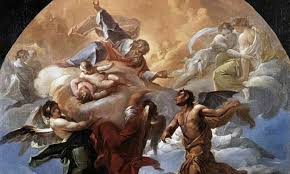
Text: 20 Then Job arose and tore his robe and shaved his head and fell on the ground and worshiped.21 And he said, “Naked I came from my mother’s womb, and naked shall I return. The Lord gave, and the Lord has taken away; blessed be the name of the Lord.” (Job 1:20-21)
Questions: Have you ever experienced immense suffering? Have you ever been mad at God? Have you ever blamed God? Have you ever shaken your fist at the heavens, even if only internally, and cursed God? Have you ever implied that it was God’s fault that you suffered? If we are honest, I think we’ve all been there. We may have articulated our anger in different ways. But if we’re honest, I would wager that most folks have “been there and done that.”
Context, Context, Context: The verses preceding the ones I quoted above recount how God allowed Satan to take Job’s property and children. Just let that sink in. Job’s sons and daughters were killed by the Sabeans (Job 1:15). Job’s servants and sheep were destroyed (Job 1:16). Also, the Chaldeans murdered Job’s servants (Job 1:17). You think we have it bad some days? Just read Job’s life.
Encouragement: But here’s what you must remember as you study the 42 chapters of Job: Job trusted God and in the ultimate goodness of God. Goodness cannot be separated from God himself. It is one of his immutable attributes. And God doesn’t change. Does God allow suffering? Yes, that should be obvious. But God is still good and God is still present through the valley of the shadow of death, in order that he might bring his people through that valley. Satan’s only good at destruction and division, not at construction or unity in truth. Please don’t miss that.
Introduction: I’m currently reading through the Book of Job. It is one of the masterpieces of world literature and of course sacred Scripture. The reason for Job’s prominence in the canon is straightforward: the Book of Job deals with “undeserved suffering.” Another way of phrasing it is, “If God exists, and God is good, then why suffering? Wouldn’t a ‘good’ God intervene?”
Those are great questions. And not to get too far ahead but, yes, God exists. And suffering exists. Yet God has intervened, continues to intervene, and is sovereign in and through suffering. Christianity alone deals with suffering in a way that no other worldview does—namely, by explaining why suffering exists and what God has done as the suffering servant to redeem and restore a people to himself through the gospel.
But in the first installment I wish only to focus on one particular topic, and that is God’s initiationof Job’s education. When the Book of Job opens, verses 8-12 of chapter 1 are crucial to understand:
8 And the Lord said to Satan, “Have you considered my servant Job, that there is none like him on the earth, a blameless and upright man, who fears God and turns away from evil?”9 Then Satan answered the Lord and said, “Does Job fear God for no reason? 10 Have you not put a hedge around him and his house and all that he has, on every side? You have blessed the work of his hands, and his possessions have increased in the land. 11 But stretch out your hand and touch all that he has, and he will curse you to your face.” 12 And the Lord said to Satan, “Behold, all that he has is in your hand. Only against him do not stretch out your hand.” So Satan went out from the presence of the Lord. (Job 1:8-12)
Teaching: If you don’t pay attention, you might think that Satan is running the show in the Book of Job. But it was God who summoned Satan, a created angel, to the court of heaven. It wasn’t Satan who initiated all of that was going to unfold. That’s so important. Why? Because God is the one who’s in control. God is the sovereign. Satan is a contingent, created, fallen being. God is not contingent, is uncreated, and holy. Again, pay attention to the text: “Have you considered my servant Job . . .?” was a question from God to Satan about Job. God was the initiator in all this. And God, if you’ll stick with me through Job, you will see is there at the end.
Encouragement: For now, however, just remember this: Satan’s not sovereign; God is. God is the hero of the Book of Job. Those who follow hellish counsel will be humiliated by the end of this history, and Job, the righteous sufferer, will be rewarded. But we’ll get there.
Text:12 And they told Mordecai what Esther had said.13 Then Mordecai told them to reply to Esther, “Do not think to yourself that in the king’s palace you will escape any more than all the other Jews. 14 For if you keep silent at this time, relief and deliverance will rise for the Jews from another place, but you and your father’s house will perish. And who knows whether you have not come to the kingdom for such a time as this?” (Esther 4:12-14)
Context, Context, Context: Always keep the big picture in mind. The big picture is that God’s people are strangers and exiles in the world system. We’re to be salt and light in a world of rot and darkness. In the Book of Esther, set in Persia in the 470s B.C., Mordecai and Esther embodied and personified God’s people under Ahasuerus the Persian king. (Ancient Persia was a world power then. And here we are in our day once again dealing with the same region, but that’s another topic.) At any rate, Mordecai and Esther were Jews. And a holocaust had been decreed against them by wicked Haman and Ahasuerus (Esther 3:11).
Teaching: Mordecai was God’s man. He maintained short accounts with God. He prayed fervently. He interceded on behalf of his people against the wicked schemes of Haman, a yes man and utterly self-absorbed opportunist. Mordecai spoke to his adopted niece the words you read above in verses 13-14. “For such a time as this” has become one of the most cited verses in all of Scripture. Why? Because the wise person understands the times and what God’s people are to do. And what was Esther to do? Have courage. Be humble but act with courage. Trust the Lord and act with courage.
Encouragement: Courage is not the same thing as bravado. We all know people who inculcate bravado. Wicked Haman was such a person. And Haman is truly one of the most despicable people in history. He was self-absorbed, a flagrant self-promoter, shameless, and a liar. But God was going to use the courage of Mordecai and Esther, exiles and sojourners, to overturn an empire. Haman would get what was coming to him. But before that, it took one crucial element: the courage of God’s people. Nothing has changed, dear ones. Nothing has changed.
There is no paucity of zeal surrounding the understanding of “the temple” from myriad spheres–Christian, Muslim, political, etc. But what is the Bibe’s own testimony regarding the temple? Is it a building that is to be the focus? Is it a place of real estate that is to be the focus? How should Christians understand “the temple”? How do our understandings of the temple affect the person and work of Christ?
Text:
18 “But will God indeed dwell with man on the earth? Behold, heaven and the highest heaven cannot contain you, how much less this house that I have built! 19 Yet have regard to the prayer of your servant and to his plea, O Lord my God, listening to the cry and to the prayer that your servant prays before you, 20 that your eyes may be open day and night toward this house, the place where you have promised to set your name, that you may listen to the prayer that your servant offers toward this place. 21 And listen to the pleas of your servant and of your people Israel, when they pray toward this place. And listen from heaven your dwelling place, and when you hear, forgive. (2 Chronicles 6:18-21)
Context, Context, Context: In the passage above, King Solomon was dedicating the temple in Jerusalem. Notice the question asked up front: “But will God indeed dwell with man on the earth?” (2 Chr 6:18a). Will God be amongst his people? Will God manifest himself? Will God take on flesh?
The second half of verse 18 answers the question. The answers? No, heaven cannot “contain” God, much less any house or temple. Folks, that’s crucial to understand. Yes, God will be amongst his people. Yes, God will manifest himself. Yes, God took on flesh. That’s the very definition of incarnation.
Christianity is not about a building, a piece of real estate, a political identity, or any such thing. It’s about God. It’s about Christ. Jesus is the temple.
All of the Bible coheres; it all tells one coherent, interconnected, unified story of Creation, Fall, Redemption, and Restoration. If we misunderstand the temple, we misunderstand the Christian worldview.
Revelation 21:22 reads, “And I [John] sawno temple in the city, for its temple is the Lord God the Almighty and the Lamb.” How clear is that? Crystal.
Encouragement: The temple was God tabernacling among his people. It was a picture of what God would do in the Son’s incarnation–dwell among us. What happened in the incarnation of the Christ? John 1:14 reads, “And the Word became flesh and dwelt [tabernacled] among us, and we have seen his glory, glory as of the only Son from the Father, full of grace and truth.”
As part of the church I serve as a teaching elder/pastor, we have begun sending out 60-second reels on social media entitled “Truth Through Theology.” The goals are simple: depth and brevity simultaneously. It’s no use decrying the fact that we live in a culture plagued by short attention spans. Most folks will not suffer through legthy, weighty, deep discussions or lectures or books. I could whine about that. But as the cliche goes, it is what it is. This is simply where most folks are. To gain a hearing, we almost always have to keep it pithy and easily digestible. Hence, our efforts via “Truth Through Theology.”
So what, right? Why should you care? Well, I’m glad you asked. The reason is that theology is unavoidable. Everyone has a worldview. No exceptions. Some folks are atheists. Some are materialists. Some are pantheists. Some are polytheists. Some are monotheists. Some are nihilists. Others, still, claim to be agnostic. The list could continue.
Regardless of the camp, however, everyone has a worldview. And theology is unavoidable. Everyone has a worldview, coherent or not, consciously held or not, regarding basic questions/issues like the following:
Where did everything come from?
Does God exist?
If God doesn’t exist, on what basis should creatures complain about categories regarding ‘justice’? Rocks don’t complain.
If God does not exist, are we not by definition just matter in motion, molecules in motion, hairy apes without freedom?
Why is there such evil in the world?
Where do we get categories of right and wrong, good and evil?
Where did mind come from?
How do you explain irreducible complexity?
Why is there so much suffering in the world?
How do we explain language?
What happens when we die?
What’s wrong with the world and is it fixable?
Why is there something rather than nothing?
This list of questions could go on and on. But each worldview has to grapple with these and other foundational questions. Regardless of one’s worldview, you have to grapple with these issues. Hence, “Truth Through Theology.”
In the Christian worldview, we have answers to these profound questions. God does exist. He has spoken. He has revealed himself in creation, in conscience, in the incarnation of Christ the Son, and in Scripture. For example, David wrote in Psalm 19 the following:
19 The heavens declare the glory of God, and the sky above proclaims his handiwork. 2 Day to day pours out speech, and night to night reveals knowledge. 3 There is no speech, nor are there words, whose voice is not heard. 4 Their voicemgoes out through all the earth, and their words to the end of the world. In them he has set a tent for the sun, 5 which comes out like a bridegroom leaving his chamber, and, like a strong man, runs its course with joy. 6 Its rising is from the end of the heavens, and its circuit to the end of them, and there is nothing hidden from its heat. (Psalm 19:1-6)
This is what’s known as general revelation. God’s creation attests to and manifests his existence.
Illustration: As I sit in my library each night and study, my desk and tables and chairs are littered with books. (My wife lets me know the stacks often grow out of control and that I need to give more of them away. Pray for me!) But here’s where I’m going. As I look at the book on my table beside my chair right now that I’ve put down in order to type this out, I could pose some basic questions about the book: 1) Did it just come into existence on its own? No, of course not. That would mean that it had to exist before it acually existed. Self-creation is utterly illogical. One does not birth oneself; 2) Did not the book have an author? Of course. It had an author. And it had an editor. And it was typed. And it was bound. And it was marketed; 3) And did the book not have a mind behind it, a mind that communicates with my mind through the media of language and culture and ideas?
Takeaway:Theology is unavoidable. Everything that has been created has a creator. Each worldview has to deal with the matter of origins. God is the Author of life (Acts 3:15). That’s enough for this installment, but I hope it encourages you to explore foundational/worldview questions. Thanks for sticking with me. More to follow.
Questions: What comes to mind when you hear the word prophet? One who predicts future events? Bravery? Truth-teller? Forth-teller?
In Scripture, all of those attributes are true. Think of Elijah, Elisha, Jeremiah, Ezekiel, Daniel, and John the Baptist, as just some examples. Each man was used by God to tell the truth forthrightly; each man was brave; each man did speak of future events that would and did take place, etc.
Now think of the text below from 2 Kings:
10They set up for themselves pillars and Asherim on every high hill and under every green tree, 11 and there they made offerings on all the high places, as the nations did whom the Lord carried away before them. And they did wicked things, provoking the Lord to anger, 12 and they served idols, of which the Lord had said to them, “You shall not do this.” 13 Yet the Lord warned Israel and Judah by every prophet and every seer, saying, “Turn from your evil ways and keep my commandments and my statutes, in accordance with all the Law that I commanded your fathers, and that I sent to you by my servants the prophets.”
14 But they would not listen, but were stubborn, as their fathers had been, who did not believe in the Lord their God. 15 They despised his statutes and his covenant that he made with their fathers and the warnings that he gave them. They went after false idols and became false, and they followed the nations that were around them, concerning whom the Lord had commanded them that they should not do like them. 16 And they abandoned all the commandments of the Lord their God, and made for themselves metal images of two calves; and they made an Asherah and worshiped all the host of heaven and served Baal. 17 And they burned their sons and their daughters as offerings and used divination and omens and sold themselves to do evil in the sight of the Lord, provoking him to anger. 18 Therefore the Lord was very angry with Israel and removed them out of his sight. None was left but the tribe of Judah only. (2 Kings 17:10-18)
Teaching: Israel once again fell into idolatry and apostasy. They failed to believe God and follow his revealed covenantal promises. They sinned, and they grew increasingly callous. They sacrificed their children by burning them atop idols. The list is long of their abominations. And yet, God sent his servants the prophets. And what was their duty? To call the people back to God, to holiness, to restoration.
Encouragement: As I’ve said countless times to our people, “Soft preaching makes hard people; hard preaching makes soft people.” That is undisputable. If you tickle ears and pimp people sentimentally, you’re a hireling and coward. God hates such shenanigans. God calls his servants the prophets to tell the truth, to serve the Lord, to fear God and love the sheep of his pasture. The fear of man is a snare. If we’re God’s shepherds, we’re to fear the Lord and serve the Lord. And that baseline will shape the trajectory of our ministries because that’s the solemn office to which some of us are called. The crux comes in having people with enough discernment to distinguish between hirelings out for their own fame and fortune and the true men of God who are laboring to please the Lord Jesus and to serve his bride, the true church.
Text: “For this is a gracious thing, when, mindful of God, one endures sorrows while suffering unjustly” (1 Peter 2:19).
Context, Context, Context: Peter, the apostle of hope, was writing to Christians who were dispersed across what is much of modern-day Turkey and, by extension, to Christians throughout church history.
Peter wrote this letter during the mid 60s A.D., just thirty years or so after Jesus’ bodily resurrection from the Jerusalem tomb.
Question: Why did Peter write this letter? In short, he wrote to encourage them to stand strong amidst some level of persecution because suffering is part of the human condition. To live means, to some degree, the embrace of suffering.
But what about unjust suffering? Good question. Let us think of the Lord Jesus Christ for a moment:
Do we have grief and troubles? So did Christ. Then he said to them, “My soul is very sorrowful, even to death; remain here, and watch with me. (Matthew 26:38).
Do our bodies suffer? So did Christ in his bodily form. And they spit on him and took the reed and struck him on the head. (Matthew 27:30)
Are we mocked and slandered? So was Christ. And when they had mocked him, they stripped him of the robe and put his own clothes on him and led him away to crucify him. (Matthew 27:31).
Encouragement: The Lord Jesus suffered all of this and more. But he endured the cross so Christians wouldn’t. He became the curse for us (2 Corinthians 5:21) so that we who repent and believe upon him would be reckoned righteous in the eyes of holy God. That’s the great exchange, you see? Our rags are replaced by his robes. My sins but his saving effectual grace. My disobedience forgiven because of his obedience, even unto death upon the tree. We press on because our savior pressed on, even as the Roman nails pierced the flesh and spikes crushed the bones and the spear opened his side. But three days later, oh yes, three days later, God again demonstrated the schemes of hell are but part of God’s plan to thwart the arrows of hell. Press on, pilgrim. God sees, and God has won the victory through the person and work of Christ. Look to him in your suffering, knowing that he knows it all and he overcame, and so will you if you are in him.
Solomon was great in some ways. In other ways, however, he failed profoundly. Towards the end of his reign, Solomon’s heart strayed from the Lord. He became idolatrous. He gave in to his flesh. He built altars to idols. He had multiple wives and concubines. Solomon became a syncretist and he sullied much of his legacy.
Text:
11 Now King Solomon loved many foreign women, along with the daughter of Pharaoh: Moabite, Ammonite, Edomite, Sidonian, and Hittite women, 2 from the nations concerning which the Lord had said to the people of Israel, “You shall not enter into marriage with them, neither shall they with you, for surely they will turn away your heart after their gods.” Solomon clung to these in love. 3 He had 700 wives, who were princesses, and 300 concubines. And his wives turned away his heart. 4 For when Solomon was old his wives turned away his heart after other gods, and his heart was not wholly true to the Lord his God, as was the heart of David his father. 5 For Solomon went after Ashtoreth the goddess of the Sidonians, and after Milcom the abomination of the Ammonites. 6 So Solomon did what was evil in the sight of the Lord and did not wholly follow the Lord, as David his father had done. 7 Then Solomon built a high place for Chemosh the abomination of Moab, and for Molech the abomination of the Ammonites, on the mountain east of Jerusalem. 8 And so he did for all his foreign wives, who made offerings and sacrificed to their gods. (1 Kings 11:1-8)
Context, Context, Context: Syncretism is the blending and/or combination of opposing worldviews. For example, if I said that as a Christian, one of the core beliefs is that Jesus rose bodily from the tomb in Jerusalem on a Sunday and was seen by hundreds of people afterwards, and even ate with them. That is a truth claim. It’s either true or it isn’t.
But let’s say Joe Snuffy claims he’s a Christian, too, but that he believes that Krishna, an avatar of Vishnu, Sun Myung Moon, and Joseph Smith are just like Jesus, prophets of God and ‘good’ men. Well, Houston, we have a problem. Because both claims cannot be simultaneously true. I could be right or wrong. The second guy could be right or wrong. We could both be wrong. But we cannot both be right. This is where apologetics can be helpful.
Well, think of Solomon. He’d earlier prayed for wisdom and God granted him that. Solomon’s wisdom was world-famous. As was his wealth. But Solomon got too big for his britches, we might say. He grew proud. He grew increasingly prurient. He grew self-absorbed. And syncretism crept in. He tried to blend or combine contradictions, but reality is not a contradiction. Either God is who he says he is and has revealed himself to be, or idolatry is just fine and dandy. But idolatry is not just fine and dandy, of course. God calls his people to genuine holiness and devotion to the truth, not to play around with erecting statues, poles, Asherah, or high places for Chemosh (1 Kings 11:7). God will not share his glory with idols.
God’s Response: “And the LORD was angry with Solomon, because his heart had turned away from the LORD, the God of Israel, who had appeared to him twice, and had commanded him concerning this thing, that he should not go after other gods. But he did not keep what the LORD commanded” (1 Kings 11:9-10).
Encouragement/teaching: The chastisement of the Lord among his people is demonstration of God’s love for his sheep. Divine discipline is indicative of the heavenly Father’s love of his people. “For the Lord disciplines the one he loves, and chastises every son whom he receives” (Hebrews 12:6). Trying to blend contradictory allegiances is at the heart of syncretism and it is nothing short of idolatry. Keep short accounts with God, the only living and true God, because all else is wood, hay, and stubble.
Introduction: Theology is unavoidable. What a man believes about God shapes his life. It is unavoidable.
Theology, simply defined, is the study of God. Does God exist? Yes or no? If God doesn’t exist, morality is reduced to moral relativism, human assertions, and the will to power. But if God does exist, what is his nature? Has he spoken/revealed himself? Yes or no? If he has spoken/revealed himself in words, in history, in creation, and in conscience, how should we then live?
These are some of the fundamental questions and issues addressed in theology.
Connections to Current Events: If you take some time and think through what is happening currently in the Middle East, a person’s theological beliefs/worldview shape his understanding.
I had the misfortune of viewing Greg Locke’s screed recently (linked below for you) of why I call it a misfortune. This level of theological muddleheadedness is replete with problems. Christians worship Christ, not a temple. This should be so basic. Christians do not worsip real estate, be that a former temple (Solomon’s) or a city (Jerusalem) or a race (Jews, e.g.). Christians worship the Lord who was “born of the Virgin Mary; suffered under Pontius Pilate; was crucified, dead, and buried; he descended into hell; the third day he rose again from the dead; he ascended into heaven, and sits at the right hand of God the Father Almighty; from there he shall come to judge the living and the dead” (from the Apostles’ Creed).
But there is a push among many influential people who claim to be Christian who are calling for race wars, blowing entire countries to smithereens, and for rebuilding the very temple that was destroyed in A.D. 70.
Will folks even take the time to read Scripture’s own testimony of why the temple was destroyed? It was in direct fulfillment of 1 Kings 9:
4 And as for you, if you will walk before me, as David your father walked, with integrity of heart and uprightness, doing according to all that I have commanded you, and keeping my statutes and my rules, 5 then I will establish your royal throne over Israel forever, as I promised David your father, saying, ‘You shall not lack a man on the throne of Israel.’ 6 But if you turn aside from following me, you or your children, and do not keep my commandments and my statutes that I have set before you, but go and serve other gods and worship them, 7 then I will cut off Israel from the land that I have given them, and the house that I have consecrated for my name I will cast out of my sight, and Israel will become a proverb and a byword among all peoples. 8 And this house will become a heap of ruins. Everyone passing by it will be astonished and will hiss, and they will say, ‘Why has the Lord done thus to this land and to this house?’ 9 Then they will say, ‘Because they abandoned the Lord their God who brought their fathers out of the land of Egypt and laid hold on other gods and worshiped them and served them. Therefore the Lord has brought all this disaster on them.’” (1 Kings 9:4-9)
In short, the destruction of the temple by the Romans in A.D. 70 was a direct result of unbelievers rejecting Jesus. Unbelievers, Jews and Gentiles, hated Christ, who put an end to repeated ineffectual sacrifices and ritual days of atonement. That’s what the book of Hebrews is all about.
Concluding Thoughts: I write as a Christian. These shallow and immature calls for levelling real estate (a la Greg Locke and other loud Christian Zionists), of rebuilding a temple, of racial wars upon entire demographics, etc. are not biblically, theologically mature worldviews or Christian. They are, in fact, completely opposed to Christ. Christians are to preach the gospel, to plant churches, to shepherd well, and to pray for those who persecute us.
11 Then Nathan said to Bathsheba the mother of Solomon, “Have you not heard that Adonijah the son of Haggith has become king and David our lord does not know it? 12 Now therefore come, let me give you advice, that you may save your own life and the life of your son Solomon. 13 Go in at once to King David, and say to him, ‘Did you not, my lord the king, swear to your servant, saying, “Solomon your son shall reign after me, and he shall sit on my throne”? Why then is Adonijah king?’ 14 Then while you are still speaking with the king, I also will come in after you and confirm your words.” (1 Kings 1:11-14)
Context, Context, Context: King David was now an old man. He had been a man of war for years. The consequences of his sin against Uriah and his (David’s) adultery with Bathseba, as well as his (David’s) disastrous relationship with his son Absalom were coming full circle. David was still king, yes, but his power was weakening in myriad ways. He was physically diminished; he was old (1 Kings 1:1), etc. And David’s enemies thought it was the time to strike, the time to assert themselves to gain power, and to install themselves as king in David’s stead. Adonijah saw himself as that man, as one willing to try and replace David and David’s son, Solomon.
Teaching: And yet God had his servant, Nathan. Nathan was a phenomenal prophet. He was a truth-teller. He was God’s man for David, just as David was God’s man. So Nathan goes to David’s now-wife Bathsheba and explains to her Adonijah’s wicked plan to replace David as king. Bathsheba lets David in on Adonijah’s plot. God was determined, you see, to bring about the immediate son (Solomon) as king, but ultimately God the Son as king. That’s what this is all about.
No powers of hell or schemes of man can topple God’s plan for Christ as king. As Psalm 2 phrases it, “The kings of the earth set themselves, and the rulers take counsel together, against the LORD and against his Anointed, saying, “Let us burst their bonds apart and cast away their cords from us.” But then you get to verse 4: “He who sits in the heavens laughs; the Lord holds them in derision.”
Encouragement: Folks can and do try to outsmart God. That is clear. But what should be even more obvious is this: that’s a fool’s errand. You can deny reality but reality still wins. You can mock God, but God still is. You can plot and scheme and lie, but God still sees and God is holy. You can take counsel together against the Lord, but God laughs at you. There’s no outsmarting God’s plan, and his plan was and is and ever shall be this: Christ is king.








 MIND & MATTERS