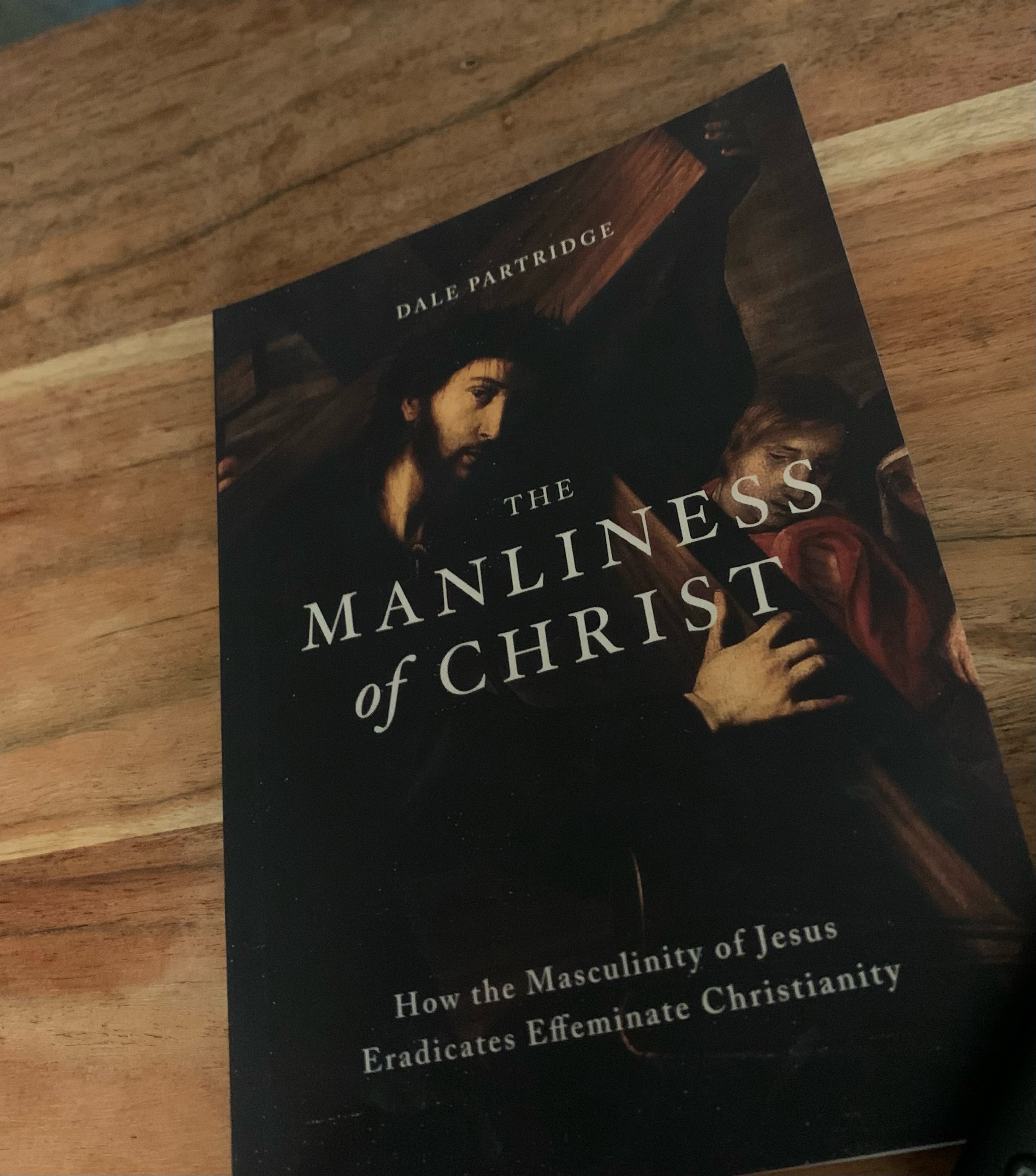
The Manliness of Christ

Introduction: This morning in my studies I was in the book of Ezekiel. Specifically I was in Ezekiel 28-31. These chapters recount God’s judgment upon Tyre, Sidon, and Egpyt because of their sin and unrepentance, their hardening of themselves against the revealed will of God.

Questions: When one reads the Scriptures, can he honestly think God changes? In other words, did the God of Scripture pour out judgments upon Egypt, Tyre, Sidon, Babylon, and on and on, but later on “evolve on the issue” of sin? Has God’s nature or perspective changed?

Segue: The questions are of course rhetorical. God’s nature does not change. God cannot change. He is immutable. He changes not (Malachi 3:6). There is “no variation or shadow due to change,” James says of God’s nature (James 1:17).

After I read through these passages again and again, I read the short book by Partridge pictured above. Partridge quotes Kangmin Lee as writing,

Americanized Christianity has convinced millions of professing Christians that “love your enemies” means “have no enemies.” This has resulted in the church becoming apathetic toward, and tolderant of, unbridled evil. (30)

Partridge does an excellent job by pointing us to the Jesus of Scripture, of history, who was masculine, who lived out courage, who didn’t capitulate to pressures to be like the world, who didn’t ingratiate himself to the crowds.

Connections to Scripture: In Matthew 23:13 and John 8:55, Jesus called people hypocrites and liars to their faces. He called them broods of vipers (Matthew 23:33). He called them children of Satan (John 8:44). He called them blind guides (Matthew 15:14). Partridge references all of these passages and more in his book. (31)

Encouragement: We are long past time to return to the Christ of the Scriptures, rather than to the feminized, limp, helpless Jesus of much of superficial and kitschy Christian pretenders.

Christ led. He accomplished his appointed mission.

He was faithful when others were faithless. He did not change. He was obedient even unto death.

And he was raised bodily as proof of his victory over the liars and the father of lies, Satan.

In a world that is drowning in cartoonish masculinity being spray-tanned abs and perfect hair, and flying cartoons of men wielding laser pistols, what might happen if Christian men emulated Christ himself and lived out truth as biblical men in this hostile age, and trusted the Lord with the results? It would call for actual courage rather than Marvel or DC silliness and endless entertainment.

I salute Dale Partridge for his courage and his book. Well done. May we thus learn and do.

Saturday Soul Food

Hit the woods today for a few miles after I got home.

I cannot explain my fascination with trees, even dead ones.

Sometimes it is just the play of light across fallen pine or the way oak leaves move in the September wind.

But here were some images that caught my eye yet again.

Even caught a couple of deer watching me as I intruded upon their grazing.

Two Announcements:

First, tomorrow we will upload Pirtle Points, Episode 7, on the Gospel as the better way. I will begin unpacking with you how false worldviews are reductionistic, how they begin with the wrong source of authority, etc. and how faulty presuppositions lead to the fallout we are witnessing.

Second, for any bibliophiles out there, I have taken my friend Greg’s enouragment (or is it a dare?) to begin posting short videos on the classics and/or books I think will be part of the canon of classics. Episode 1 of Pirtle’s Pages is here:

See you tomorrow.

Artistry

Just cosmic accidents, of course. No design. No purpose. Just random collocations of matter+time+chance.

Said no honest man ever.

“The almighty, everywhere-present power of God, whereby, as it were by His hand, He still upholds heaven and earth with all creatures, and so governs them that herbs and grass, rain and drought, fruitful and barren years, meat and drink, health and sickness, riches and poverty, indeed, all things come not by chance, but by His fatherly hand” (Answer to Q:27, “What do you understand about the providence of God?” Heidelberg Catechism).

Evaluating Frederick Buechner

A voracious reader, there are scores of writers from whom I benefit. I tend to read the classics. But there are some contemporary writers, more or less, I adore. One is Buechner. He died less than a fortnight ago. And he wrote some great stuff. His sermons are good, too, at least the ones I’ve been able to listen to.

Differences: He attended a liberal seminary. He studied Tillich. He studied neo-orthodox theologians. He (I think) imbibed much of their teachings. That, in my view, is deeply flawed. Read them, sure, bur recognize that they departed from the biblical gospel. Experience is not the canon; Scripture is.

Similarities: What I continue to adore about Buechner is his commitment to Shakespeare, to Milton, to Dante, to the literary pen whose wielder is steeped in the authority of the Scriptures and the individual witness of human experience.

Some of Buechner’s books have made me weep because of their honesty and transparency. His world could wrench tears from you.

They’re like (and this was Buechner’s favorite piece) Lear when he was going mad amidst the storm (literal and existential) in the play bearing his name.

Buechner wrote about his struggles in ministry, in marriage, in the writing life, in academia, in battling his demons, in wrestling with how the greatest literature is used by God redemptively.

Takeaway: There are very few authors with whom I could say, “Yes, I agree. 100% I’m with you.” That’s certainly not the case with Fred Buechner. But in terms of his telling the truth via literary and lyric genres, and doing it from a worldview saturated with the biblical worldview, one could do worse than reading the oeuvre of Fred Buechner. He quoted Solomon and Shakespeare in the same breath. He went way left, in my view, on many issues, but he wrote well, almost as if he were the fool, almost as if he were telling the truth to the mad, mad world.