Author: japfth
Soul Food in September

Moisture hung on the leaves, in the air, inside the mushroom caps. The creek ran swiftly in the valley. Its sounds came to me in the heavy air. The granite stones, topped with green moss, were slippery beneath the soles of my hiking boots. I laid the Ann Patchett novel down I was reading. Inhaled. Tasted the air. Drank the smells of recent rains with more to come. All was still except the sounds of waters running in the valley. I picked up the novel again, zipped it up in my ruck, grasped my hiking poles. Took my bearings. Continued to feast.

Soul food in September. My cup overflows.
Any Daniels Left?

Why Daniel matters: Readers with some familiarity with history and biblical heroes may have heard of Daniel. The titular book in Scripture bearing his name was written in the 600s–500s B.C. It records events from Daniel’s life and also events yet to come. The main theme of Daniel is the sovereignty of God.
I have never been one particularly interested in things to come, as a subset of theology. I prefer history. I prefer what has been revealed. When a seminary student, there was invariably the group of anxious theologians whose passions revolved around timelines and predictions and prophetic passages in Scripture about things to come.
I love reading Scripture, to be sure, but the least interesting parts to me involve prophecy. Prophetic passages are certainly important to God because He put them in Scripture. However, I find that some folks focus on eschatology and prophecy and “reading the tea leaves” camps of theology, and they neglect historical realities. Sometimes they become animated at seeing signs everywhere. “This means this, don’t you see?” they imply. Um, okay. You go ahead with your interpreting signs everywhere. I’ll stick with the past and what I can learn from history and what has been revealed (Deut 29:29).
Daniel, though the second part is largely concerned with future events, is about God’s rule, about God’s sovereignty. Despite wicked rulers, despite human folly, despite rampant sin, God is sovereign. And part of God’s sovereignty includes times of testing, times of suffering, times of raising up wicked leaders so that a genuine believer–but more importantly, the Lord Himself, is made manifest.
Suffering is required to teach the willingly obtuse. Why? Because the instruction of fools is folly (Pr 16:22b). Some folks just won’t listen or learn until it’s too late. They are what God repeatedly calls in Scripture, fools. Daniel, however, was most certainly not a fool. Sometimes I picture a scene from one of my favorite movies, The Shawshank Redemption, where Andy Dufresne responds to the pagan, wicked Warden Norton with a caustic question, “How can you be so obtuse? Is it deliberate?”
Daniel is only 12 chapters long. You can read through it in less than an hour. I have spent a good bit of time in Daniel. Partly it is because Scripture speaks to all of life. We are living in a time when government officials are mandating free American citizens to submit to injections. So much for feminists’ call of “My body, my choice.” Abort boys and girls? Fine. Just don’t refuse the jab ostensibly for the Chinese coronavirus with a 99% survival rate for those who don’t have compromised systems. And we all know of people who’ve taken the jabs and still gotten sick and/or died. But the letters of the Greek alphabet continue to be rolled out by the friendly government–delta, lambda, etc. Fear not, your government and big pharma tell you, just a few more boosters. Then you’ll be good to go.
Now some government officials pronounce, as if they were not elected employees, “You will comply.” This is one reason the book of Daniel is relevant for us today. This is one more reason I appreciate knowing history. Daniel, you see, was a prisoner of a foreign occupying force. First he was captive under the Babylonians and Nebuchadnezzar. Then he was captive under the Medo-Persians under Cyrus. He was an exile. He was educated in the language and arts and culture of pagan systems (Dan 1:5). He was given wisdom by God Himself (Dan 1:17). He had a heart for wisdom (Dan 1:20), a heart for God (Dan 1:8). He lived in a time when the human governing authorities in his life were pagan, wicked rulers.
Connections to today: When the wicked ruler in Daniel’s day told him that the sorcerers and fake prophets could not interpret his (Nebuchadnezzar’s) troubling dream (a not uncommon experience when trusting in lies and peddlers of lies), Daniel prayed to the sovereign Lord, not to government. Daniel’s prayer is one of the most beautiful prayers in the Bible:
“Blessed be the name of God forever and ever, to whom belong wisdom and might. He changes times and seasons; he removes kings and sets up kings; he gives wisdom to the wise and knowledge to those who have understanding; he reveals deep and hidden things; he knows what is in the darkness, and the light dwells with him. To you, O God of my fathers, I give thanks and praise, for you have given me wisdom and might, and have now made known to me what we asked of you, for you have made known to us the king’s matter.” (Dan 2:20-23)
The pagan ruler Nebuchadnezzar acted as if he (Nebuchadnezzar) was God. He was not. Daniel interpreted Nebuchadnezzar’s dream accurately. Nebuchadnezzar’s response? “Truly, your [Daniel’s] God is God of gods and Lord of kings, and a revealer of mysteries . . .” (Dan 2:47).
Then Nebuchadnezzar had a second dream that he longed to be interpreted and understood correctly. Once again, Daniel was the truth-teller to the pagan governing authority. And Nebuchadnezzar’s response?
“At the end of days I, Nebuchadnezzar, lifted my eyes to heaven, and my reason returned to me, and I blessed the Most High, and praised and honored him who lives forever, for his dominion is an everlasting dominion, and his kingdom endures from generation to generation; all the inhabitants of the earth are accounted as nothing, and he does according to his will among the host of heaven and among the inhabitants of the earth; and none can stay his hand or say to him, “What have you done?” (Dan 4:34-35)
Encouragement: Daniel’s ministry was not self-centered; it was God-centered; it was truth-centered. Do we have any Daniels left? I think so. There are truth-tellers about … even still. Though we are living in a time of cultural upheaval when evil is called good and good is called evil, when darkness is put for light and light for darkness, be assured, God remains sovereign. There is a time for every matter under heaven. And the Judge of all the earth will do what is just. The questions before the world remain. Will we call for Sauls of the world when the Lord has rejected them? Will we instead heed the truth-tellers? Will we acknowledge the fountain of truth and only hope of redemption? Do we have any Daniels left?
Remembering: Fallenness, Redemption, & Reconciliation
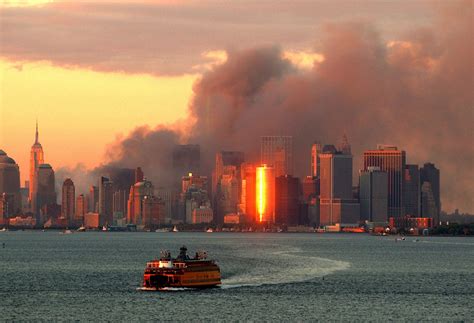
Remembering Fallenness: Many people remember JFK’s assassination somewhat like many of my generation probably remember the September 11, 2001 attacks—with shock, incredulity, and disbelief. I was in Savannah, GA. Suddenly the secretary, who kept a tiny TV on but muted behind her desk, shouted, “O, my God!” I rose from my chair in the office and walked briskly out to her desk. “What is it?” I asked.
She was staring at the TV. Over and over the commentators appeared to grasp for appropriate words. Donna and I stared at the TV screen. We watched the images of the planes crashing into the towers. We watched the president halt all air travel. The skies suddenly became ominous. I literally looked up at the ceiling in our office, as if I could gaze through the roof into the skies outside. I know it sounds silly, but my thoughts were not rational for a few moments. Visceral fear entered. My thoughts raced regarding those I loved. Where were they? Would our phones work? Where was safe? Were we at war? Was this the end of something? Was it the beginning of something? Who was behind this? What now? The questions multiplied.
The days that followed were fraught with emotion, with bloviating, with courage, with resolve, with love of neighbor, with hatred, with patriotism, with xenophobia, with sacrifice, with bravado, with truth, with lies.
Some pontificated this was God’s judgment on America for her iniquity. Then the predictable responses came: “How dare one say that? Don’t you know America is a city on a hill, a light to the nations?” (For the sake of transparency and clarity, I am an American patriot to my core, but America is assuredly not the gospel.
Receiving Redemption: The gospel is about who God is, what He has done in the person and work of Christ the Son, how we sinners who repent and believe upon Christ’s work are reconciled to holy God. Our sin is imputed to Christ; His righteousness is imputed to us. This is done by grace alone through faith alone in Christ alone. It is not sinners meriting righteousness. We are not infused with righteousness. We are clothed in the righteous robes of Christ when we flee to Him in repentance and faith, knowing that we are otherwise justly condemned. But God has done what we never would or could do—reconciled particular sinners through the redemption accomplished and applied by the triune God of Scripture.
2 Corinthians 5:21 puts in plainly: “For our sake he [God the Father] made him [Jesus the Son] to be sin who knew no sin, so that in him [Jesus the Son] we might become the righteousness of God.”
Rejoicing in Reconciliation: As I tried to sleep tonight, I could not. I don’t know if it’s all the years in the Army and sleeplessness that seems to come with that, or if it’s the fact that September 11th has been on my mind for days, or whether it’s just the thunderstorm raging outside currently. Regardless, here I sit … writing in the wee hours of the morning.
I see the country’s fallenness like a banner on the news on my computer screen: Americans left to be martyred in Afghanistan; law enforcement officers being fired for not taking mandatory jabs; colleges students being paid to take the jab (what does it say that you have to bribe someone with cash to allow you to put something in his/her body?); Fauci’s latest contradictions; threats of Islamic attacks on this anniversary of September 11th; open borders with flu (coronavirus-infected) illegals pouring into Texas and being bussed to Wisconsin, North Carolina, and Georgia. The list goes on. Fallenness is manifested with each article I read.
But God’s reconciliation is still to be offered. We are to endure. We are to be an enduring people, especially in the midst of the fallenness. Now is not the time to shrink, to retreat, to quit. No. Trust the Lord. Press into Him and His Word. Remember that the Lord is sovereign and His will cannot be defeated: “Ah, Lord God! It is you who have made the heavens and the earth by your great power and by your outstretched arm! Nothing is too hard for you” (Jeremiah 32:17).
Why does that not amaze us anymore? It should, folks. God’s sovereignty is the believer’s comfort. If God is not sovereign, then your lot is worse than you can possibly imagine. The universe would be an unpiloted chaos–no design, no Designer, and no foundation. But God is sovereign and His grace towards us sinners is amazing. Grace is amazing. Why? Because we don’t deserve any. We deserve judgment.
God calls reconciled sinners to have what the Bible calls a “ministry of reconciliation” (2 Corinthians 5:18-19). He then calls believers “ambassadors for Christ” (v. 20). And He calls us to the mission field. To do what? To hold fast the word of life (Philippians 2:16). To appeal to fellow sinners to be reconciled to God through the person and work of Christ (2 Corinthians 5:20).
Remembering tonight that we are a fallen race, yes, that is certain. But the gospel is also certain. It is certain that God is redeeming a people for Himself, reconciling sinners to Himself through the person and work of Christ; that the triune God of Scripture is calling people out from darkness into light, and that they will rejoice in the midst so that many may see and say that the Lord is good.
On Wisdom
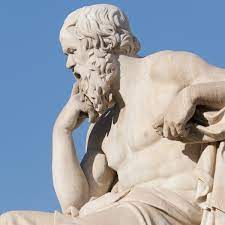
Is this an age of wisdom? Is this an age of creativity in art and culture? Is this a generation characterized by those whose wisdom rivals that of Milton, Shakespeare, Dante, or Sophocles? We surely have certain geniuses scattered in the highways and hedges who are honing their crafts. Maybe I will live long enough to see a great American novel to rival Moby Dick or The Road. Maybe.
What I find more prevalent, however, is that this is an age of crassness, of imbecility, of shallowness that exposes an emptiness of soul. There is a vulgarity in today’s world that saps the soul of sublimity. Art museums have been replaced by video games, if you will. We have lost a sense of appreciation for the beautiful, sublime, and wise. Kitsch over depth.
In part of Scripture’s “wisdom literature,” Proverbs explores the theme of wisdom vs. folly. Listen to how clearly Solomon sets the stage for the thirty-one chapters of proverbial wisdom: “The fear of the LORD is the beginning of knowledge; fools despise wisdom and instruction” (Proverbs 1:7 ESV).
Notice what’s happening here. The first part of the verse posits the very genesis of knowledge/wisdom: the fear of the Lord. The wise person is one who fears God. And the second part of the verse restates the same truth by way of contrast. Since the wise person is the one who fears the God of Scripture, what is the other type of person? What is he like? Solomon writes of that type of person by penning, “fools despise wisdom and instruction.” That’s the nature of fools. They don’t fear God. They scoff at wisdom. They mock the idea that they should be instructed. They are puffed up, impetuous, and unteachable.
The controlling principle for wisdom is submission to the revealed will of God in Scripture. Stated another way by Christ Himself, we know a tree by its fruit. When Jesus was teaching in Luke’s account, He said, “For no good tree bears bad fruit, nor again does a bad tree bear good fruit, for each tree is known by its own fruit” (Luke 6:43-44 ESV) and in the very next sentence He says, “ . . . for out of the abundance of the heart the mouth speaks” (Luke 6:45 ESV).
Our words ought to reveal wisdom and maturity. May we be those who speak wise words, words grounded in the wisdom of the revealed words of God (Scripture). May we pray to the Lord—the fount of wisdom—to raise up mature, wise men and women in this age diminished by the puerile.
Appearance vs. Reality

Illustration: When I was in college and graduate school for English, one of my favorite professors was a Shakespeare scholar. He taught classes on the Bard’s plays—the histories, the comedies, and tragedies. He taught classes on the sonnets. He taught overview courses of Elizabethan drama, of Renaissance literature, of the history of England as she fought through power plays between Roman Catholicism and Protestantism. I took all the classes I could from said professor. He was gifted in teaching how history is often best understood by way of literature.
I have read a lot of books of ancient history, but when you read Shakespeare’s Julius Caesar, for example, history comes alive. In the play, you get a sense of the personalities of Caesar, of Brutus, of Cassius, etc. Evil is not just a theological term there; you can smell its sweat and feel its breath on your neck. Hamlet (in the titular play) originally thought Elsinore was all above board; he discovered the reality that the kingdom was shot through with evil. His father had been murdered by Claudius, Hamlet’s uncle, who was having an affair with Hamlet’s mother. Caesar thought he was surrounded by friends, but he was literally stabbed by his “friend” Brutus. Even non-readers would surely know the line, “Et tu, Brute?” Appearance vs. reality.
Connections: If you are like I am, you are well past the weary stage regarding prevarications. We have been subjected to “fifteen days to flatten the curve” to going on almost two years now. My spidey sense tells me some camps are jockeying for more lockdowns. Excited yet? We have heard we should wear masks, but then see videos of politicians and Hollywood entertainers at a former president’s palace on Martha’s Vineyard where (Presto!) masks are unnecessary. They dance the night away. Masks? Bah humbug! No need for “social distancing” there.
You hear that the Taliban in Kabul are not preventing folks from fleeing Taliban terror but then you see with your own eyes images of civilians clinging to the landing gear as planes depart a nation that has once again descended into hell on earth. Appearance vs. reality—over and over again. You are told one thing but the reality is something quite different.
Scripture: In Psalm 55, David illustrates it this way via literary parallelism: “His speech was smooth as butter, yet war was in his heart; his words were softer than oil, yet they were drawn swords” (Psalm 55:21 ESV). The false person’s speech was as smooth as butter. That was the appearance of things. But “war was in his heart.” That was the reality. Then you get a restatement of the same truth in the parallel image. The false person’s words were softer than oil. That’s pretty soft, isn’t it? Slick, smooth, rhetorically polished even. And yet … those smooth words concealed the reality that they were actually drawn swords. Appearance vs. reality.
Encouragement: It’s a theme as old as man: appearance vs. reality. In what can you trust? What source is reliable? Is truth to be found? O yes, thank God. Listen to Scripture’s encouragement: “Let God be true though every one were a liar . . .” (Romans 3:4 ESV). Remember John 3, after Jesus taught Nicodemus that God was and is the sovereign One, that man’s heart is known by God. Listen to the words near the end of John 3 and take encouragement, especially if you are well past weary of the mendacity, of the prevarications, of the distortions, lies, and all appearances that try to deny reality.
In writing of Christ, the apostle John says, “He who comes from above is above all, He who is of the earth belongs to the earth and speaks in an earthly way. He who comes from heaven is above all. He bears witness to what he has seen and heard, yet no one receives his testimony. Whoever receives his testimony sets his seal to this, that God is true” (John 3:31-34 ESV). With Christ, there is no distinction between appearance and reality. He was and is truth. His words are true. He cannot lie because then He would no longer be holy. Why would we not want that?
To the Ridge with Crusoe
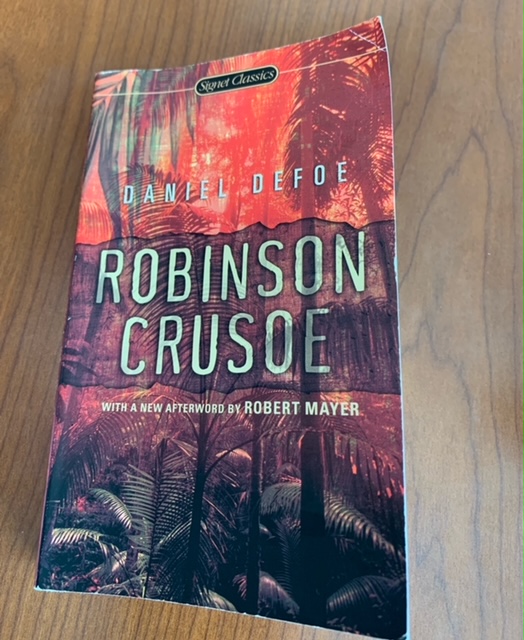
When I was seventeen and a college freshman, I read Defoe’s Robinson Crusoe. It is often cited as the first English novel. It packs a lot boys and arguably many men gravitate to imaginatively–(sea) adventures, voyages, tests of one’s mettle, shipwrecks, miraculous survival, Providence, isolation, savages, exotic islands, dangers from hurricanes, floods, madness, survival, improvisation, primitivism, ingenuity, gratitude vs. ingratitude, beasts, kindnesses repaid, friendship (the unforgettable character Friday), love, sacrifice, and more. Not bad for one book, right?
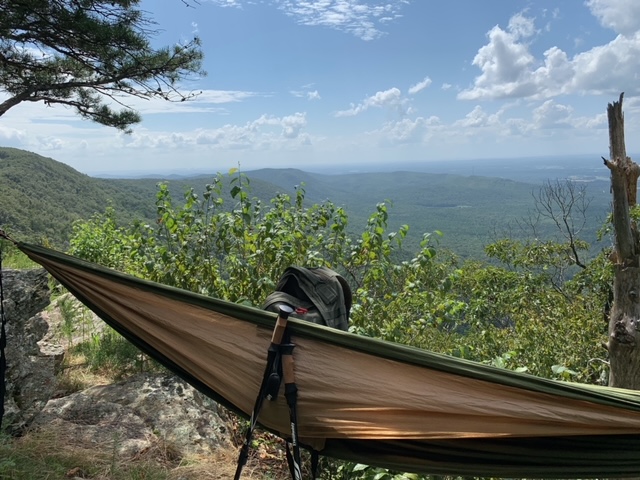
I packed my little paperback copy in my ruck on the way up to the ridge during a recent hike. It was nestled in there between hammocks and some bottles of red Gatorade. I had only a few pages left but I wanted to read them from what I felt to be a proper place–a place where I could take more in visually. It was a sunny day, so I knew I would be able to see a great distance once I got to the top.
During the ascent, I paused to take sips of my Gatorade. I felt something staring at me. You know the feeling. I was hiking a spur up to the ridge. Down to my right ran the creek. There was a tunnel of view in the rhododendron and laurel. I could hear the creek running, the water splashing on the rocks. I peered down through the tunnel, and I saw what first saw me. A doe was lying down beside the running waters. Her black nose was up in the air. I assume she was smelling me, as I was already sweaty from my climb. I reached into my right pocket to retrieve my phone in an effort to capture the moment. But when I set my hiking poles down to reach into my pocket, she popped up and scampered down the hill, from the direction I had come. How does one capture such moments? Why do they seem so important to me? Why do I feel the need to share them? I don’t know that I can answer my own questions. But there is something about the hike, something about the smell of mountain laurel and rhododendron thickets, and the sound of water rolling over the rocks, and of the way a deer sizes you up long before you see her, that moves me. It is soul food. I am of northern European stock, but I have the soul of a Native American in many ways. I like living close to the earth. Give me small town life. Buckhead has its perks but it’s far from my soul.

My climb continued. I intentionally was hiking the steepest way up, just to test myself. Occasionally, however, I would hit a relatively flat area. Variegated mushrooms dotted the forest floor. Kaleidoscopes of fungal color everywhere. I took more pictures. Why? In order to remember, I think. Danger lurks when we downgrade beauty; the soul atrophies.
I continued. An hour or so later, I was at the top. I could feel the winds now. Birds did figure eights in the skies, their eyes dialed on prey hundreds of feet below. I strung up my hammock, unlaced my hiking boots, sipped more red Gatorade, and opened Crusoe again. And I am grateful. Crusoe learned gratitude throughout his adventures in the novel. He learned to thank God for His mercies, for provisions in the forms of beauty, Scripture, the incarnation of God, friendship, and even suffering. Obviously there are millions of people who prefer concrete jungles of downtowns. But I cannot feed my soul there. Some will understand. Indeed I am grateful for days like this on the ridge with Crusoe.
An Age of Lawlessness
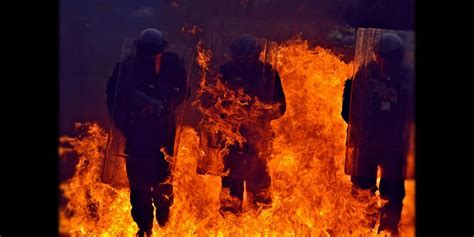
It was about 10 p.m. I was so upset at what I was seeing stream across my computer screen I could not explain it to myself. I turned away, hoping to shut off the images. I texted a Marine friend of mine with whom I deployed to Iraq a few years ago. I told him, “We are all Marines tonight, brother.” He, in his eternally optimistic way, wrote me right back. “Our brothers never died in vain over there [Afghanistan], and the mainstream media doesn’t get to change that for their sound-bites.” We texted back and forth, trying to make sense of it all, trying to encourage one another, longing to return to Afghanistan.
It was not from vainglory or because we are different from thousands of other service members for wanting to go back. No, it’s because of the brothers on the left and right side of us, those who remain in the core of who we are.
And yet the appearance from all the video footage is of terror on every side. Ten Marines, two Soldiers, and one Navy corpsman are listed among the dead. At least 169 Afghanis were killed. Hundreds are maimed, blinded, and crippled for life.
The White House briefers are predicting more bloodshed in Kabul, Afghanistan and abroad. A Marine commander has been relieved for questioning on social media the wisdom of the plan of egress from Afghanistan. The Marine named names in his questioning of what is playing out on the world stage. The current Secretary of Defense Lloyd Austin, along with others of Mr. Biden’s counselors, and General Mark Milley, current Chairman of the Joint Chiefs of Staff under Mr. Biden, were all named by the 17-year Marine officer. Said Marine officer has been removed.
I have not seen times quite like this in my years. When I was a kid, I fell in love with novels and memoirs and other books and films of the Vietnam War. I was a child during Vietnam, and so all I know of it is via history. I still have my tattered copies of The Things They Carried and Going After Cacciato and We Were Soldiers Once and Young. I have shelves of accounts by Soldiers and Marines in southeast Asia. The list could go on. What I see in those books is a glimpse into times of cultural upheaval, of folly on a grand scale, of often senseless death and violence, of sinister purposes by powerful coteries. Terror on every side, as Jeremiah says in his book.
And as I try to process what I am seeing unfold, as I try to understand how and why we are committing cultural suicide by a thousand cuts, of how many seem more convinced that a paper mask they hang on their car mirror and stuff in their pocket and then put back on their face is somehow going to save civilization, and how supposedly vaccinated people continue to die ostensibly from the coronavirus, but we are to trust the government that big pharma has a ready supply of “boosters” and second and third and fourth doses that will be just the cure. Just a few more shots, folks.
I stayed up most of the night, worrying, grieving over my nation, trying to pray and articulate what I was feeling, but the words would not come. I was just … spent. Emotionally wrung out. I see a culture that is fracturing. I see a culture being indoctrinated with wokeness–where we are told to evaluate people based upon skin color, sexual behavior, and their perceived senses of entitlement. Don’t hire based on merit; hire based on gender and sexuality and grievances. Identity politics. Division. Class warfare. Alphabets for new groups. What? Is that what it has come to?
O folks, may it not be so. Let us sober up. Let us learn our history rather than tear it down statue by statue, burn it up block by block, rewrite it via propaganda and grievance studies. Lord, have mercy. We have lost our way. May You relent from what we deserve and humble us and mature us before it is too late.
According to His Work

Question: Do you have someone you look up to for his/her courage? I have several people in my life that inspire me in terms of courage. I had a fellow officer on a deployment to Afghanistan some time back that remains one of those men. When pressured to go along with some unwise practices, he kept to the high road; he did not acquiesce; he upheld his oath. What abides with me most about him, however, even more than our oath as officers, is the way he maintained his honor. He spoke the truth and did so at significant personal costs. He was maligned at the time by some peers for his principled stand, and yet he endured. I saw him again recently after many months. We caught up. And my respect for him increased even more. He continues to keep to the high road. Compromising on matters of honor and integrity is not in his wheelhouse. And I am grateful to him and for him for that. I saw a man whose honorable works matched his honorable words.
Scripture: In the wisdom literature of the Old Testament, especially in the book of Proverbs, the literary device is of a wise father teaching his son. In Proverbs 24, the father says,
If you faint in the day of adversity, your strength is small. Rescue those who are being taken away to death; hold back those who are stumbling to the slaughter. If you say, “Behold, we did not know this,” does not he who weighs the heart perceive it? Does not he who keeps watch over your soul know it, and will he not repay man according to his work? (Proverbs 24:10-12, ESV)
So many lessons are here:
- Adversity comes, so be steadfast. Don’t “faint” amidst the trials.
- Guard those in your keep.
- Remember that God sees all. Our motives are known to God almighty.
- Holy God will mete out justice.
Our works demonstrate our character. As the half-brother of our Lord Jesus said, “ … faith apart from works is dead” (James 2:26b). People demonstrate their faith through their works. And God repays justly.
Connections: When we survey the current climate, we see the results of various ideas/faiths/worldviews. We see the works. This week I read the news online and was met with the following:
- ‘Hands-off’ strategy in Portland, Oregon regarding ANTIFA despite destruction
- Disgraced Cuomo commutes sentences of convicted murderers in New York
- Kabul, Afghanistan airport terror threats ‘very real’
- American woman stranded in Kabul, beaten by Taliban
The list goes on and on. These are the works of our hands. Does God not see? Do you think God won’t repay/is not repaying? So, where are the adults? Where is courage? Where is clarity? Where is conviction? “Does not he who keeps watch over your soul know it, and will he not repay man according to his work?” What do these works say? Do they say that we’ve a mature mind, honorable leaders, and self-disciplined citizens? Or do the works demonstrate the follies of abandoning God and subsequently being abandoned by God?
Encouragement: The good news remains where it has always been, however—in the gospel. When the prophet Jeremiah spent his years of telling the truth to Israel and Judah in 600s-580s B.C., and when his nation was being judged by Assyria and then Babylon, and when he saw Jerusalem destroyed by Nebuchadnezzar and the temple desecrated, he continued to herald the good news for all with ears to hear:
But this I call to mind, and therefore I have hope: The steadfast love of the LORD never ceases; his mercies never come to an end; they are new every morning; great is your faithfulness. “The LORD is my portion,” says my soul, “therefore I will hope in him.” (Lamentations 3:22-24, ESV)
That is good news for all who are in Christ, to all who are grafted into the true vine. Listen to the words of Christ Himself who laid it out plainly:
Abide in me, and I in you. As the branch cannot bear fruit by itself, unless it abides in the vine, neither can you, unless you abide in me. I am the vine; you are the branches. Whoever abides in me and I in him, he it is that bears much fruit, for apart from me you can do nothing. If anyone does not abide in me he is thrown away like a branch and withers; and the branches are gathered, thrown into the fire, and burned. (John 15:4-6, ESV)
One of great benefits of truth is that it does not change. It is steadfast, sure, unchangeable. The God of truth does not change. And He calls out through His gospel to those whose works only reveal their own lostness and folly. He said it through Jeremiah; He said it through Solomon; He said it through Jesus’ incarnation; He said it through the resurrection of Christ from the tomb: God will repay according to our works if we refuse Him. But for all who will repent and believe upon the One whom He has sent, the Lord Jesus, God in the flesh, we receive the benefits of Jesus’s works instead of our own. In short, redemption purchased and applied to us who flee to God in the gospel of Christ. There alone, we sinners who are in Christ are reconciled … and it’s all according to His work, not ours. And for that the praises of all the redeemed will utter, “Amen! Blessing and glory and wisdom and thanksgiving and honor and power and might be to our God forever and ever! Amen.”
—CH Pirtle
Conformed to the Idolatrous

Here are four literal or essentially literal English translations of Proverbs 29:18 from the Hebrew text:
KJV: “Where there is no vision, the people perish; but he that keepeth the law, happy is he” (Pr 29:18).
NASB: “Where there is no vision, the people are unrestrained, But happy is one who keeps the law” (Pr 29:18).
ESV: “Where there is no prophetic vision the people cast off restraint, but blessed is he who keeps the law” (Pr 29:18).
NKJV: “Where there is no revelation the people cast off restraint; But happy is he who keeps the law” (Pr 29:18).

Proverbs is part of the wisdom literature in Scripture. The book bearing the name of Proverbs is just that–31 chapters of wisdom for daily living about folly vs. wisdom; man’s way vs. God’s way; perishing vs. life; reprobation vs. blessing; chaos vs. Christ.
Proverbs 29:18 speaks about what happens when there is a rejection of wisdom. People perish. They cast off restraint. They regress. The descend into mobs.
Often when I counsel people who are in dire straits, I ask them them about their core beliefs, about where wisdom comes from. Most cannot articulate a clear and coherent answer. Their answers are often messy and jumbled, chaotic, disconnected, and illogical.
When you have an age unable to articulate answers to fundamental questions about wisdom, it is well past time to take notice. The imbecility of what passes for wisdom should terrify you.
We are in an age of folly. Emotivism and narcissism have replaced revealed wisdom and biblical moorings. And we wonder why people cast off restraint? They don’t view themselves as accountable to God or to anyone or anything.
It is as if those with eyes can’t see and those with ears can’t hear. But those words, too, are from the One who inspired Proverbs.
Behold, the consequences of suppressing the truth. You are witnessing a casting off of restraint: unrestrained mobs, violence, the silencing of the prophetic voices. Behold your gods.
What a bed we have made.

