Cattle on a Thousand Hills

The last few days have been gorgeous. Long days of sunshine, clear skies at night, and a full moon today. You don’t need a flashlight outside at night.

Anglers are out, their lures in Allatoona and Clarks Hill and Lanier and Sinclair. Kayakers slide across the waters in near silence. Bicyclists in tight and brightly colored spandex bike shorts peddle along the edges of our roads. Motorcyclists, dressed in leather, roll across the state, taking in the scenery and feeling the wind.

It is hard to beat, at least in my opinion. If you are not dead to beauty, it is abundant. It calls out to be appreciated, to be enjoyed, and to be stewarded.

Connection to Scripture: A lot of folks may know something of these verses:

For every beast of the forest is mine,

   the cattle on a thousand hills.

I know all the birds of the hills,

   and all that moves in the field is mine. (Ps 50:10-11)

Context: The poet Asaph penned these lines in Psalms to remind God’s people that just going through the motions of religiosity, just checking the spiritual block, was a sinful pattern that God detests. God wants authentic genuine worship, not lip service. He spoke through the poet Asaph these words:

Hear, O my people, and I will speak;

   O Israel, I will testify against you.

   I am God, your God.

Not for your sacrifices do I rebuke you;

   your burnt offerings are continually

      before me.

I will not accept a bull from your house

   or goats from your folds.

For every beast of the forest is mine,

   the cattle on a thousand hills.

I know all the birds of the hills,

    and all that moves in the field is mine. (Ps 50:7-11)

The Teaching: You see, it is not burnt offerings that please the Lord. It isn’t bulls or goats or any human work that will mollify or satisfy the holy requirements of God. Only God himself is holy. That is why God provided the ram in the thicket for Abraham. Isaac, Abraham’s son he loved, would not have to be sacrificed. And Abraham’s response? “So Abraham called the name of that place, “The LORD will provide”; as it is said to this day, “On the mount of the LORD it shall be provided.” (Gen 22:14)

Asaph wrote about it in Psalm 50. Moses wrote about it in Genesis 22 regarding Abraham and Isaac and God’s provision of the ram in the thicket. Paul wrote about it in letter after letter. John wrote about in gospel and in letter form.

Christ is the one and only sufficient Passover lamb (1 Cor 5:7), sacrificed for his people (Heb 7:25), slain in accordance to the eternal decree of the triune God (Eph 1:11), “written before the foundation of the world” (Rev 13:8).

Encouragement: It is because God owns the cattle on a thousand hills that redeemed people know how and why to steward beauty. It is because holy God is satisfied with the person and work of Christ, the only sufficient lamb, the ram–not caught in a thicket but nailed to the tree—that redeemed people know how and why the birds sing and soar, the beasts of the field and forests roam, the firmament shows forth its majesty, and the cosmos heralds God’s glory. It is because it is all a theater of God’s glory.


The Art of Attention

It was just after 4:20 a.m. Windless. Clear skies. The moon was a waxing gibbous, just a few hours short of its fullness. The firmament was so clear, the moon so bright, I could see the lone wisp of white cloud where it floated like something out of an Edgar Allan Poe story, between me and the face of the moon.

I climbed on my motorcycle for the ride to work. Samuel Johnson wrote, “The true art of memory is the art of attention.” This week we are approaching Memorial Day for 2021. Memorial Day is officially the last Monday of May on which Americans honor the men and women who died while serving in the U.S. military.

That word–memorial–has a Latin etymology meaning “remembering” or “being mindful of.” That’s part of why I appreciate Johnson’s quote, “The true art of memory is the art of attention.” When I got on my bike this morning, I was captivated by the spectacle of the moon, the white wispy cloud hanging mysteriously in front of it, and when I crossed the bridge over the Etowah and heard the whine of my tires on the bridge’s macadam, I smelled the river and turned my head to see the moonlight reflected off the river below.

The art of attention, Johnson called it. Being mindful of the beauty that is there. Remembering why Memorial Day this coming Monday is significant. Being mindful of the men and women who rendered all.

When I got to work, my routine quite early each day is to read Scripture, then look over my list of things to accomplish for the day, and to just center myself for what lies ahead. For whatever reason, I just think better in the mornings. It’s quiet. There are no interruptions. I can, as Johnson said, attend. I can be mindful of things, can easily focus, can listen, and see, and notice.

When I read the news online later in the day, I saw–once again–a nation ripping herself asunder. A sitting U.S. senator from Kentucky is receiving death threats and is being stalked. Anthony Fauci has been caught in still more prevarications. ‘Wokeism’ has now replaced actual history. Reading, writing, and arithmetic are passe, replaced by grievance studies. America is the bane of the world, the wokesters shout.

And my mind returns to the ride under the moonlight this morning. To what am I paying attention? I see my nation doing two things simultaneously: 1) saying it still believes in Memorial Day (and actually knowing what it denotes) and 2) tearing herself apart via grievances and contradictory emoting.

Our land is imperfect. She has always been so. Why? Because it is filled with imperfect fallen sinners. But she has goodness, too. There have been some, are some, and, Lord willing, will be more to come, who are builders and not destroyers. There are some who are givers and not takers.

There are some who want–not to tear down statues and eradicate history–but who wish to preserve history and learn from it.

The moon will be full in just a few more hours. I already look forward to looking up early in the morning to see it. I look forward to paying attention to the way its light plays off the river’s face. I look forward to seeing any white wisps of clouds that may slide across the firmament in the morning, but it will mean I will need to pay attention to the good things. It will mean remembering the good. Not a bad way to start the day.

Exile and the Kingdom

Why Biblical Prophecy Matters: Isaiah’s book is indubitably one of the most poetic and beautiful books in Scripture. Isaiah was a prophet in the 700s-600s B.C. during the time of the kings Uzziah and Sennacherib. This is helpful not just to history buffs but also because it reminds us that God raises up prophetic voices to speak into the lives of those who will listen. God works in and through history. God enters history because it is His story. God spoke and the universe came to be (Genesis 1). God formed man from the dust of the earth (Genesis 1:26-27). God the Son took on flesh “in the fullness of time” (Galatians 4:4).

Jesus spoke to Pilate in a particular week, and on a particular day, and was betrayed by Judas, and went to the cross on a particular Friday, and was resurrected on a particular Sunday, and all of this matters because God is a God who works in history. We live, in sum, in God’s world, and what happens in this world happens under the sovereignty of God. And one of the most powerful recurring patterns you see in Scripture is the role of the prophet to call out to the nations, to warn them of God’s holiness, of God’s nature, of our sin and rebellion, and of judgment.

The many prophets’ messages were often a variation upon this theme: Return to the Lord, because your sins have separated you. Because you are spiritual/political/moral/individual rebels, exile is your just state. Because you have rejected God and his kingdom, because God’s justice demands he deal justly, you are where you are. Return, therefore, in humility–and be restored.

Examples from Scripture: And yet God raises up men like Isaiah. Why? To plead with sinners to repent, to humble themselves before it is too late, to return to God. God’s hand “is not shortened, that it cannot save, or his ear dull, that it cannot hear …” (Isaiah 59:1).

Isaiah called out a simple, unpopular, clear warning to the people in his generation (and to ours by extension), Why will you choose exile instead of the kingdom? Listen to the prophet’s words to the nation in his time:

Truth is lacking, and he who departs from evil makes himself a prey. The LORD saw it, and it displeased him that there was no justice. He saw that there was no one to intercede; then his own arm brought him salvation, and his righteousness upheld him (Isaiah 59:15-16).

Sounds like it could be from today, doesn’t’ it? We live in the midst of a people of unclean lips. We see relationships fractured due to sin, betrayal, moral cowardice, dishonesty, bribery, and on and on.

Connection to Our Day: But read those words from Isaiah again. You see, he was telling the people that “God saw that there was no one to intercede.” See that in the text? So what happened? God’s own arm brought salvation. What could that possibly refer to? God would bring salvation from himself? Yes. Exactly.

God declares that he is a God of justice: “I the LORD love justice; I hate robbery and wrong” (Isaiah 61:8). God knows that a kingdom of righteousness means that its denizens practice righteousness, live justly rather than unjustly, love goodness rather than evil. But is that what we see? No, we see exiles behaving as rebels against God and his will, and we see secular fiefdoms in conflict, wars and rumors of wars. Just as, wait for it, was prophesied.

Encouragement: Isaiah’s message, like that of the other true prophets in the Bible, called those who would hear, to look to the One who was and is the only means of redemption. Listen to how Isaiah ends chapter 59:

“And a Redeemer will come to Zion, to those in Jacob who turn from transgression,” declares the LORD. “And as for me, this is my covenant with them,” says the LORD: “My Spirit that is upon you, and my words that I have put in your mouth, shall not depart out of your mouth, or out of the mouth of your offspring, or out of the mouth of your children’s offspring,” says the LORD, “from this time forth and forevermore.” (Isaiah 59:21)

And what do you see Jesus do when he begins his public ministry? He quotes Isaiah’s words as being fulfilled. How? In and through himself—Jesus, the Christ, the Redeemer:

And he came to Nazareth, where he had been brought up. And as was his custom, he went to the synagogue on the Sabbath day, and he stood up to read. And the scroll of the prophet Isaiah was given to him. He unrolled the scroll and found the place where it was written,

The Spirit of the Lord is upon me, because he has anointed me to proclaim good news to the poor. He has sent me to proclaim liberty to the captive and recovering of sight to the blind, to set at liberty those who are oppressed, to proclaim the year of the Lord’s favor.”

And he rolled up the scroll and gave it back to the attendant and sat down. And the eyes of all in the synagogue were fixed on him. And he began to say to them, “Today this Scripture has been fulfilled in your hearing” (Luke 4:16-21).

You see, folks, God did keep his promise about the One who would be raised up by God himself, the intercessor, the Righteous One, the Holy One of Israel. His name is Jesus. He is the Messiah. And he has his prophets who call out and herald the same refrain: Exile or the Kingdom? The king has come once; he went to the cross, in precise fulfillment of Isaiah’s prophecy. He is coming a second time, too, again in precise fulfillment of prophecy. But this time it is a coronation for his kingdom. Will you attend to the words of the Lord? As Luke records in 4:22, they “marveled at the gracious words that were coming from his mouth.”

Long Obedience in God’s Direction

A Good Start: You know something of King Solomon, right? Folks with some knowledge of Scripture and history may know tidbits of his life. He is referred to, in his early life, as wise: “And God gave Solomon wisdom and understanding beyond measure, and breadth of mind like the sand on the seashore, so that Solomon’s wisdom surpassed the wisdom of all the people of the east and all the wisdom of Egypt, For he was wiser than all other men …” (1 Kings 4:29-31). That was early on in Solomon’s life.

Solomon had the temple built in Jerusalem (2 Chronicles 3). His wealth grew to immense proportions (1 Kings 10:14-29). He had the ark of the covenant brought to Jerusalem (2 Chronicles 5:2). He created beautiful architecture and landscapes in Israel by having artists and architects and designers design and create beautiful buildings, roads, and trees with meticulous detail (2 Chronicles 9). These were no small accomplishments.

A Compromising Middle: But Solomon was a sinner, too. He was far from a perfect ruler. He would not remain king. The perfect King would be later, the One would obey the Father’s will completely on behalf of all who believe. Solomon had a weakness for women (1 Kings 11). He had 700 wives and 300 concubines (1 Kings 11:3). Scripture records that they “turned away his heart after other gods, and his heart was not wholly true to the LORD his God, as was the heart of David his father” (1 Kings 11:4). He erected idols. He not only allowed idolatry; he lauded it. He called evil good (1 Kings 11:7-8), and this from a man who began with such promise.

A Dark End: The remainder of 1 Kings 11 is a catalog of how Solomon’s compromises with sin cost him and his legacy and the nation and the world. False gods were worshiped. Foreign powers entered. Corruption characterized the nation. Solomon’s sons were wicked men. The kingdom split. The country’s wealth was squandered. Mob rule began. Despots arose. Exile occurred.

Segue: Recently at CNGC we had an event honoring our retirees. Community organizations came out to honor retired veterans and spoke to them about services and opportunities they have earned by virtue of their service. It was a sweet event, a compassionate one in my view. It was refreshing to see men and women who have contributed to this organization, who have made it and us, better. One of the most influential men in my life came. We spent much of the day together and I continued, as I’ve done for 15 years now, to pepper him with questions. “Sir, what have you learned? How have you seen the Lord’s providence through the years and now into retirement?” He sipped his coffee and in that deep pastoral voice, said, “Jon, to be who God calls us to be and trust Him with the results, as He sees more than we see. He sees the end from the beginning.” Yes and amen, sir, I thought. Yes and amen.

Takeaway/Encouragement: When we look at Solomon, we see a man who began well but who eventually fell very short due to his own sin, his unwillingness to kill it, and it (the sin) killed him, and much of the culture. But God also places those in our lives who demonstrate what faithfulness looks like, what long obedience in God’s direction, looks like. We all fall short; we all have sin in our lives. All except One. There is One who was made sin so that we might be declared righteous. “For our sake he [the Father] made him [the Son] to be sin who knew no sin, so that in him [the Son] we might become the righteousness of God” (2 Corinthians 5:21). This is the good news of the gospel, folks. The Righteous One was made sin so that we sinners who repent and believe upon the person and work of Christ are made righteous. It does not get better than that. Yes and amen. Yes and amen.

Gratitude

Illustration: A phrase from poet Gerard Manley Hopkins reads, “Glory be to God for dappled things” from his poem “Pied Beauty.” For the balance of the poem, the speaker describes finches’ wings, rose moles, skies of “couple-colour,” and the rainbow sheen of trout in water. The color, the arrangement, the intricate detail, the beautiful creations we may behold if we pause to look. It is as if the Creator speaks through his creation, saying, “Look; taste and see. These things are good.”

Segue: Yesterday I had another funeral for one of our fellow veterans. He was a veteran of the Vietnam War/Conflict. I talked with his family for quite some time prior to the honors ceremony. Nephews and nieces of the deceased recounted the veteran’s service in Vietnam to me, the Bronze Star he received, and of the way he volunteered for Vietnam rather than waiting to be drafted. Not only did he volunteer but he enlisted, even after he had graduated from college. Before I could ask the family why they thought he had done that, the nephew and niece said, “He was just that kind of man, Chaplain. He was grateful for the nation. He wasn’t a complainer. He was a contributor.” Then they paused, looking at me. Did they want me to respond? I looked at them and remained silent. “He never spoke about Vietnam, Chaplain, after he returned. But he was proud of his service. He was a grateful man.”

As I crossed the lake yesterday en route to Georgia National Cemetery, I had Hopkins’ poem in my mind: “Glory be to God for dappled things.” Just 30 minutes later, I was speaking with families of veterans. And I listened to them talk of their loved one. And I presided as the chaplain for yet another military funeral honors, while our excellent Soldiers and NCOs played “Taps” and folded the flag and handed it to me, and I then presented it to the veteran’s wife, as she patted her face with her son’s handkerchief, and tried to restrain more of her tears. I approached her and knelt and presented: “On behalf of the President of the United States, the United States Army, and a grateful nation, please accept this flag as a symbol of our appreciation for your loved one’s faithful and honorable service.” Then I rendered my salute.

I’ve done it hundreds of times. But it moves me each time. I think it’s because when you speak with folks and their facades are removed, you may find that there are still good men and women about, those who are grateful, those who understand gratitude makes sense because of the One who created all beauty.

Encouragement: If you take your worldview from mainstream media, you will likely be bitter and resentful. You may find yourself stirring up controversy where there need not be any. Why? Because most media thrive on whipping up emotion, on “Us vs. Them” paradigms.

But for the Christian, he understands what Hopkins understood, and what the Vietnam veteran and his family understood. Thanklessness/ingratitude is an ugly thing. Remember Lear’s line in the play that bears his name? “How sharper than a serpent’s tooth it is [t]o have a thankless child,” (King Lear,1.4.295-96).

 Striking beauty surrounds us but we must pay attention. The Christian, unlike the pagan, understands that good things exist because of the good Creator. This is not a random, accidental, happenstance world. It is the creation of Creator God. We should be grateful because there is a personal God to whom we are accountable and before whom we should be grateful—for the “dappled things,” as Hopkins wrote, and for the wisps of clouds above a glassy lake, and for the vets who served with honor, etc. You see, the creation attests to its Creator. We creatures are to see that, and to draw near. As David wrote in one of his poems in the Bible, “Oh, taste and see that the LORD is good” (Psalm 34:8).  

For the Love of Books

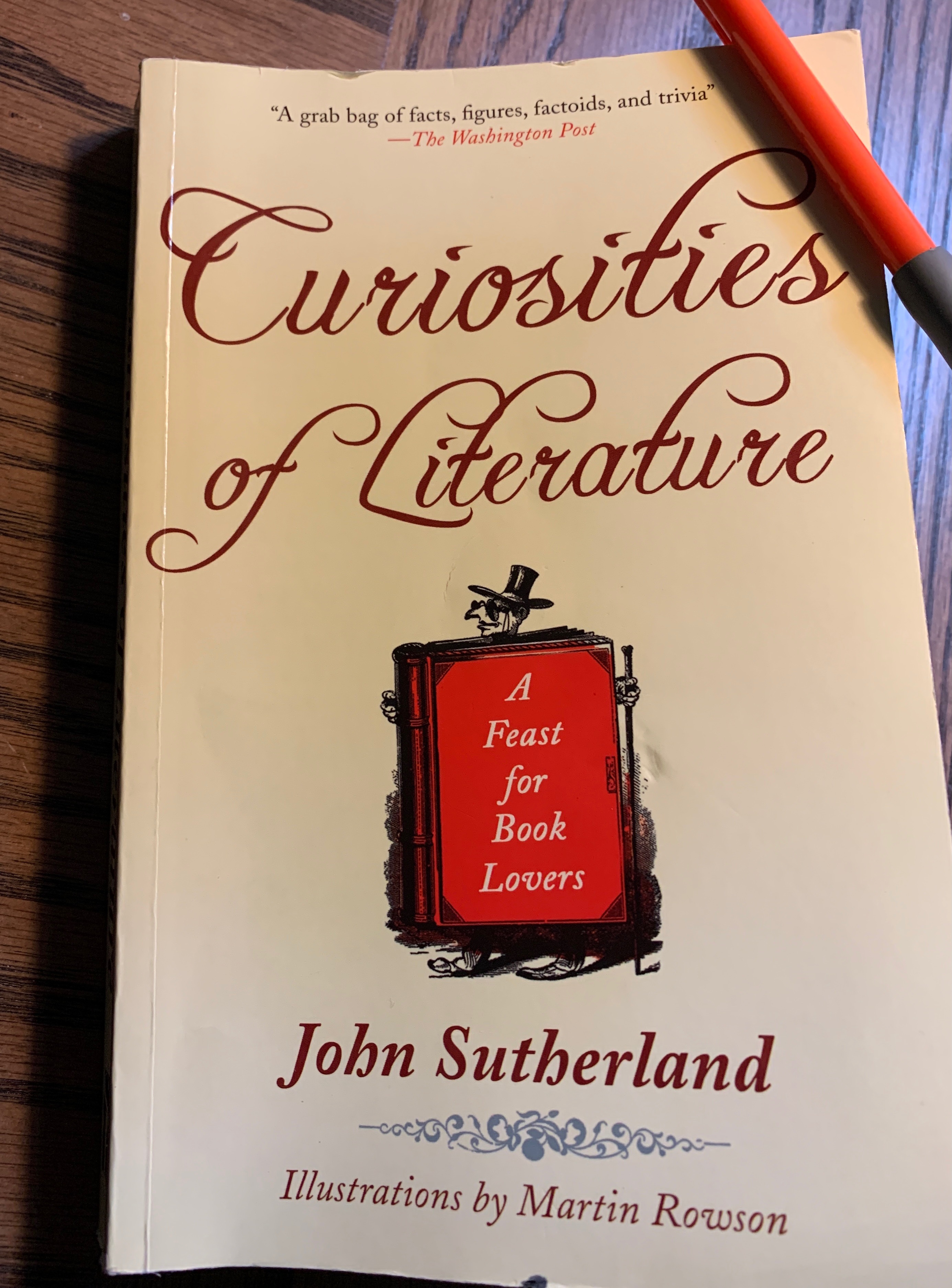
Sutherland’s books invariably stimulate bibliophiles to closer and deeper reading. I completed his Curiosities of Literature recently. Following are a few of the said curiosities:

  1. Balzac would drink up to forty cups of coffee a day (130).
  2. The shortest novel to win the Pulitzer Prize? Hemingway’s The Old Man and the Sea (113).
  3. The most difficult reading? The list includes Robert Browning’s Sordello, Joyce’s Finnegan’s Wake, and Pynchon’s Gravity’s Rainbow (103).
  4. The paralyzed French writer, Jean-Dominique Bauby, “dictated his post-stroke memoir, Le Scaphandre et le Papillon (The Diving Bell and the Butterfly), with an alphabetic code, involving 200,000 blinks of his left eyelid, the only functioning part of his body” (106).
  5. Earlier and mercifully abolished titles of Fitzgerald’s The Great Gatsby were Trimalchio in West Egg and The High-Bouncing Lover. And Orwell’s earlier title for Nineteen Eighty-Four was The Last Man in Europe (178).

For the remnant of bibliophiles scattered hither and yon, read on.

The oft-quoted maxim from Francis Bacon still holds: “Some books are to be tasted, others to be swallowed, and some few are to be chewed and digested.”

A Call for Clarity

Illustration: I have a friend who has never been in the military but he is an American patriot and a Christian. We are on opposite sleep schedules. I go to bed early and rise early. When I woke up recently at my normal hour I had a text from him waiting on my phone. He was asking for my thoughts on the continuing destruction across the nation by various insurrectionist groups. I texted him back after I drank my coffee, saying I was unfamiliar with the latest destruction. He later asked about Portland, Oregon, about cities in Minnesota, and whether America’s Guardsmen would continue to be called up and put on duty to protect Americans from Americans. I wrote back saying, “I don’t know, brother; it appears to me the train has left the tracks. Just keep your head on a swivel and your powder dry.”

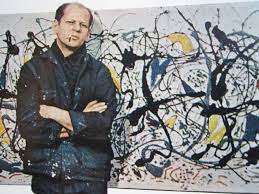
Segue: Few qualities are more important to me when it comes to understanding than clarity. One of my favorite maxims is, “Clarity is more important than agreement.” When folks are clear about what they believe and why they believe it, that can make life so much easier. Of course, many wicked people are crystal clear in their thinking; they just choose wickedness, so I am aware of the perils of oversimplification. A common issue, however, is that many folks don’t know what they believe. They’re “all over the map,” so to speak. Their worldview is a hodgepodge conglomeration of inconsistent and often contradictory ideas. Picture a Jackson Pollock piece—a little bit of this and a little bit of that, a pastiche ostensibly suggesting chaos rather than order, cacophony rather than harmony, strife instead of peace.

How long will Antifa continue their Sherman-like method of burning almost everything they can? Will America allow the defunding of her own police? In short, will the thugs be allowed to win because law-abiding citizens are afraid to stand up to the mobs? I don’t know. However, I do have clarity regarding this: we continue to disintegrate. That is, we are dis (not) + integrated (together). Scripture phrases it thus:

 “There is no peace,” says my God, “for the wicked.” (Isaiah 57:21, ESV)

Our spiritual house is divided against itself:

“If a kingdom is divided against itself, that kingdom cannot stand. And if a house is divided against itself, that house will not be able to stand.” (Mark 3:24-25)

These are part of the inevitable consequences of suppressing God and his revelation for us. These are consequences of reaping what we have sown. This is the law of the harvest:

“Do not be deceived: God is not mocked, for whatever one sows, that will he also reap. For the one who sows to his own flesh will from the flesh reap corruption, but the one who sows to the Spirit will from the Spirit reap eternal life. And let us not grow weary of doing good, for in due season we will reap, if we do not give up. So then, as we have opportunity, let us do good to everyone, and especially to those who are of the household of faith.” (Galatians 6:7-10)

Encouragement: Again, clarity is so helpful. What is to be our governing authority? Will it be secularism? How is that working out for us? Will it be the overthrow of biblical morality? How is that working out for us? Will it be identity politics? How is that working out for us? Will it be judging people based upon the amount of melanin in our skin? How is that working out for us? You see, beloved, we are witnessing what happens when a ship has severed her moorings. She has severed her moorings and failed to explain why she is to sail at all—or even where or how. She is being tossed by tempests that come from not thinking through the consequences, of not being clear. How much clearer must things become?

And yet the God of Scripture calls out to all who will hear, “do not harden your hearts” (Psalm 95:8a). May we be mature and clear in our thoughts and in our actions. My friend is both clear-headed and courageous. The time for such men (and women) has long been upon us.

With Isaiah on the Water

Illustration: Spring finds a lot of folks enjoying the outdoors, relishing the blessings of creation. I completely track with that. When I unloaded the kayak from the truck and put in at the water’s edge recently, a father and his two children were fishing for bream. I could see their bright lime green and blaze orange corks floating on the water. A light wind blew across the lake. Around the edge of the lake, yellow-green pollen coagulated on the shoreline in bubbly hillocks. The sun had another 90 minutes before it would descend upon the ridge to the west. The light breeze was already beginning to taper off. It was just right for kayaking. The last 90 minutes of these spring days are nearly perfect for kayaking and paddle boarding. A young couple was paddle boarding near where I put in my kayak, and we exchanged pleasantries about the evening.

I took the prophet Isaiah kayaking with me. Isaiah, from the 700s B.C., the poetic prophet who held forth the truth to Israel and Judah in the 700s-late 600s B.C.  Isaiah’s messages were not for the faint of heart. He spoke about God’s holiness, about man’s sin, about God’s sovereign plan to execute judgment his own way and for his own glory. Listen to how direct Isaiah’s message was:

Ah, sinful nation,

   a people laden with iniquity,

offspring of evildoers,

   children who deal corruptly!

They have forsaken the LORD,

   they have despised the Holy One of Israel,

   they are utterly estranged. (Isaiah 1:4, ESV)

That’s not the sort of message that wins popularity contests. But Isaiah, like all authentic prophets, spoke the truth. He was God’s man who “spoke truth to power,” as a hackneyed phrase puts it. He saw his nation immersed in sin. It was not primarily a political tragedy; it was not primarily an economic tragedy; it was not primarily a military tragedy; it was not primarily a racial or ethnic tragedy. It was a sin tragedy. And God’s prophet longed to see people humble themselves before God so that judgment would not fall upon them. God had sovereignly created and ordained a nation, Israel, to be a light to the nations. But they fell short; they became idolatrous; they wanted to be like the world’s other nations; they didn’t have hearts faithful to the Lord. In precise fulfillment of Isaiah’s prophecies, Israel and Judah (the northern and southern kingdoms respectively) were conquered by the Assyrians and the Babylonians. Judgment came in the forms of invasions, in abominable forms of moral melee, and in the forms of control by wicked empires by reprobate rulers. All this I thought about as I paddled the lake in my kayak.

Connection: As I paddled and slid out to deeper water, a mallard paddled by me, just a few yards out. Mallards are stunningly beautiful. The richness of the green head, the necklace of white ringing the throat, the sable eyes behind the bright yellow bill, and the ways the water beads upon their feathers. I tried to take some pictures with my iPhone as he moved with apparent ease across the lake and occasionally dipped his head under now and again in rhythmic beauty. It all seemed so natural. He was doing exactly what he was designed for. His legs paddled invisibly below the surface; his colors advertised his place among his own; the lake provided seeds and stems for his diet, etc. All seemed in order.

And yet, I thought, how differently humanity is portrayed in Isaiah’s words, and, ergo, in the eyes of God. We tend to kick against the goads. We tend to rebel. We are moral creatures. We have choice. We don’t just swim upon the surface of life and eat. No, we are God’s special creatures, created for fellowship with him and with one another and with the earth. But we’ve made a mess of things. Again I listened to Isaiah’s words and felt the irony as I imbibed the peace of the evening. Listen to God’s heart for people via his prophet, Isaiah:

                                    Come now, let us reason together, says the LORD:

                                    though your sins are like scarlet,

                                       they shall be as white as snow;

                                    though they are red like crimson,

                                       they shall become like wool.

                                    If you are willing and obedient,

                                       you shall eat the good of the land;

                                    but if you refuse and rebel,

                                       you shall be eaten by the sword;

                                       for the mouth of the LORD has spoken. (Isaiah 1:18-20, ESV)

Takeaway: I have never been a political person; I don’t like how politics tends to replace God in people’s lives. When people neither know nor fear the Lord, they fashion God substitutes. In short, they prove what the Scriptures teach, namely, that sinful man is an idolater. And very often that idolatry in world history has led to tyrannical government. It is a form of judgment allowed by God to teach and discipline us. Isaiah knew it, and he proclaimed it to all who would listen in his day.

God sent prophets to speak the truth, to point even to the obvious when necessary, to bear witness to God’s way vs. sinful men’s ways. “Let us reason together,” the Lord said through Isaiah.

Yes, Lord, I pray we would, for we seem very unlike this mallard swimming past me on the lake this evening. He seems to be right where he is supposed to be, and doing things the way you intended. May you raise up faithful truth-tellers to warn the bellicose, to woo the backslidden, and to welcome the prodigals. May you raise them up, Lord, and make them faithful.

And Yet You Are Mindful of Him …

Illustration: You probably noticed it, too—the brightness of the moon. When I walk outside early each morning to walk my dogs before leaving for work, the very early mornings are normally dark, even amidst the starlight. But not this morning. The trees surrounding me appeared as clearly as if it were daylight. The moon was so bright the forest floor was washed in milky whiteness. Normally I would wear my headlamp when I take the dogs out but that was unnecessary this morning. I could clearly see the ridge to the south of our property. The limbs of the hickories and oaks limned the periphery of my steps as I watched the dogs go out into the woods for their morning routine. It was quiet. Moonlight washed over all. And the only sounds were from the dogs as they walked on the leaves. I could see our cat under the magnolia bush in the front of the house, where she perches each morning, waiting on the first birds to appear at the birdfeeder when the sun rises in a couple of hours.

Slightly over every 27 days the moon orbits the earth. The precision is remarkable. I only took one astronomy class in my college days, and it blew my mind. When you study the heavens, the precision of the heavenly bodies, the rotation of earth on its axis, the ways in which the moon is used vis-à-vis the earth’s tides and rhythms, it redounds to its brilliant Creator.  

Scripture: Psalm 8 is one of the most beautiful of poems in the Old Testament book of Psalms. The first few lines read this way:

                  O LORD, our Lord,

     how majestic is your name in all the

earth!

You have set your glory above the heavens (v.1)

Then in the following verses, David makes profound observations and follows them with profound questions:

                  When I look at your heavens, the work

                             of your fingers,

                       the moon and the stars, which you

                              have set in place,

                  what is man that you are mindful of

                               him,

                  and the son of man that you care for

                           him? (Ps 8:3-4, ESV)

Encouragement: Sometimes when it’s quiet like it was this morning, and you listen to your dogs scamper on the forest floor, and you look around at the hills suffused in moonlight, and you hear the creeks running fast below, and you see the massive trees with their limbs webbing upward towards the heavens from whence come their necessary light and rains, and you see yourself as a partaker in a script wherein the Author of the moon, the stars, the trees, the creeks, the beauty and mystery of it all calls out. Every poem has its poet; every painting has its painter; every song has its composer; every story has its writer. And every moon-bathed morning, too, has its Maker. And the Maker says, He is mindful of you.

Wood, Hay, & Straw

Illustration: Who would think a hay bale could be so dangerous? Let me explain. This morning on the drive south, traffic was doing between 65-75 mph, and heading south towards the city. All seemed normal. Finally we neared the merge of 575 with 75S. Suddenly, the drivers in front of me hit their brakes, swerved right, then left, and some crossed several lanes—all in an instant. Brake lights. Horns. In short, it appeared we were all about to be involved in big pileup on the interstate at the I75-575 merge. Why? Some hay bales had fallen from a truck bed and littered the interstate. Hay was blowing everywhere due to the draughts of wind from vehicles zooming past. I swerved, too, just like the other drivers, trying to navigate through the hay blowing across five lanes of morning traffic. And just as quickly as it happened, it was over. I had made it through. I caught my breath. I felt my chest relax. I felt suddenly super-spiritual, like God had shaken me by the shoulder and called my name.  

Connection to Scripture: I cannot get the image of hay out of my mind. It blew across the interstate this morning and it continues to blow across my imagination still. Paul used the image of hay (wood, hay, and stubble in the older English translations) to describe how insubstantial our lives are if not built upon truth and Christ as the foundation. Here is the way Paul put it:

For no one can lay a foundation other than that which is laid, which is Jesus Christ. Now if anyone builds on the foundation with gold, silver, precious stones, wood, hay, straw—each one’s work will become manifest, for the Day will disclose it, because it will be revealed by fire, and the fire will test what sort of work each one has done. If the work that anyone has built on the foundation survives, he will receive a reward. If anyone’s work is burned up, he will suffer loss, though he himself will be saved, but only as through fire (1 Cor 3:11-15, ESV).  

Encouragement: Traffic was shaken in an instant. Many pulses, I dare say, raced this morning. Mine certainly did. Verses of Scripture came to my mind instantly: “yet you do not know what tomorrow will bring. What is your life? For you are a mist that appears for a little time and then vanishes” (Jas 4:14) and one of my favorites that Peter adopts from Isaiah:

For “All flesh is like grass and all its glory like the flower of grass. The grass withers, and the flower falls, but the word of the Lord remains forever” (1 Pt 1:24-25).

It is easy for us to forget, but our days are numbered. May we know the truth, live the truth, proclaim the truth, because it is truth alone that sets sinners free. All else is wood, hay, and straw.