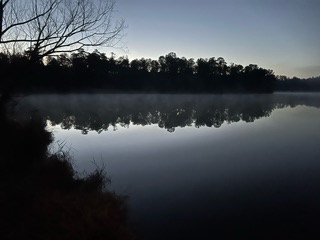
Another Start & Another Set of Reflections

Background and Context:

The first moments of mornings remain my favorites. When a boy, it was my favorite time with my stepfather during deer season. The temperature would drop; a wind would sometimes pick up; then the first sounds of morning would come. Usually the sounds came from sparrows and finches on the floor of the forest. Gray squirrels would twitch their tails as they emerged from their lofty nests and scurried down the trees in search of food. Then, if we were lucky, we would hear the inimitable stamp of deer in the woods. There’s no sound like the sound of deer walking. To this day, I never tire of watching them–the ways their ears scan their environs like hairy antennae, the ways they lift their noses to the winds to know what’s in the area, the ways they stomp their forelegs when vigilance is called for, the ways the older and wiser does and bucks will remain in cover until they’re convinced it’s safe to emerge into more vulnerable areas.

This morning I am far from a deer stand, but rather preparing for teaching in Indiana. I rose early as is my pattern, read and wrote some, drank my first cup of coffee, and cleared out some emails. And I was in the Pentateuch this morning, studying the life of Abraham, the lives of his sons Ishmael and Isaac. It is so interesting to see that human nature is consistent–the ways in which Abraham’s fidelity to the words of God would ebb and flow, though God’s words remained steadfast. Throughout history, the same patterns recur. Men and women do well for a while in their spiritual disciplines, but then they blow it. They have an awful moment, or day, or week, or year, or season. What do I mean? In Genesis 21:12, God tells Abraham that Isaac is the son of promise through whom the ordained offspring of the Messiah will come: “. . . . for through Isaac shall your offspring be named.” This promise finds its fulfillment in Jesus, as the New Testament makes explicit in Galatians 4:

Text:

Tell me, you who desire to be under the law, do you not listen to the law? For it is written that Abraham had two sons, one by a slave woman and one by a free woman. But the son of the slave was born according to the flesh, while the son of the free woman was born through promise. Now this may be interpreted allegorically: these women are two covenants. One is from Mount Sinai, bearing children for slavery; she is Hagar. Now Hagar is Mount Sinai in Arabia; she corresponds to the present Jerusalem, for she is in slavery with her children. But the Jerusalem above is free, and she is our mother. For it is written,

“Rejoice, O barren one who does not bear;
break forth and cry aloud, you who are not in labor
!
For the children of the desolate one will be more
than those of the one who has a husband
.”

  Now you, brothers, like Isaac, are children of promise. But just as at that time he who was born according to the flesh persecuted him who was born according to the Spirit, so also it is now. But what does the Scripture say? “Cast out the slave woman and her son, for the son of the slave woman shall not inherit with the son of the free woman.” So, brothers, we are not children of the slave but of the free woman. (Galatians 4:21-21, ESV)

Abraham’s weaknesses were overcome by the strength and covenant steadfastness of God.

The theology/doctrine is straightforward: God worked through his chosen means (Abraham, Sarah, Isaac, etc.) to lead to his appointed end: Jesus Christ. The promise of Genesis 3:15, that the seed of Eve (Jesus) would bruise/defeat the head of the serpent (Satan) was and is fulfilled in Christ Jesus. All of the Bible coheres, in short, revealing what God does through his plan of judgment and redemption.

Encouragement: As I ponder sometimes of how many glorious sunrises I have witnessed, how many times I have seen it rise over the earth’s seas, over mountains in Afghanistan, over deserts of Iraq, from aircraft in the skies, from deer stands in my home state, or from my neighborhood, we live in a cosmos that demonstrates God’s nature as one of promise and fulfillment. Lord willing, we will have another year to work towards the right goals and for the right purposes. Welcome to 2024.
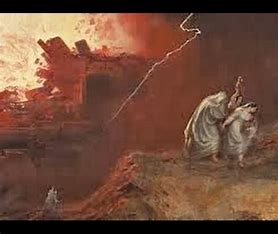

Abraham’s Math, God’s Grace, & the Gospel

Principle: Recognizing our unrighteousness drives the humble to Christ’s righteousness offered to them in the gospel. Righteousness comes to us from God in the person and work of Christ; it never arises naturally from the flesh/sinful nature.

Text: Genesis 18:22-33

So the men turned from there and went toward Sodom, but Abraham still stood before the Lord. Then Abraham drew near and said, “Will you indeed sweep away the righteous with the wicked? Suppose there are fifty righteous within the city. Will you then sweep away the place and not spare it for the fifty righteous who are in it? Far be it from you to do such a thing, to put the righteous to death with the wicked, so that the righteous fare as the wicked! Far be that from you! Shall not the Judge of all the earth do what is just?” And the Lord said, “If I find at Sodom fifty righteous in the city, I will spare the whole place for their sake.”

Abraham answered and said, “Behold, I have undertaken to speak to the Lord, I who am but dust and ashes. Suppose five of the fifty righteous are lacking. Will you destroy the whole city for lack of five?” And he said, “I will not destroy it if I find forty-five there.” Again he spoke to him and said, “Suppose forty are found there.” He answered, “For the sake of forty I will not do it.” Then he said, “Oh let not the Lord be angry, and I will speak. Suppose thirty are found there.” He answered, “I will not do it, if I find thirty there.” He said, “Behold, I have undertaken to speak to the Lord. Suppose twenty are found there.” He answered, “For the sake of twenty I will not destroy it.” Then he said, “Oh let not the Lord be angry, and I will speak again but this once. Suppose ten are found there.” He answered, “For the sake of ten I will not destroy it.” And the Lord went his way, when he had finished speaking to Abraham, and Abraham returned to his place. (Genesis 18:22-33, ESV)

Context: This is likely familiar turf to folks who know Scripture. But for any who might be rusty, this is part of the historical record wherein God destroyed much of Sodom and Gomorrah in the 2000s B.C.

Sodom and Gomorrah are regions in Israel adjacent to the Dead Sea, southeast of Jerusalem. The reasons God was going to destroy them were part of judgment for sin. Abraham, the father of the faith because he believed God and was counted therefore as righteous, was a type of mediator who believed God: “And he [Abraham] believed the LORD, and he [God] counted it to him [Abraham] as righteousness” (Gen 15:6).

In addition to being a type of the Messiah who was to come in the person and work of Jesus Christ, Abraham petitioned for God to spare the righteous and only judge the wicked in Sodom and Gomorrah. Abraham asked God, “Will you indeed sweep away the righteous with the wicked?’ (Gen 18:23). Abraham pleads with God that the 50 righteous people who are—surely—within the culture be spared (v. 24).

Then Abraham did some more math, subtraction specifically. How about if 45 righteous people are there? Would God relent then (v. 28). Then Abraham further tightened his qualifications: How about 40? Then, how about 30? Then, how about 20? Finally, Abraham says to God, “Suppose ten are found there” (v. 32).

God, gracious to sinners but steadfast and holy in his nature, says he will not destroy the righteous. That is not God’s nature.

The result? God rescues Lot (Abraham’s nephew) and two of Lot’s children. Abraham witnessed God grant grace to sinners. How? By leaving a remnant to be witnesses to grace.

Now, fast forward through the history of redemption: What was the world’s response when the Messiah came? Did all the world flee to him in repentance and faith as the Redeemer? Hardly. They stripped him, crowned him with briers/thorns, mocked him, spat upon him, stripped him publicly, and had him nailed to a cross in Jerusalem on a Friday (Matthew 27:27-31). But what was happening? What does all this have to do with Abraham and his intercession on behalf of the supposedly righteous in Sodom and Gomorrah?

The New Testament is explicit: “For our sake he [God the Father] made him [God the Son, Jesus the Messiah] to be sin who knew no sin, so that in him [God the Son, Jesus the Messiah] we might become the righteousness of God” (2 Corinthians 5:21).

Encouragement: All of Scripture coheres, you see. It is telling one unified historical and redemptive true story of what God has done and is doing in his world to redeem a people for himself so that they might be salt and light to the rest of the world. Abraham knew there were no righteous people in Sodom and Gomorrah or anywhere else. Why? Because Abraham understood human nature. None of us is righteous. If we are to be forgiven by the thrice-holy God, it will only be because we have received an alien righteousness imputed to us by God himself, the redeeming Messiah, Jesus Christ.

And that is why Paul’s words in 2 Corinthians 5:21 are so encouraging. They explain what God has done. God was made sin and took the punishment in order that we sinners might flee to him, the true ark of God, and be saved from the flood and wrath of judgment.

Soul Food in December: Videos, New Hiking Boots, Deer, and a Good Book from a Brother

Made it home today. Finally. Laced up the new hiking boots (Christmas gift … yay!), took to the woods, and my, o my, the critters were out and about.

Linked up with the wifey, and grabbed a bite to eat, and walked for a bit and people-watched.

Thanks to the rain recently, the creeks were moving again.

Played with the dogs outside, too, and, well, it’s good to be home.

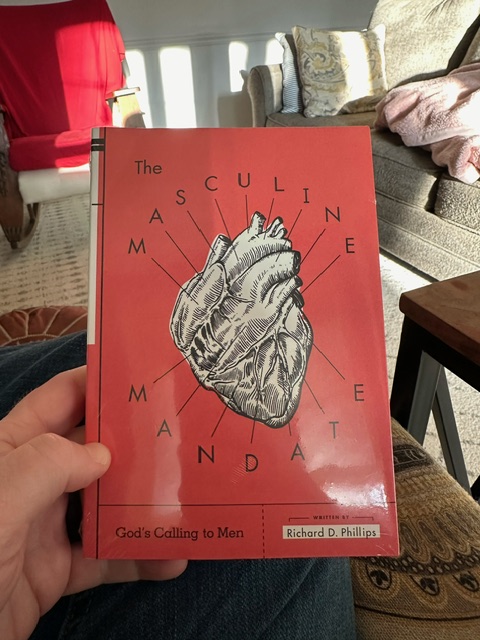
Thanks to my friend Justin for the Richard D. Phillips book, The Masculine Mandate. Throughly enjoying it.

Biblical Wisdom of Malcolm Muggeridge

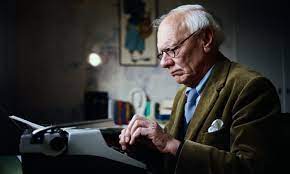
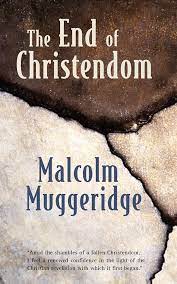
Read Muggeridge’s talks artfully titled, The End of Christendom, again today. True to his nature, he taught with more wisdom in 60 pages than most people utter in a lifetime.

When you see the drivel that passes for intelligent conversation today, it is refreshing to see that the world has always hated Christ and the truth, but that Christ and the truth always and everywhere rise to outlive the morgues and gulags of the secularists.

Here are just two of Muggeridge’s zingers:

  1. Previous civilizations have been overthrown from without by the incursion of barbarian hordes. Christendom has dreamed up its own dissolution in the minds of its own intellectual elite. Our barbarians are home products, indoctrinated at the public expense, urged on by the media systematically stage by stage, dismantling Christendom, depreciating and deprecating all its values. The whole social structure is now tumbling down, dethroning God, undermining all its certainties. All this, wonderfully enough, is being done in the name of the health, wealth, and happiness of all mankind. That is the basic scene that seems to me will strike a futre Gibbon as beig characteristic of the decline and fall of Christendom (17-18).

2. We look back on history, and what do we see? Empires rising and falling; revolutions and counter-revolutions succeeding one another; wealth accumulating and wealth dispersed; one nation dominant and then another. As Shakespeare’s King Lear puts it, “the rise and fall of great ones that ebb and flow with the moon.” In one lifetime I’ve seen my fellow countrymen ruling over a quarter of the world, and the great majority of them convinced – in the words of what is still a favorite song – that God has made them mighty and will make them mightier yet. I’ve heard a crazed Austrian announce the establishment of a German Reich that was to last for a thousand years; an Italian clown report that the calendar will begin again with his assumption of power; a murderous Georgian brigand in the Kremlin acclaimed by the intellectual elite as wiser than Solomon, more enlightened than Ashoka, more humane than Marcus Aurelius. I’ve seen America wealthier than all the rest of the world put together; and with the superiority of weaponry that would have enabled Americans, had they so wished, to outdo an Alexander or a Julius Caesar in the range and scale of conquest. All in one little lifetime – gone with the wind: England now part of an island off the coast of Europe, threatened with further dismemberment; Hitler and Mussolini seen as buffoons; Stalin a sinister name in the regime he helped to found and dominated totally for three decades; Americans haunted by fears of running out of the precious fluid that keeps their motorways roaring and the smog settling, by memories of a disastrous military campaign in Vietnam, and the windmills of Watergate. Can this really be what life is about – this worldwide soap opera going on from century to century, from era to era, as old discarded sets and props litter the earth? Surely not. Was it to provide a location for so repetitive and ribald a production as this that the universe was created and man, or homo sapiens as he likes to call himself – heaven knows why – came into existence? I can’t believe it. If this were all, then the cynics, the hedonists, and the suicides are right: the most we can hope for from life is amusement, gratification of our senses, and death. But it’s not all (49-51).

Dostoyevsky, December Rain, & the Underground

It was as a 17-year-old boy that I read Dostoyevsky for the first time. Crime and Punishment was the first of his novels I read, and I was hooked. I then read Notes from the Underground, The Brothers Karamazov, and The Idiot.

I know of many people who love to quote lines from The Brothers Karamazov, but I wonder how many of those people have actually read that novel or Dostoyevsky’s other writings. I am going through Notes form the Underground again over the last couple of days, and I am astonished–yet again–at Dostoyevsky’s prescience. Reading him now, he seems more than ever to have been a prophetic voice crying in the wilderness about what was coming if the world embraced materialism, secularism, and nihilism. It’s almost as if the horrors of the 20th century were written on the pages of Dostoyevsky’s works in the 1800s, but most did not have eyes to see or ears to hear.

Dostoyevsky is not light fare, but nothing enduring is. It takes commitment and diligence to read Karamazov, which runs just less than a 1,000 pages. But the invested hours are more than worth it because we glimpse truths about man’s nature, about God, about good and evil, about the horrors that result from rejecting Christ, from rejecting grace, from determining to go our own ways, and where those ways lead. Exhibit A: Just look at the unfolding suicide of Western civilization where Harvard presidents plagiarize their dissertations, but because the mobs of wokesters and Diversity, Equity, and Inclusion (DEI) minions are running the West’s colleges and universities, she laughs in the face of all who would call out her lies. She continues to get paid, and the kiddos still go to Ethics class, and no one sees there’s a problem. Um, Houston, we do indeed have a problem. Cognitive dissonance is in technicolor, and yet nothing happens.

Dostoyevsky wrote about the psychological derangement that would inevitably follow when truth is rejected, when the Author of truth was rejected, when secularism was imposed upon a people professing themselves wise, but who only demonstrated their folly.

Tolle lege, if you will, dear ones. There is wisdom to be gained in reading and heeding this Russian giant.

Jean Stafford and Christmas Eve

Earlier this year I purchased “The Collected Stories of Jean Stafford.” I had no idea what I was in for. As it turned out the first story I read from her oeuvre was “The Hope Chest.” The story is about a spinster in New England, a woman named Rhoda. She is feisty, proud, a snob, and suffering in unspeakable ways.

Miss Rhoda Bellamy lives on the capital of the past, is unwilling to love anyone, romanticizes her past memories to such an extent that she shuts out her contemporary life as being unworthy of her time and certainly her respect.

When a neighborhood boy comes to her door to she if she will purchase a Christmas ornament for twenty-five cents (the boy’s name is Ernest, by the way, a well-chosen name), Rhoda shuts him down, arguing over price and humiliating the boy.

But finally Rhoda, for unvoiced reasons of her own, finally gives in and says she’ll purchase the boy’s labor of love, but that Ernest must give lonely Rhoda a kiss. Rhoda pays the price agreed upon. The boy, too, keeps his side of the bargain. But rather than opening up to love, instead of loving another, she again retreats, and the story ends with one of the most heart-rending paragraphs I have read in a long time. The paragraph is sheer pathos, the last sentence ending with these words: “she [Rhoda] nursed her hurt like a baby at a milkless breast, with tearless eyes” (119).

If you have a heart, this short story will break it.

Exploring the Mask with Dostoyevsky’s “The Double”

Mr. Golyadkin is a poor single man with an even poorer servant, Petrushka. Golyadkin lives a boring life of work-to-home, work-to-home, work-to-home. He envies the ostensibly happy, respected, and affluent that appear to have happiness and the respect which he covets. A doctor visits Golyadkin, encourages him to get out more, socialize, entertain, and to cultivate a visible hobnobbing life. Golyadkin takes the doctor’s prescription, and that’s where the horrow ensues. Golyadkin appears to go mad as his twin, (the double) with precisely the same name, torments him at every turn, by pointing out his masks.

For 150 pages, Dostoyevsky does what no writer does better. Like Kafka, he dramatizes the soul’s internal conflict and shows what it means to be a divided man. The metaphor running throughout is that of the mask–of its ubiquity and necessity–if one is to skate through life.

“The Double” is not as lauded as Crime and Punishment or The Brothers Karamazov but Dostoyevsky’s themes are all here. Great stuff for those who have the character to examine the darker spheres of our nature.

Aurora from the Pond

Due to having covid again I have had to isolate. I can only stay indoors by myself so long before my spirit kicks at the goads. I have long since reached that point. So I took time to relish my favorite time of the day from one of my favorite spots.

I have seen many much more ornate places in my life than a pond in south GA. I have skied steep slopes in Switzerland and Austria. I have enjoyed Florence and Venice, Italy on gondolas. I have gazed out upon Paris at night from the Eiffel Tower, etc.

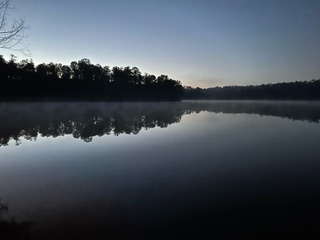
But when I am on a pond an hour before the sun rises, and the ducks and cranes begin to rustle, and the temperature drops, and the fog hangs in an ethereal mist over the surface of the water like something out of a Poe story, and the sun’s first gold rises from behind the pines, it’s about as content as I can be in this world. I think nothing of politics or strife or covid or of the silliness of so much that fills our days. I think only that I am grateful for such moments, for the sky bathed in honeycomb light and the smell of the air in the morning and of how none of it is by accident.

Below are a few shots from my old iPhone from some of my early moments to just before the sun emerged from over the pines. I hope you enjoy, too.