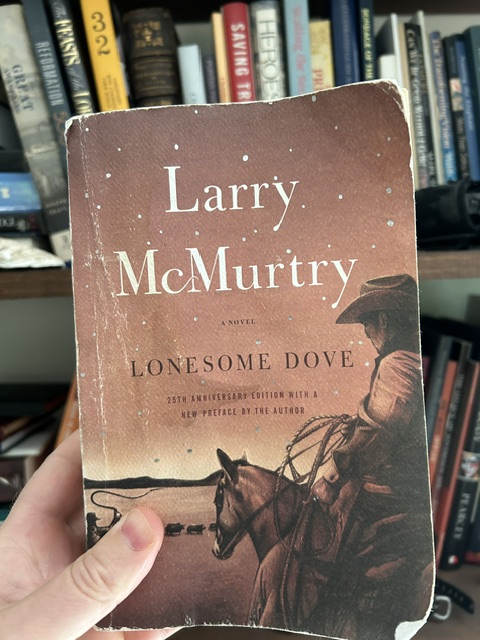
Reflections Upon McMurtry’s Novel, ‘Lonesome Dove’

Introduction: For years and years, I had heard about this novel. I even had it on a shelf in my library for years. Finally I resolved to read it. It’s not that I didn’t want to. It was that I have so many books on my TBR list that I’d simply not gotten to it. But the time came at last. And to give you an idea of how highly I found the experience of reading it . . . well, I’m blogging about it. It was spectacular. If you are a serious reader, perhaps you will follow me as I share some reflections below.

Published in 1985 by Texan Larry McMurtry, the novel earned the Pulitzer Prize for Literature in 1986.

The plot is simple but not simplistic. The story hinges upon the spectacular efforts to leave the tiny community of Lonesome Dove, Texas and ride horseback to Montana to herd cattle back to Texas, and become self-sufficient ranchers and leave Texas Ranger life somewhat behind.

The two main characters are Captain Augustus “Gus” McCrae and Captain Woodrow Call. But their group of friends and associates and women and drunks and a boy (Newt), and ex-wives, and a black man/friend/scout named Deets, et al, will leave you with characters in your imagination you’ll not quickly forget. There are also Dish and Pea Eye and Lorena and Clara. The cast of characters is large as the landscapes the story covers, but they all grip you. At least they gripped me. Profoundly.

The stories involved in this tome include their heroisms, defeats, arguments, divorces, adulteries, friendships, betrayals, loyalties, love for the land, battles with Indians, a cowardly sheriff, tough-as-nails women, golden-hearted whores, grave diggers, and more.

So, What’s It Really About? It is difficult not to limit the book in answering that question. But among other things, it’s about friendship, about loneliness, about pride, about grit, about sacrifice, about freedom, about the need for others, about pity, about honor, about violence, and that’s just a start.

I have read hundreds of novels over my many years as a reader and teacher. I have never been one for genre fiction–Westerns, sci-fi, fantasy, etc. But this book, though certainly a Western, was not so much a book as a world.

Let me compare it this way: I love reading the great tragedies of Shakespeare. And each time I read Hamlet, e.g., I’m back in Elsinore. Well, in this novel, I wasn’t in Elsinore; I was in Texas, Kansas, Nebraska, Montana, Fort Smith, Arkansas, and more. I was simply but profoundly there with them. The story was that good.

The Ending: It’s a long novel, by most people’s standards–just short of 900 pages. So, yes, it takes some effort to stick with it. But I can think of few novels where I wept like I did over this one’s endings. I say “endings” because we as readers see the ends of a host of characters. We come to understand Call in his pride, Gus in his courage, Clara and Lorena, and the beautiful boy, Newt. And when you see what becomes of them, McMurtry rips our hearts out–not in cruelty towards us as readers but in our love for these men and women. I cannot get over how much the scenes between Call and Newt eviscerated my soul. And the last conversation between Gus and Call was simply an example of the best of what great literature provides to us–beauty and pathos and a reminder of the power of love, pride, honor, and sacrifice.

If you will, I simply encourage you to pick up this book. Schedule time. Read it. It took me several weeks, but it was so worth it. I know this will reveal even more of my deep love of great literature, but this book does what great literature is meant to do–remind us of what Faulkner called “the courage and honor and hope and pride and compassion and pity and sacrifice which have been the glory of [man’s] past. The poet’s voice need not merely be the record of man, it can be one of the props, the pillars to help him endure and prevail.”

And like so much that Faulkner wrote in his best novels and stories, McMurtry, too, earned his place among the greats with this novel.

7 Worth Your Time

I had several blessings this year. I returned from a military deployment to Iraq that I deeply appreciated. I worked with some fine Soldiers, Sailors, Airmen, Marines, and civilians for whom I am grateful. Each deployment brings together diverse personalities, and several people stood out via their unique giftings and particular strengths. We were a diverse group, a motley crew. Because of chaplaincy’s unique inroads, I was able to work near engineers, Marine infantrymen, pilots, mechanics, electricians, fuelers, budget analysts, accountants, cyberspace gurus, logisticians, and more. The diversity of those with whom I labored found a counterpart in my reading life. I discovered several new authors. That is, they were new to me. Some of those have become new favorites. (More on that below.)

What follows is a list of seven books that particularly stood out for me. Some refined my thinking. Some convicted me. Others confirmed my deeply held convictions. If you are a fellow reader, I hope you benefit, too, from my reflections on some of my reading. This is part one of several installations as I look back on some of this year’s reading. More reviews are forthcoming. Tolle lege: Take up and read.

You’ve Got to Read This: Contemporary American Writers Introduce Stories that Held Them in Awe This 1994 volume is edited by Ron Hansen and Jim Shepard and is my favorite volume of short story collections I own. The selections include masterpieces by Isaac Babel, Borges, Raymond Carver, Cheever, Chekhov, Tolstoy, Dickens, Welty, Munro, Joyce, Updike, O’Brien, O’Connor, and more. I am a junkie for short story collections, but the fact that these masterful short pieces are introduced by such impressive writers as Charles Baxter, Jane Smiley, Joyce Carol Oates, Ron Hansen, and Annie Dillard deepens this volume still more.

A Long and Happy Life This novel by North Carolina writer Reynolds Price was published in 1962. I read it for the first time last month. It captivated me such that I read it in a day and a half. The story of Rosacoke and Wesley, poverty and ignorance in Dixie, honor, sacrifice, loneliness, longing, and love, this story explores all of these and more in less than 160 pages. If you enjoy literary fiction set in the South of days reflected in the worlds of Eudora Welty, Faulkner, Flannery O’Connor, this is a great place to camp. Price has become a new favorite for me.

Pathway to Freedom: How God’s Laws Guide Our Lives A 2003 book brought about by hearers encouraging Reformed Christian pastor-theologian Alistair Begg to put his preaching through the Ten Commandments into book form, this volume is chock-full of biblical wisdom delivered by a winsome wordsmith and faithful pastor. Our lives invariably demonstrate our theological beliefs. Begg excels in connecting God’s words to our ways in the world. An excellent resource for the Christian church.

Why One Way? Defending an Exclusive Claim in an Inclusive World This book was published in 2002. Written by pastor-teacher/theologian at Grace Community Church and The Master’s College and Seminary, John MacArthur elucidates in 75 pages what few other men dare. In a time when many high-profile so-called Christian teachers have caved to the “social gospel” and being “woke” to the culture, MacArthur is one of the few who holds the line. Perhaps it is because I appreciate clarity so much, but MacArthur demonstrates how the gospel always offends the unregenerate, how sin is essential to diagnose, how Jesus himself confronted the world, how Scripture—time and time again—outlives its critics, and how the Christian church needs to grow up and endure the battles we were warned of long before, and engage the emptiness of secular worldviews with complete confidence in the power of God as revealed in Scripture to accomplish God’s purposes.

The Doctrine of Repentance This is a classic of Christianity. Written by Puritan Thomas Watson, it is no wonder that Banner of Truth continues to find a market for these profound writings from the deep biblical minds and pens in the Reformed tradition. My copy is now highlighted and underscored such that one would think I had had this volume for years. Wisdom on every page in this volume.

Words made Fresh: Essays on Literature & Culture Larry Woiwode is a wordsmith, fiction writer, and thinker that merits faithful reflective reading and thought. He has become one of my favorites over recent years. He writes not only moving fiction and essays, but also of other areas with the same deftness. This is my favorite collection of his essays I have read so far. Herein he writes of Shakespeare, Reynolds Price, Wendell Berry, and more. A fine book by an important writer.

Revolutions in Worldview: Understanding the Flow of Western Thought Of all the theology/worldview/”history-of-ideas” books I read in 2019, this 2007 volume, edited by W. Andrew Hoffecker, is exceptional, not just in this year’s reading, but in my library as a whole. If you are a big picture worldview thinker like I am, I cannot think of a better worldview book to have at hand. An invaluable resource.