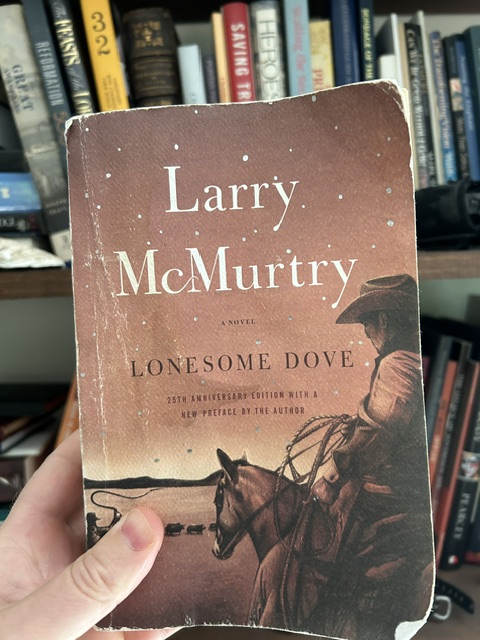
Introduction: For years and years, I had heard about this novel. I even had it on a shelf in my library for years. Finally I resolved to read it. It’s not that I didn’t want to. It was that I have so many books on my TBR list that I’d simply not gotten to it. But the time came at last. And to give you an idea of how highly I found the experience of reading it . . . well, I’m blogging about it. It was spectacular. If you are a serious reader, perhaps you will follow me as I share some reflections below.
Published in 1985 by Texan Larry McMurtry, the novel earned the Pulitzer Prize for Literature in 1986.
The plot is simple but not simplistic. The story hinges upon the spectacular efforts to leave the tiny community of Lonesome Dove, Texas and ride horseback to Montana to herd cattle back to Texas, and become self-sufficient ranchers and leave Texas Ranger life somewhat behind.
The two main characters are Captain Augustus “Gus” McCrae and Captain Woodrow Call. But their group of friends and associates and women and drunks and a boy (Newt), and ex-wives, and a black man/friend/scout named Deets, et al, will leave you with characters in your imagination you’ll not quickly forget. There are also Dish and Pea Eye and Lorena and Clara. The cast of characters is large as the landscapes the story covers, but they all grip you. At least they gripped me. Profoundly.
The stories involved in this tome include their heroisms, defeats, arguments, divorces, adulteries, friendships, betrayals, loyalties, love for the land, battles with Indians, a cowardly sheriff, tough-as-nails women, golden-hearted whores, grave diggers, and more.
So, What’s It Really About? It is difficult not to limit the book in answering that question. But among other things, it’s about friendship, about loneliness, about pride, about grit, about sacrifice, about freedom, about the need for others, about pity, about honor, about violence, and that’s just a start.
I have read hundreds of novels over my many years as a reader and teacher. I have never been one for genre fiction–Westerns, sci-fi, fantasy, etc. But this book, though certainly a Western, was not so much a book as a world.
Let me compare it this way: I love reading the great tragedies of Shakespeare. And each time I read Hamlet, e.g., I’m back in Elsinore. Well, in this novel, I wasn’t in Elsinore; I was in Texas, Kansas, Nebraska, Montana, Fort Smith, Arkansas, and more. I was simply but profoundly there with them. The story was that good.
The Ending: It’s a long novel, by most people’s standards–just short of 900 pages. So, yes, it takes some effort to stick with it. But I can think of few novels where I wept like I did over this one’s endings. I say “endings” because we as readers see the ends of a host of characters. We come to understand Call in his pride, Gus in his courage, Clara and Lorena, and the beautiful boy, Newt. And when you see what becomes of them, McMurtry rips our hearts out–not in cruelty towards us as readers but in our love for these men and women. I cannot get over how much the scenes between Call and Newt eviscerated my soul. And the last conversation between Gus and Call was simply an example of the best of what great literature provides to us–beauty and pathos and a reminder of the power of love, pride, honor, and sacrifice.
If you will, I simply encourage you to pick up this book. Schedule time. Read it. It took me several weeks, but it was so worth it. I know this will reveal even more of my deep love of great literature, but this book does what great literature is meant to do–remind us of what Faulkner called “the courage and honor and hope and pride and compassion and pity and sacrifice which have been the glory of [man’s] past. The poet’s voice need not merely be the record of man, it can be one of the props, the pillars to help him endure and prevail.”
And like so much that Faulkner wrote in his best novels and stories, McMurtry, too, earned his place among the greats with this novel.

