There’s a great narrative in the Old Testament book of Joshua that resonates with Soldiers. It is found in Joshua 6. It teaches many fundamental theological doctrines but what I want to focus on here is simple: the value of quiet consistency.
Context, Context, Context: Reading things in their proper context is essential. The big picture overview of the book of Joshua is that it’s set in the 1400s B.C. It centers upon Israelite conquest of Canaan, the so-called promised land. The book as a whole is about God’s covenant faithfulness and the Lord himself is the ultimate Warrior-King.
Quiet Consistency: Joshua was the human typology of the warrior-king-leader of a covenant people, those who believed. It had nothing to do with race or tribalism. It had everything to do with those who believed God versus those who did not. God commands Joshua to “march around the city” of Jericho for six days (Josh 6:3). Then on the seventh day, Joshua and the others are to “march around the city seven times, and the priests shall blow the trumpets” (Josh 6:4). A battle strategy? Hmmm. Most of us, especially military types trained in tactics, techniques, and procedures might have balked: “Really, Lord? This is the plan?”
But that was God’s order. The people obeyed. They blew the ram’s horn, marched, marched, and marched some more. On the seventh day, they marched around Jericho seven times and shouted, and the wall of the city collapsed. Rahab and her family, those who believed God, were spared.
Encouragement: Regardless of how many times I read this history, I am struck at what God reveals about the importance of obedience and trust in him. This divine battle plan overturns any boasting in human military strategy. It’s a way of showing that what is required of the Christian is trusting the Lord rather than trusting human machinations. It’s about quiet obedience in a godly direction.
This morning I completed another reading through the Old Testament book of Isaiah. It is 66 chapters of absolute sovereignty. In the book, the prophet Isaiah writes in the 700s B.C. of his (God’s) incomparable name. He pronounces, through the life and ministry of Isaiah, his (God’s) absolute sovereignty.
How does God do that? Mainly through pronouncements/oracles of cursing and blessing. It’s God’s way of showing that the earth is his and the fullness thereof. He is not in need of anything or anyone. God, as I tell the saints at church week in and week out, is the hero of the story.
Creation>Fall>Redemption>Restoration.
That’s the overarching pattern in Scripture and in history.
We are creatures; God is the Creator.
We are fallen due to our sin nature.
God the Son became incarnate in order to redeem his bride (the true church) from all ages. Abraham is in the true church; Moses is in the true church; Ruth is in the true church; Peter’s in the true church; and Christians from all ages are in the true church because they are grafted into the seed of promise (Christ).
Then God restoresall things in the consummation. The story comes full circle. The first Adam failed; the last Adam (Christ) succeeds. A new Jerusalem comes down; Eden is once again made perfect by the work of the triune God.
When I was wrapping up Isaiah’s book again this time, I was struck by a passage in the last chapter:
All these things my hand has made, and so all these things came to be, declares the Lord. But this is the one to whom I will look: he who is humble and contrite in spirit and trembles at my word (Is 66:2, ESV).
To whom does God look? To the one who is humble and contrite in heart. Who is it that does God’s will perfectly? Abraham? No. David? No. John? No. Peter? No. Paul? No. You? No. Me? No.
You see the pattern? All of us have fallen–and continue to fall–short (Rom 3:23). God is the hero. Over and over again, God gets the glory. Our duty and joy as Christians is to herald that truth, to strive to live it out as salt and light, to preserve the good, and to expose the darkness in faith that God does–always and forever–what is right.
Over the last few days, I’ve been privileged to witness the passing of leadership from one great leader to another. It’s interesting when you really pay attention to people. You can get a glimpse of their true nature—who they really are. When we honored COL Stone, he didn’t make the day or event about himself. He referred to God, to his own mentors, and to his brothers in arms, to his family, to his friends, and to all the Soldiers with whom he has served for nearly three decades. How can one not be moved by such words? He has now left his own legacy, just as many did before him, and many will do after him.
Question: What does it mean to leave a noble legacy? Many things, of course. Overcoming adversity; resilience; improvements; victories; accomplishments, etc. But I think one of the things we should emulate is selfless service. It’s a spirit where the team and the mission require that each Service Member be mindful that his/her actions reflect upon the whole team. It’s that culture where the small decisions each of us makes ripple out and across the surface and under the surface. It’s leaving things better than we found them. It’s leaving it all on the field for the sake of honor at having done our best. We all have bad days; let us concede that. But the overcomer is the one who does not lose sight of the legacy he/she aims to leave.
I’ve been privileged to serve under and alongside many, many fine leaders. COL Stone was one of those. May his tribe increase. May we continue to learn from such men and, as Scripture says, honor those to whom honor is due (Rom 13:7).
Today after one of the breakout sessions, a sweet spirit seemed to have been sent among several of us through the morning. It seemed to come from both outside of us and from within us. Walls began to come down. We spoke not of our educational or professional pedigrees. Rather we began with questions like, “So, what’s next for you, Craig?” or “So, what’s God calling you to, Gary?” or “How do you guys define ‘calling'”?The questions came regularly, and so did the ruminations. It was iron sharpening iron. That’s what Solomon called it: “Iron sharpens iron, and one man sharpens another” (Pr 27:17).
We had lunch together. We ate our chili dogs and salads and drank our coffee and water. We spoke of our ministries. Some were in hospital chaplaincy. Others were military chaplains. Others were prison chaplains. Some others of us were pastors/elders and/or professors or teachers. The group was chock-full with years of experience in ministry and its myriad locations. We were all sponges–both absorbing what we were hearing and also being squeezed so that we poured into one another. My intellectual, emotional, and spiritual cups were being filled by these brothers.
Later as I drove back to billeting, I came across a creek, pulled my vehicle over, got out, and went and took in the sight and sounds of the creek I’ve crossed multiple times this week. Why? To give thanks, in short. To thank God for his common grace. To quote one of the great catechisms, “God’s providence is His completely holy, wise, and powerful preserving and governing every creature and every action.” In other words, no accidents. This is not a random cosmos. We are creatures (hence, there is a Creator) who are gifted with intellectual capacities in order to glorify God and enjoy Him forever. And one of the ways God’s providence plays out in history is via simple yet profound things like deep and kind conversations among fellow pilgrims on the way.
I stood on the bank of the creek and snapped another picture and spoke my heart silently over the sounds of the waters. Just to say, Thank you for today, Lord.
Thank you that I have new contacts in my phone, men I can call and who can call me, fellow ministers/chaplains/pastors who can hug me and say, “I get it. I truly do. Let’s walk together.”
I’m back now, and headed to PT in the gym. Got to sweat of the child dog from lunch. But I take us back to wise words penned by another who likewise understood the need for encouragement: “Bear one another’s burdens, and so fulfill the law of Christ” (Gal 6:2). To my fellow brothers, thank you for making this theology visible.
Day two of training is now completed for me in this iteration here in KY. Good training today. Beautiful weather here on a beautiful seminary campus.
I had the privilege of being in a briefing with a buddy of mine with whom I did CPE (Clinical Pastoral Education) and we got to spend some time together in the afternoon and walk and talk. He’s a retired Army 1SG and chaplain, and now serves with our endorsing agency as a conduit for chaplains.
When Michael was teaching today, he said something that really resonated with me: “Calendar the stewardship of your life.” I found that a very wise statement. Why? I think it’s because if you don’t schedule your life wisely, you will waste your life on things of lesser significance. (Piper’s phrase and book about not wasting one’s life come to mind.)
Michael ribbed me because he knew I was a calendar guy. I carry a literal spiral notebook-calendar. I love it. Why? Well, it keeps me structured: 0630 for this; 0900 for that; 1100 for this; 1300 for that, etc. I note my readings, my appointments, my Scriptures for that day, etc. It works for me.
But here’s where Michael got me to see something. He asked, “You’re being the chaplain to everyone else, but where do you go? Why does everyone else get a resource but you don’t think you need one? How is that not vanity?”
Mic drop; that’s what that was for me. Then he said this: “Calendar the stewardship of your life.” Again, I was floored inside. Yep, I’m the calendar guy. I write it all down. I’d be a terrible criminal, because I have written down nearly everything that matters to me–what I’m reading, what I’m dealing with, what engagements I have, etc. in order to manage it all. But it exacts a toll. We can find ourselves exhausted on behalf of others, and depleted on the inside.
We can work oursevles to a frazzle. And for what? For whom? We’re replaced, and life goes on. That may sound harsh, but it’s nonetheless true. Michael, you taught me today, brother. I need to learn to calendar the stewardship of my life. Thank you.
As part of my job, I’m currently in the Commonwealth of Kentucky. For many reasons, I have a deep affection for this Commonwealth of Kentucky. I love its hills, many of its writers, where I spent some years in seminary for one of my graduate degrees, and for many of the people I’ve known and continue to know here. There are more reasons, but those are some of them.
Today en route to the Lexington region, I stopped for a quick lunch of fried chicken (it’s KY, after all), and as I waited for my order to be processed, I gazed around at the words and images on the restaurant’s interior. I was shaken by the one pictured above.
Why? For me, it’s theological. That word grace is weighty. In Greek, it’s χάρις. That’s karis in English transliteration. In the original, it means “divine favor.” Let that sink in–to be favored by God. To be shown favor by the Divine. Unmerited favor. Undeserved mercy. It’s God’s love in spite of our sinfulness. It’s 2 Corinthians 5:21, in other words: “For our sake he made him to be sin who knew no sin, so that in him we might become the righteousness of God.”
What struck me was the battle I was in while at the fried chicken place. The boy who worked the front cash register was impish, rude, and seemingly uninterested in my spending my money there, or in any way offering me customer-friendly service. He was curt, petulant, and cocky.
And yet there was that plaque on the wall. How ironic. Why this test, Lord? I thought. But I was friendly and respectful towards the young man in spite of his treatment of me. I paid, got my meal, ate, cleaned up afterwards, and exited. I walked back to my car and drove on towards the Lexington area.
Grace. Grace. Grace.
It’s easy to pass the language courses for some. To learn the case endings and nuances and tenses, etc. That’s just part of learning any language. But to live out grace in daily life–that’s much harder. That tests one’s mettle. That’s where we make our theology visible. That’s where we see that what’s down in the well comes up in the bucket.
“You have enemies? Good. That means you’ve stood up for something, sometime in your life,” Churchill wrote. Modern-day heroes are few. They’re here, of course. But most models of heroism are relegated to imagined characters for television and film. Fewer and fewer have a grandpa or uncle who was a hero. For many nowadays, they have to look up to imaginary Marvel characters like Spider-Man, Iron Man, or Captain America. Let that sink in: millions of Westerners worship made-up cartoon characters. They quote the films; they buy the swag; they spend billions supporting that industry. I’m for free markets; so spend your money as you like. No issue here regarding what you do with your money. But what it reveals is a hunger deep within the human spirit.
We long for heroes. We long for models, for paradigms of bravery, selflessness, and moral courage. The theologian Augustine famousely wrote, “Thou hast formed us for Thyself, and our hearts are restless till they find their rest in Thee” in his Confessions. And Solomon wrote that God “put eternity into man’s heart” (Eccl 3:11, ESV). Pascal famously wrote that man has a “God-shaped hole/vacuum” within him only God is sufficient to fill.
This Sunday I’ll be leading the saints of Christ Covenant Church (3cs-canton.org) in one of the most packed pericopes of Scripture. It’s 2 Peter 2. What’s it about? False teachers. Just a few years after Jesus’s resurrection, already churches were corrupted by nefarious leaders. Already. How much more do we need to be careful, therefore? There are those who mislead people for selfish gain. Sadly, we do not have to look far to find pastors who ask for raises again and again, who ask for more vacations, who ask for time away, for sabbaticals, for allowances, and inculcate an enviornment where there’s accountability for everyone else but not for them, et al. They see themselves as special, as exempt. “Rules for thee, but not for me.”
Peter begins chapter two this way: “But false prophets also arose among the people, just as there will be false teachers among you, who will secretly bring in destructive heresies, even denying the Master who bought them, bringing upon themselves swift destruction” (2 Pt 2:1, ESV). The Bible addresses false teachers head-on because God knows the damage they inflict upon congregations. Peter says that “in their greed they will exploit you” (2 Pt 2:3, ESV).
If you have an enemy because you take stands for truth, you are blessed. “Rejoice and be glad, for your reward is great in heaven, for so they persecuted the prophets who were before you” (Mt 5:12, ESV). We could do for more heroes, I agree. But we need to be wise about who merits that moniker. More than likely, he won’t be the one demanding comfort and protection. He’ll be the one taking care of the sheep. We are to look forward with wise hope, knowing that it’s a good thing to have the right enemies. That’s a sign we’re doing things God’s way.
Questions: Ever known of someone diagnosed with PTSD? Ever known of someone who failed to address trauma in a healthy way? Ever known of someone you could see was struggling to find productive ways to process events?
It is likely you answered yes to at least one of those questions. Perhaps you answered yes to all three. If we are honest, all of us likely know of at least one person who battles this. Perhaps it’s even you.
Connection to Scripture: In 1 Kings 19, we have the account of Elijah (God’s prophet, God’s man) fleeing. Yes, you read that correctly. He fled from wicked Jezebel. Why? I mean, wasn’t Elijah literally just coming down from a mountaintop experience where he was used by God in a miraculous way? God utterly devastated false religion. The pagans were slaughtered. God’s holiness was vindicated. And Elijah was used by God in ways that rivaled and perhaps surpassed even the events in which God used Moses earlier. By all accounts, we would think that Elijah would have renewed faith, that he’d be riding high in his spiritual walk with the Lord. But instead we find a man who is utterly spent, exhausted, and emotionally wrung out. He has PTSD. He flees when he should ostensibly be feeling invincible and at peace.
Scripture:
19 Ahab told Jezebel all that Elijah had done, and how he had killed all the prophets with the sword. 2 Then Jezebel sent a messenger to Elijah, saying, “So may the gods do to me and more also, if I do not make your life as the life of one of them by this time tomorrow.” 3 Then he was afraid, and he arose and ran for his life and came to Beersheba, which belongs to Judah, and left his servant there.
4 But he himself went a day’s journey into the wilderness and came and sat down under a broom tree. And he asked that he might die, saying, “It is enough; now, O Lord, take away my life, for I am no better than my fathers.” 5 And he lay down and slept under a broom tree. And behold, an angel touched him and said to him, “Arise and eat.” 6 And he looked, and behold, there was at his head a cake baked on hot stones and a jar of water. And he ate and drank and lay down again. 7 And the angel of the Lord came again a second time and touched him and said, “Arise and eat, for the journey is too great for you.” 8 And he arose and ate and drank, and went in the strength of that food forty days and forty nights to Horeb, the mount of God.
The Lord Speaks to Elijah 9 There he came to a cave and lodged in it. And behold, the word of the Lord came to him, and he said to him, “What are you doing here, Elijah?” 10 He said, “I have been very jealous for the Lord, the God of hosts. For the people of Israel have forsaken your covenant, thrown down your altars, and killed your prophets with the sword, and I, even I only, am left, and they seek my life, to take it away.” 11 And he said, “Go out and stand on the mount before the Lord.” And behold, the Lord passed by, and a great and strong wind tore the mountains and broke in pieces the rocks before the Lord, but the Lord was not in the wind. And after the wind an earthquake, but the Lord was not in the earthquake. 12 And after the earthquake a fire, but the Lord was not in the fire. And after the fire the sound of a low whisper.[a] 13 And when Elijah heard it, he wrapped his face in his cloak and went out and stood at the entrance of the cave. And behold, there came a voice to him and said, “What are you doing here, Elijah?” 14 He said, “I have been very jealous for the Lord, the God of hosts. For the people of Israel have forsaken your covenant, thrown down your altars, and killed your prophets with the sword, and I, even I only, am left, and they seek my life, to take it away.” 15 And the Lord said to him, “Go, return on your way to the wilderness of Damascus. And when you arrive, you shall anoint Hazael to be king over Syria. 16 And Jehu the son of Nimshi you shall anoint to be king over Israel, and Elisha the son of Shaphat of Abel-meholah you shall anoint to be prophet in your place. 17 And the one who escapes from the sword of Hazael shall Jehu put to death, and the one who escapes from the sword of Jehu shall Elisha put to death. 18 Yet I will leave seven thousand in Israel, all the knees that have not bowed to Baal, and every mouth that has not kissed him.” (1 Kings 19:1-18, ESV)
Encouragement: Sometimes after intense emotional highs and/or lows, we need to remember something: decompression and rest are essential. Do we know how to switch off and just rest? Really rest. For me, I hike, or read, or fish, or kayak. For Elijah, he needed to be reminded that he wasn’t alone, that God had his people then. And he has his people still today. “Taking a knee” is a spiritual discipline we need as soldiers in uniform and as soldiers of God.
3 You keep him in perfect peace whose mind is stayed on you, because he trusts in you. 4 Trust in the Lord forever, for the Lord God is an everlasting rock. (Isaiah 26:3-4, ESV)
Context, Context, Context:
Isaiah was God’s prophet during the ascent of Assyria and the decline of Judah in the 700s B.C. His message was plain: the holiness and glory of God and his righteous hatred of idolatry/religiosity devoid of the truth.
Always when truth is proclaimed, when righteousness is called for, a winnowing occurs. What’s down in the well of people comes up in the bucket. Pressure reveals what we are like as people. Some will reveal resentment and seek to destroy; others will cling to the Lord and seek to encourage the saints.
That’s where these lines from Isaiah are so germane and helpful. Isaiah writes that “the Lord will keep him in perfect peace” whose mind is fixed upon the Lord. Why? Because the man or woman of God trusts the Lord, the everlasting rock.
Yesterday at church, we sang “From Everlasting [Psalm 90]” by Sovereign Grace. And typical of the music of Sovereign Grace, it is rooted in Scripture. Psalm 90:2 reads as follows:
Before the mountains were brought forth, or ever you had formed the earth and the world, from everlasting to everlasting you are God.
Unlike sinners, God is steadfast, constant, and unchanging. And the man or woman of God who longs for biblical shalom will trust God rather than man. That’s what Christ taught, too, of course: “Peace I leave with you; my peace I give to you. Not as the world gives do I give to you. Let not your hearts be troubled, neither let them be afraid” (John 14:27, ESV).
Encouragement: There are many metaphors used in Scripture to describe the Lord–water, light, bread, Good Shepherd, on and on. But the one Isaiah uses here is that the Lord is an “everlasting rock.” He’s the Rock of Ages–steadfast, constant, and trustworthy. For God’s people, we are given the peace/shalom of God, and our lives will bear that out.
It’s one of those passages in the Bible that is inexhaustibly rich in terms of drama, pathos. It’s Isaiah 6:
In the year that King Uzziah died I saw the Lord sitting upon a throne, high and lifted up; and the train of his robe filled the temple. Above him stood the seraphim. Each had six wings: with two he covered his face, and with two he covered his feet, and with two he flew. And one called to another and said:
“Holy, holy, holy is the Lord of hosts; the whole earth is full of his glory!”
And the foundations of the thresholds shook at the voice of him who called, and the house was filled with smoke. And I said: “Woe is me! For I am lost; for I am a man of unclean lips, and I dwell in the midst of a people of unclean lips; for my eyes have seen the King, the Lord of hosts!”
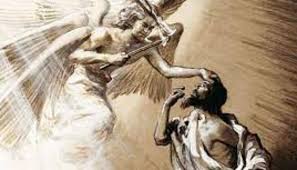
Then one of the seraphim flew to me, having in his hand a burning coal that he had taken with tongs from the altar. 7 And he touched my mouth and said: “Behold, this has touched your lips; your guilt is taken away, and your sin atoned for.” (Isaiah 6:1-7, ESV)
Teaching: Here is the great prophet Isaiah, and he is reduced to nothing spiritually. He is brought low under the sovereignty of God. Isaiah finally understood who God was. And then Isaiah accurately understood who he was–a sinner in need of grace. Otherwise, he would be consumed by the justice of God.
God saved Isaiah from God but also through God. This is the glory of the gospel. God demonstrated his holiness and his grace simultaneously.
God’s singular seraph came down, touched Isaiah’s mouth, and atoned for Isaiah’s sin (vv. 6-7). This is the gospel in the Old Testament. It’s God coming down, interposing his grace to the sinner, atoning for others’ sins (God doesn’t have sin), and redeeming his creation. Isaiah’s response was gratitude: “Here I am! Send me” (v. 8).
Encouragement: I’m not sure how anyone can miss this typology. It’s the gospel in Isaiah 6.
2 Corinthians 5:21 unpacks it even more explicitly: “For our sake he [God the Father] made him [God the Son, Jesus] to be sin who knew no sin, so that in him [God the Son, Jesus] we [sinners who repent and believe] might become the righteousness of God.”